

 Travel Essentials
 Travel Essentials

Discover Auvers-sur-Oise, where Vincent van Gogh spent his final months creating 74 paintings. A pilgrimage through the fields, studios, and landmarks that defined his legacy.
 Travel Essentials
Nestled approximately 30 kilometers northwest of Paris in the Oise region of France, the modest village of Auvers-sur-Oise represents one of the most significant locations in art history. For many travelers and art enthusiasts, this picturesque rural community serves as a destination to understand the final chapter of Vincent van Gogh’s life and career. Between May and July 1890, the Dutch master spent just over two months in this small French village, a period that proved remarkably productive despite—or perhaps because of—his deteriorating mental and physical condition. During these seventy days, van Gogh created approximately seventy-four paintings and over fifty drawings, establishing himself as one of the most prolific artists in history during his time there. The village itself remains largely unchanged from van Gogh’s era, making it an ideal location for those seeking to connect with the artist’s final works and understand his state of mind during his concluding months.
Van Gogh’s decision to move to Auvers represented a significant turning point in his life trajectory. After spending approximately two years in the south of France—first in Arles and later in Saint-Paul-de-Mausole asylum near Saint-Rémy—the artist yearned to reconnect with his primary emotional support system. His brother Theo, who had consistently provided both financial and emotional support throughout van Gogh’s artistic career, resided in Paris with his wife and young family. Geographically, Auvers offered an ideal compromise: close enough to Paris for regular contact with Theo, yet rural enough to provide the natural inspiration that van Gogh sought for his artistic endeavors.
The village also attracted van Gogh due to its reputation as an established artists’ community. Throughout the nineteenth century, Auvers-sur-Oise had served as a creative haven for numerous painters, including the Impressionist masters Camille Pissarro and Paul Cézanne. The presence of Dr. Paul Gachet, a physician known for his interest in art and sympathetic understanding of artistic temperament, further influenced van Gogh’s choice. Van Gogh had corresponded with Dr. Gachet regarding his health concerns, and the prospect of receiving medical supervision from someone who understood and appreciated art offered a glimmer of hope for stability.
Upon arriving in Auvers on May 20, 1890, van Gogh found himself surrounded by landscapes and subjects that ignited his creative passion. The rolling countryside, with its wheat fields, orchards, and pastoral scenes, provided endless material for artistic exploration. The Oise River, which flows through the village, offered additional compositional opportunities and atmospheric variations depending on light and season. Unlike his tumultuous experiences in the south of France, where he had struggled with isolation and conflict with other residents, van Gogh approached Auvers with renewed artistic ambition and, initially, a sense of hope.
The landscapes of Auvers differed markedly from the dramatic southern French terrain van Gogh had recently left behind. Rather than the intense Mediterranean light and arid hillsides of Provence, Auvers offered softer illumination, verdant fields, and a temperate climate more aligned with northern European traditions. This environmental shift seemed to influence van Gogh’s palette and subject matter, resulting in works that demonstrated different artistic concerns than his earlier southern productions.
Van Gogh’s accommodation during his Auvers stay was the Auberge Ravoux, a modest inn that provided meals to its residents alongside lodging. His room, located in the attic of the establishment, measured barely large enough to contain a small bed and personal possessions. The sparse, somewhat austere conditions of this space contrasted sharply with the vibrant, colorful compositions van Gogh created during his residence there. Today, the Auberge Ravoux operates as a restaurant and museum, preserving the historical significance of this location and allowing visitors to glimpse the cramped quarters where one of history’s greatest artists spent his final weeks.
The innkeeper, Gustave Ravoux, and his family treated van Gogh with kindness and respect, providing him with simple meals and a stable living environment. This stability, though modest, represented an improvement over some of van Gogh’s previous accommodations. The establishment became not merely a place of residence but a social hub where van Gogh could interact with locals and other guests, partially alleviating the isolation he had experienced during his time in the south.
The artistic productivity van Gogh achieved during his Auvers period remains staggering by any standard. Creating approximately one painting every day for seventy consecutive days, the artist demonstrated an almost obsessive commitment to his work. Among the notable paintings produced during this time was the haunting “Wheatfield with Crows,” a work that has invited considerable scholarly interpretation regarding its thematic and emotional content. Other significant compositions included portraits, still lifes featuring flowers, panoramic landscape studies, and various studies of the village architecture and surrounding countryside.
The technical execution of these works showed consistent refinement and experimentation. Van Gogh employed varied brushwork, explored different color relationships, and investigated diverse compositional strategies across his daily output. Rather than demonstrating repetitive or formulaic approaches, the collection of Auvers paintings reveals an artist engaged in active artistic investigation, constantly seeking new solutions to problems of representation, color harmony, and emotional expression.
Contemporary visitors to Auvers-sur-Oise can follow a marked trail that connects locations significant to van Gogh’s final period. This walking route, subtly marked throughout the village, guides travelers to sites that directly inspired or relate to the artist’s work and daily life. The trail encompasses artistic landmarks, natural landscapes, and personal spaces, creating a comprehensive biographical and artistic journey through the village.
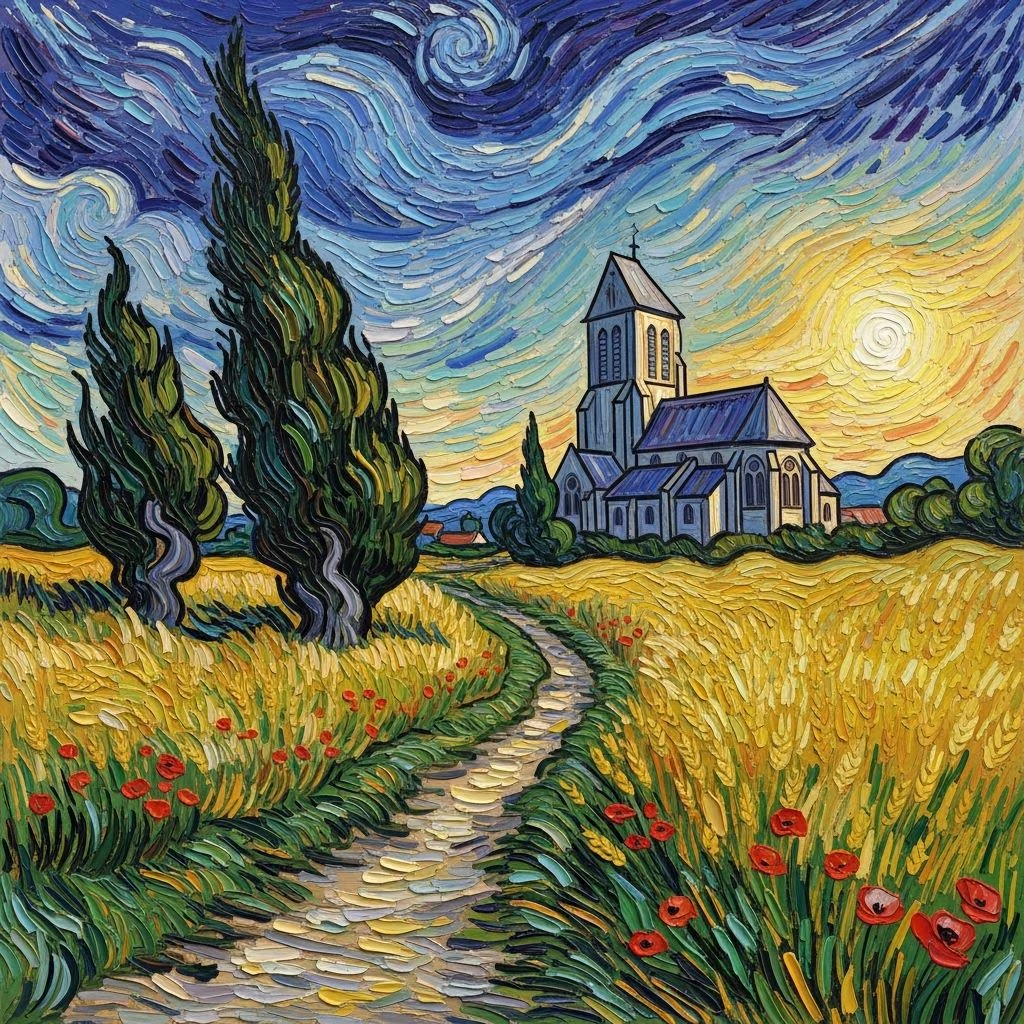
The Eglise Notre-Dame-de-l’Assomption, the village church that van Gogh immortalized in paint, stands as one of the most recognizable stops along this route. Though architecturally modest compared to grand French cathedrals, the church held particular significance for van Gogh as both a compositional subject and a symbol of community continuity. The structure’s subtle beauty and spiritual resonance attracted his artistic attention and resulted in multiple studies and interpretations.
The Auvers cemetery holds profound significance for understanding van Gogh’s legacy and final resting place. Here, beneath ivy-covered graves marked with simple headstones, Vincent and his brother Theo lie side by side. The cemetery’s location, adjacent to the very fields that van Gogh painted during his residence in the village, creates a poignant geographical and symbolic connection between the artist’s creative output and his final earthly resting place. The proximity of the gravesite to the landscapes that inspired his work creates a permanent link between the artist and the environment that nurtured his final artistic endeavors.
The cemetery itself functions as an open-air monument to van Gogh’s influence and recognition. While he was not widely celebrated during his lifetime, the transformation of his gravesite into a pilgrimage destination for art lovers worldwide testifies to the profound impact his artistic vision ultimately achieved. Visitors from across the globe make the journey to Auvers specifically to pay respects at this location, transforming the modest village cemetery into an international memorial to artistic genius and human struggle.
The circumstances surrounding van Gogh’s death on July 29, 1890, remain partially shrouded in historical uncertainty and ongoing scholarly debate. On July 27, van Gogh shot himself in the chest in one of the wheat fields that had become central to his artistic practice. Remarkably, he managed to return to the Auberge Ravoux, where he was attended by both the village doctor and Dr. Gachet. Theo, alerted to his brother’s condition, rushed from Paris to be present during Vincent’s final days. Despite medical intervention, the wound proved fatal, and Vincent died two days later with his devoted brother at his side.
The precise nature of van Gogh’s motivations and the exact circumstances of the incident have spawned considerable historical investigation and interpretation. While popular accounts often characterize the event as a straightforward suicide attempt, more recent scholarship has raised questions about alternative interpretations. Regardless of the specific circumstances, the tragedy represented the culmination of years of psychological struggle, creative intensity, and the artist’s ongoing battle with mental illness.
Dr. Paul Gachet represented a unique intersection of medicine and art appreciation during the nineteenth century. Van Gogh’s correspondence reveals his complex assessment of his physician, describing Gachet as “rather eccentric” while acknowledging the doctor’s dedication to addressing nervous disorders and psychological suffering. The physician himself was an accomplished artist and art collector, enabling a rapport between doctor and patient that transcended typical medical relationships of the era. Gachet’s house, which van Gogh visited regularly, provided not only medical consultation but also intellectual companionship and artistic conversation.
The relationship between van Gogh and Gachet illuminates the artist’s capacity for connection and his appreciation for individuals who bridged the worlds of science and art. While the medical treatment Gachet provided ultimately could not prevent tragedy, his presence and support during van Gogh’s final months offered moments of stability and human connection that the artist desperately valued.
Van Gogh’s funeral, held at the Auberge Ravoux, reflected both the simplicity of his circumstances and the affection he had garnered in the village community. Theo, devastated by the loss of his beloved brother, decorated the space with sunflowers, yellow dahlias, and Vincent’s own paintings—a touching tribute that acknowledged his brother’s artistic identity and the profound emotional bond between them. The procession to the cemetery proceeded through the fields where Vincent had worked, creating a final journey through the landscape that had occupied so much of his attention during his final weeks.
Though van Gogh received relatively limited recognition during his lifetime, his legacy has expanded exponentially in the decades following his death. Auvers-sur-Oise, once simply a rural French village, has become synonymous with the final chapter of one of history’s most influential artists. The village preserves this legacy through museums, preserved sites, marked trails, and continuing scholarly research that ensures van Gogh’s final period remains central to art historical discourse and public understanding.
Contemporary visitors to Auvers-sur-Oise can experience the village largely as van Gogh knew it. The rolling landscape, river valleys, and agricultural character remain relatively unchanged from 1890, though naturally the village has experienced selective modernization. The combination of historical sites, museums, restaurants, and the preserved natural environment creates an engaging destination for art enthusiasts, history buffs, and general travelers interested in experiencing locations connected to significant historical and cultural figures.
The village’s accessibility from Paris—approximately one hour by train—makes it feasible as either a day excursion or an extended stay. Many visitors choose to spend several days in Auvers to fully absorb the landscapes, revisit multiple sites, and reflect on the profound artistic and personal dimensions of van Gogh’s final period. The quiet atmosphere of the village, its preserved character, and the emotional resonance of its connection to van Gogh combine to create a contemplative travel experience that extends beyond typical tourist activities.
