

 Travel Essentials
 Travel Essentials

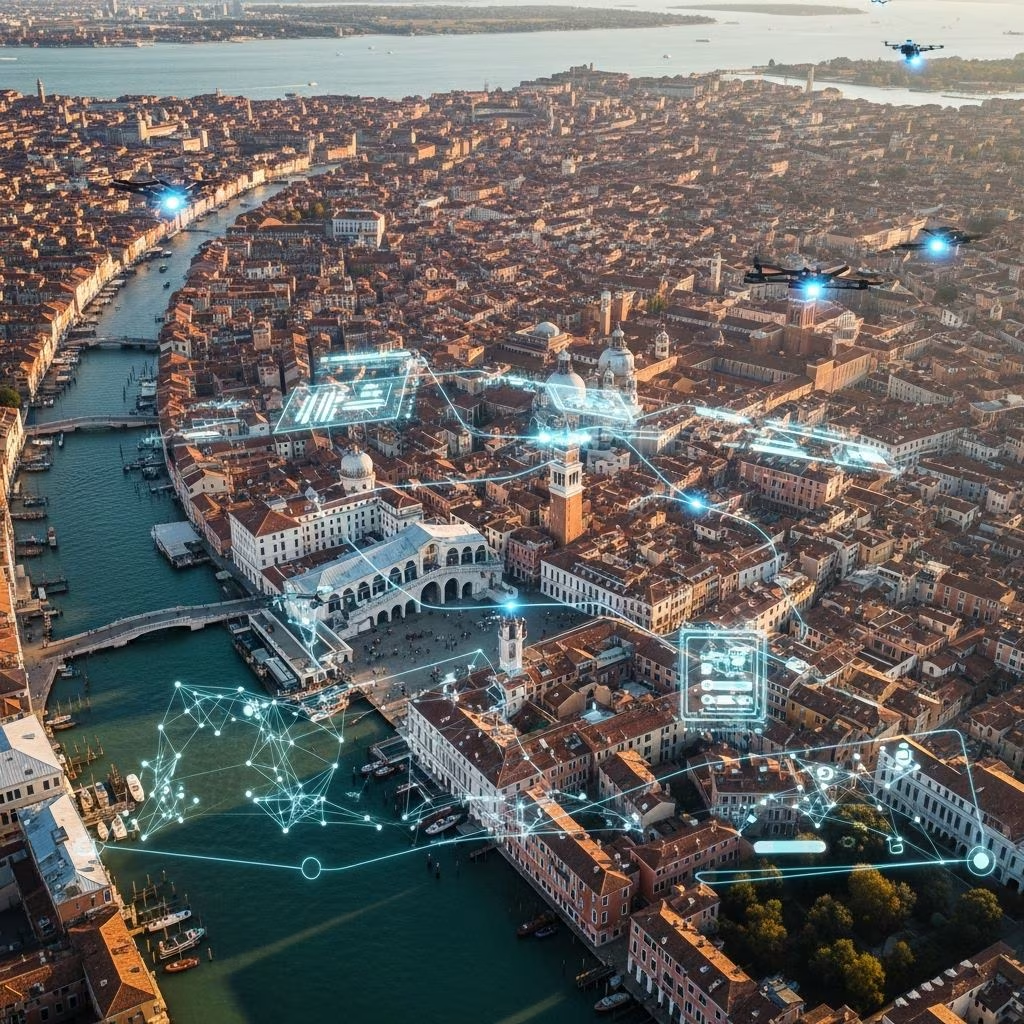
Venice is using cameras, sensors, and mobile data to monitor tourist flow in real time, aiming to ease overtourism without tracking individuals.
 Travel Essentials
The historic city of Venice has long struggled with the challenges posed by mass tourism. With approximately 30 million visitors arriving annually to a city with only around 50,000 permanent residents, the pressure on infrastructure, cultural preservation, and quality of life has become unsustainable. In response to this crisis, local authorities have implemented an innovative yet controversial technological solution: a comprehensive surveillance and tracking system designed to monitor, measure, and ultimately regulate the flow of tourists through the lagoon city.
This sophisticated monitoring infrastructure represents one of the most ambitious attempts by any European city to use technology to combat overtourism. By combining multiple data collection methods, Venice’s system provides real-time insights into visitor movements, origins, and behavioral patterns. However, this technological response has also sparked important conversations about privacy, surveillance ethics, and the appropriate role of government monitoring in managing public spaces.
Venice’s visitor monitoring system represents a multi-layered technological approach rather than a single initiative. The system was launched in September 2020, though its implementation went largely unnoticed at the time due to pandemic-related travel restrictions that eliminated the typical influx of tourists. As travel resumed and visitor numbers rebounded, the system became more prominent in public discourse.
The core components of this monitoring infrastructure include:
The technical architecture underlying Venice’s monitoring system is notably sophisticated. According to Marco Bettini of Venis, the company that developed the system, the infrastructure functions as “the brain of the city,” enabling authorities to understand in real time how many people occupy specific neighborhoods and from which countries they originate.
The system aggregates multiple data streams to create a comprehensive picture of tourist behavior. Canal traffic patterns are monitored alongside public transportation schedules, allowing officials to track not just where tourists are, but how they move through the city. Pedestrian counts derived from CCTV footage are then cross-referenced with cellular data to determine visitor origins and identify peak congestion periods.
Rather than tracking individual phones, the system operates on an aggregated level. Officials note they cannot see specific phone identification information but can instead observe patterns indicating where visitors originate geographically. This aggregation approach is central to the city’s assertion that the system maintains anonymity while still providing actionable data for management purposes.
While monitoring is one aspect of the system, its primary objective is enabling evidence-based management strategies. Venice’s authorities argue that effective tourist management requires accurate baseline data. Traditional measurement methods—such as counting overnight hotel guests—fail to capture the full visitor picture, particularly the millions of day-trippers who arrive via train or boat and depart the same day.
With approximately 30 million annual visitors compared to 50,000 residents, the disproportion demands intervention. The tracking system provides administrators with precise, real-time information about daily visitor volumes, allowing them to implement targeted strategies during peak periods. This data foundation supports potential interventions including:
The deployment of such extensive surveillance infrastructure naturally raises significant privacy concerns. The system’s ability to track mobile phone movements, combined with hundreds of CCTV cameras, creates a comprehensive monitoring environment that critics argue represents unprecedented surveillance of public spaces.
City officials have repeatedly emphasized that the system operates anonymously, with no capability to identify specific individuals or their personal information. The focus, they maintain, remains on aggregated trends and population density patterns rather than individual tracking. However, this reassurance has not fully satisfied privacy advocates who point out that any system with the technical capacity to track phone signals inherently possesses the potential for more invasive use, regardless of current stated limitations.
The system also distinguishes between permanent residents and tourists, raising questions about how this classification occurs and what happens with that categorized data. While this differentiation supports the city’s stated goal of understanding visitor-specific patterns, it also means the system actively categorizes inhabitants based on residency status and travel patterns.
Venice’s technological initiative does not end with the current monitoring infrastructure. City planners have proposed implementing a formal reservation or ticketing system for entry into Venice, modeled on approaches used at major theme parks and international airports. Such a system would require visitors to obtain entry authorization in advance, potentially controlling access during peak periods and spreading visitor arrivals across less congested times.
This proposed expansion represents a significant shift in how Venice conceptualizes tourism—moving from a freely accessible historic city to a managed destination with controlled entry. Proponents argue this approach is necessary for preservation, but critics contend it further transforms Venice into a curated experience rather than an authentic living city, essentially converting the entire destination into a managed attraction.
Venice’s surveillance and tracking system exemplifies the growing tendency of cities worldwide to address complex social and environmental challenges through technological solutions. The system offers genuine advantages: real-time data enables responsive management rather than reactive problem-solving, and accurate visitor measurement supports evidence-based policy development.
However, technology alone cannot resolve the fundamental tension underlying Venice’s overtourism crisis. The root issues—the city’s status as a UNESCO World Heritage Site and cultural icon that attracts global tourism; its limited geographic area and infrastructure capacity; economic dependence on visitor spending; and the pressure exerted by short-term rental platforms and cruise ship tourism—require multifaceted solutions extending well beyond surveillance.
The monitoring system may help optimize how visitors flow through existing infrastructure, but it does not address whether Venice’s current visitor volumes are fundamentally sustainable regardless of how efficiently they are managed. This distinction is critical: better data about congestion does not necessarily translate into better outcomes for residents or heritage preservation if the underlying visitor volume remains unsustainable.
Venice’s experiment with comprehensive visitor surveillance has relevance beyond the lagoon city. As global tourism concentrates increasingly in specific destinations—creating overtourism challenges in Barcelona, Amsterdam, Dubrovnik, and other heritage cities—the technological approaches pioneered in Venice may be replicated elsewhere. Cities facing similar pressures face a choice: adopt comparable surveillance and management systems or pursue alternative strategies including limiting visitor access, implementing sustainability fees, or restructuring tourism economics.
The Venice model demonstrates that technology can provide valuable data for urban management. However, it also illustrates the trade-offs involved: enhanced surveillance capability comes at the cost of privacy and potentially diminishes the spontaneous, unmanaged character that makes cities vibrant and authentically livable.
Venice’s system does not track individual tourists in the traditional sense. Instead, it monitors mobile phone signals to determine where devices are registered geographically, providing aggregate data about visitor origins. The system combines this with CCTV footage to measure pedestrian density and movement patterns across the city.
Venice authorities maintain the system complies with European privacy regulations by operating on an aggregated, anonymized basis. However, the legal framework surrounding such comprehensive surveillance remains evolving, and privacy advocates continue to debate whether the system’s current implementation adequately protects individual privacy rights.
The system functions through ambient data collection rather than individual consent mechanisms. Tourists with mobile phones operating on connected networks are part of the data collection process by default, though the city argues this occurs at an anonymous aggregate level rather than identifying specific individuals.
Immediate applications include real-time crowd management and infrastructure allocation. Proposed future uses include implementing visitor reservation systems and dynamic pricing to distribute tourists across different time periods and neighborhoods.
Venice’s approach may influence other overtourism-affected destinations. However, each city’s legal framework, cultural context, and political priorities differ, making direct replication unlikely. Some cities may adopt similar technology while others pursue alternative strategies for managing visitor impacts.
