

 Travel Essentials
 Travel Essentials

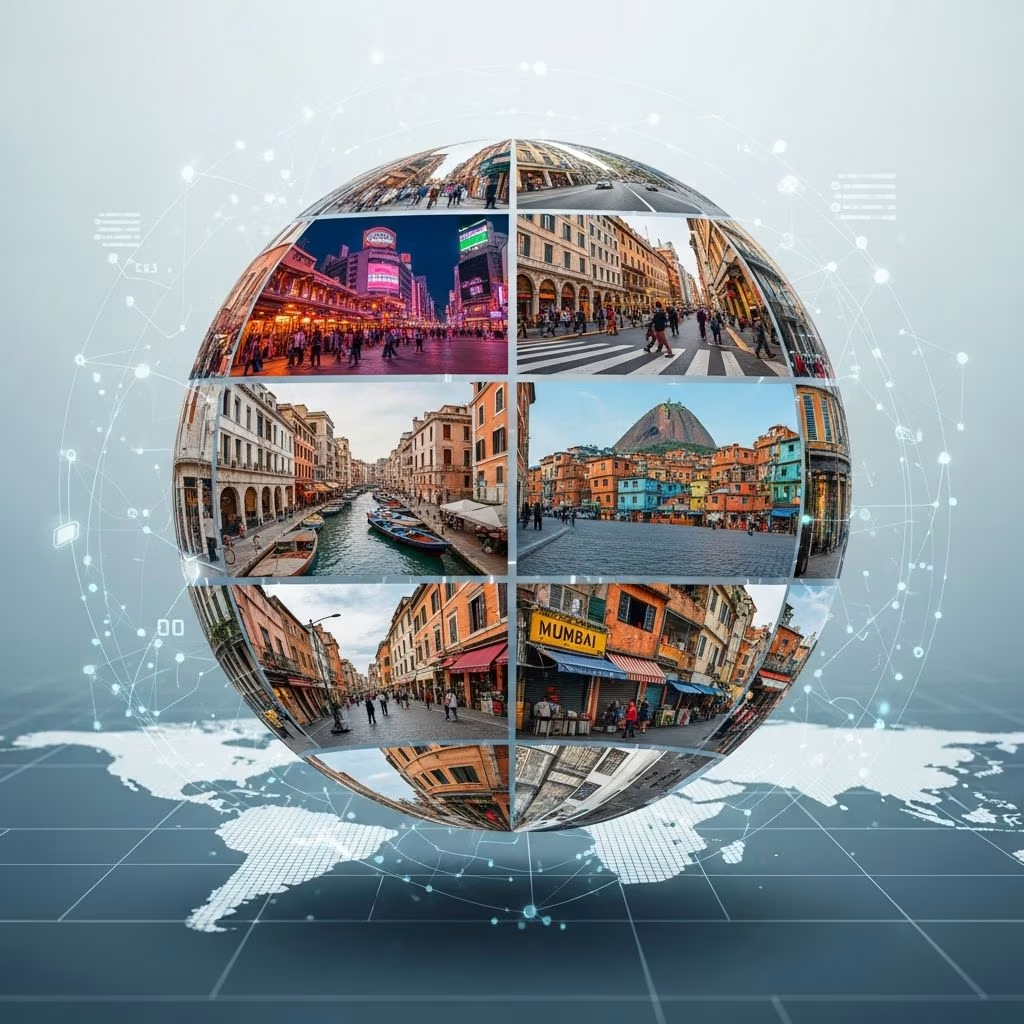
Virtual street tours let you explore cities, landmarks, and neighborhoods online—ideal for travel planning, learning, and accessible exploration.
 Travel Essentials
The evolution of digital technology has fundamentally transformed how we experience the world without physical travel. Virtual street tours represent a significant advancement in this transformation, allowing individuals to navigate unfamiliar environments, discover cultural landmarks, and plan trips with unprecedented detail and interactivity. These digital exploration tools bridge geographical distances and provide accessibility options for people who may face mobility challenges or financial constraints that limit conventional travel.
Virtual street exploration relies on sophisticated imaging and navigation systems that capture real-world environments in comprehensive detail. These platforms utilize panoramic photography, 360-degree video capture, and advanced mapping technologies to create navigable digital representations of physical spaces. Users can explore cities, landmarks, and neighborhoods at their own pace, zooming into architectural details and examining street-level features with clarity that approaches in-person observation.
The technology underlying these platforms combines multiple data collection methods. High-resolution cameras mounted on vehicles, drones, or portable equipment capture sequential images as they traverse streets and pathways. Specialized software then stitches these images together, creating seamless panoramic environments that users can navigate intuitively. This process enables the creation of detailed digital maps that preserve the authentic appearance of locations while allowing interactive exploration.
Several major platforms have established themselves as leaders in virtual street exploration, each offering unique capabilities and geographic coverage.
Virtual street exploration serves essential practical functions in the contemporary travel planning process. Prospective travelers can examine neighborhoods before booking accommodations, assess commercial districts for shopping and dining options, and evaluate transportation accessibility. This preliminary research reduces uncertainty and enables more informed decision-making regarding destination selection.
For business travelers, virtual exploration facilitates meeting preparation and client location assessment. Individuals planning conferences or business meetings can familiarize themselves with venue locations, nearby transportation hubs, and surrounding commercial establishments. This preparation enhances operational efficiency and reduces logistical surprises upon arrival.
Educational institutions utilize these platforms for curriculum enrichment, enabling students to examine historical sites, archaeological locations, and cultural landmarks as components of educational programs. Virtual field trips provide economical alternatives to physical travel while maintaining educational value through immersive visual presentation and professional narration.
Virtual street exploration technology democratizes access to global destinations for populations facing various barriers to physical travel. Individuals with mobility limitations can navigate environments at their preferred pace without physical demands or accessibility concerns. The technology provides pathways for experience regardless of financial resources, health conditions, or geographical proximity.
Elderly populations and individuals with chronic health conditions can engage in meaningful cultural exploration without exhaustion or health risks associated with conventional travel. Families with young children can preview destinations, identify family-friendly features, and establish realistic expectations before committing to expensive international travel arrangements.
Additionally, these platforms serve incarcerated populations, military personnel deployed overseas, and individuals in remote locations, expanding opportunities for cultural engagement and global awareness. The inclusive nature of digital exploration extends educational and cultural benefits across diverse population segments previously excluded from convenient access to international experiences.
Beyond practical travel applications, virtual street exploration facilitates genuine cultural learning and appreciation. Users can examine architectural traditions, observe street-level cultural practices, identify local commerce patterns, and understand urban organization principles across different societies. This multi-sensory information processing contributes to cultural awareness and international understanding.
Professional-led virtual experiences enhance educational outcomes through contextual narration and expert interpretation. Licensed guides and archaeological specialists provide historical background, cultural significance, and contemporary relevance, transforming simple visual observation into structured educational experiences. Users develop nuanced understanding of locations beyond surface-level imagery.
The asynchronous nature of recorded tours enables flexible learning schedules. Students and curious individuals can revisit specific locations multiple times, pause for detailed examination, and engage at their preferred learning pace. This flexibility accommodates diverse learning styles and individual scheduling constraints.
Commercial enterprises leverage virtual street tour technology for marketing, customer engagement, and operational transparency. Businesses display interior and exterior environments to potential customers, enabling informed purchasing decisions and enhancing consumer confidence in unfamiliar establishments. This application proves particularly valuable for hospitality businesses, retail locations, and service providers seeking to attract clientele through transparent environmental presentation.
Real estate professionals utilize virtual exploration to showcase properties, neighborhoods, and community amenities to prospective buyers and renters. Detailed property imagery combined with surrounding neighborhood context facilitates remote property evaluation and reduces necessity for physical viewing trips, streamlining the real estate transaction process.
Urban planning professionals and municipal governments utilize comprehensive virtual street mapping for infrastructure assessment, public engagement, and digital documentation. These records preserve historical urban conditions and facilitate analysis of development patterns over time.
Despite significant advantages, virtual street exploration presents inherent limitations. Static imagery captures moments in time, potentially missing dynamic cultural practices, seasonal variations, and temporal changes in environments. Weather conditions, temporary structures, and transient phenomena cannot be fully represented through fixed panoramic photography.
The sensory experience remains incomplete compared to physical presence. Ambient sounds, atmospheric conditions, olfactory elements, and physical tactile sensations remain beyond technological replication. This sensory incompleteness affects authenticity and emotional resonance of experiences.
Geographic coverage remains incomplete despite extensive platform expansion. Remote regions, developing areas, and locations with restricted access or privacy concerns may lack comprehensive digital documentation. This coverage gap perpetuates existing global inequalities in digital representation and accessibility.
Emerging technologies promise enhanced virtual exploration capabilities. Artificial intelligence integration enables intelligent navigation assistance, automated translation of location-specific content, and personalized experience curation based on individual interests and preferences. Machine learning algorithms can identify relevant points of interest and automatically highlight significant cultural or architectural features.
Augmented reality technology enables overlay of historical information, real-time translations, and contextual data onto virtual environments. Users may view historical photographs alongside modern imagery, creating temporal perspective on environmental changes and urban development processes.
Virtual reality technology advancement will enable more immersive experiences with enhanced spatial presence and embodied interaction. Full-body immersion in digital environments may approach psychological authenticity of physical travel, potentially transforming virtual exploration from supplementary planning tool to primary experiential medium.
Virtual street exploration functions optimally as complementary rather than replacement technology for physical travel. Digital exploration enhances physical travel experiences through pre-visit preparation, enabling visitors to navigate with greater confidence, identify priority locations, and maximize limited travel time. Post-visit revisitation of virtual environments reinforces memories and facilitates continued learning.
The technology enables hybrid travel experiences where digital and physical engagement combine sequentially. Individuals might complete preliminary virtual exploration, undertake focused physical travel to priority locations, and subsequently revisit virtual experiences to deepen learning and reinforce memories.
Users maximize virtual exploration value through systematic approach. Initial broad surveys of entire cities establish geographic orientation and identify areas of specific interest. Subsequent focused exploration of selected neighborhoods and landmarks enables detailed examination of architectural features, cultural elements, and functional infrastructure.
Cross-referencing multiple platform views provides comprehensive perspective, as different platforms may feature different coverage areas or image qualities. Professional-led tours enhance understanding when available, providing expert interpretation alongside visual exploration.
Documentation of discoveries through note-taking, screenshot collection, and personal mapping facilitates retention and enables sharing of findings with others. Integration of virtual exploration with supplementary research through historical archives, cultural databases, and contemporary news sources deepens understanding beyond visual observation alone.
