

 Travel Essentials
 Travel Essentials

An inspiring journey through Madagascar combining personal challenge with lemur conservation awareness, showcasing the island's unique biodiversity and environmental challenges.
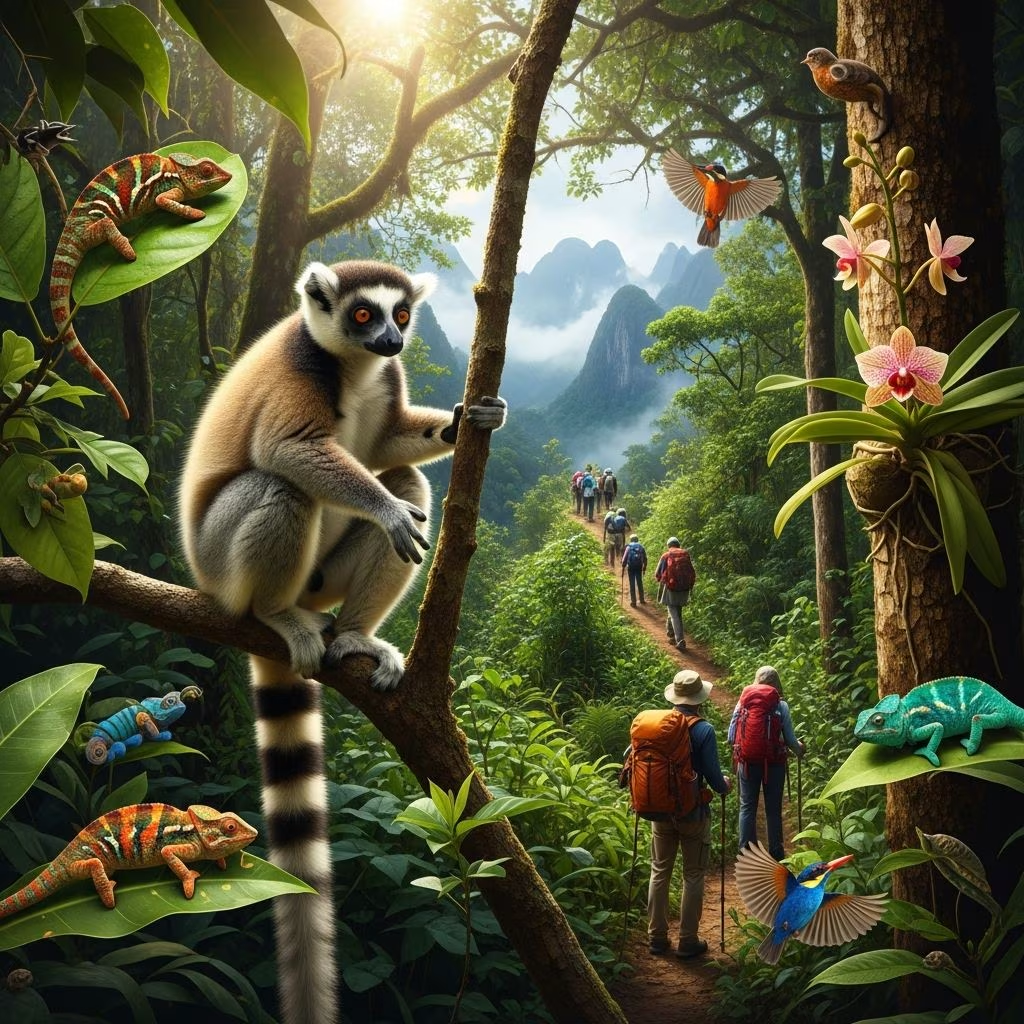 Travel Essentials
The African island of Madagascar stands as one of Earth’s most remarkable ecosystems, home to wildlife found nowhere else on the planet. Among its most iconic residents are lemurs, primates that have captured the imagination of conservationists and travelers alike. In recent years, adventurers have discovered that combining personal physical challenges with conservation missions creates powerful opportunities to raise awareness about Madagascar’s threatened environments and unique species.
Madagascar’s isolation from mainland Africa for millions of years created an evolutionary laboratory unlike any other. The island developed its own distinct fauna and flora, with approximately 90% of its wildlife found nowhere else in the world. Lemurs represent perhaps the most recognizable ambassadors of this unique biodiversity, with 33 species inhabiting the island’s various ecological zones. These primates range from tiny mouse lemurs weighing just over an ounce to the larger indri lemurs that can weigh up to 20 pounds.
The island’s geography presents dramatic contrasts. Dense tropical rainforests cloak the eastern highlands, while the western regions transition into drier deciduous forests. Limestone formations create karst landscapes that support specialized plant and animal communities. This environmental diversity means that different regions of Madagascar host entirely different lemur species, each adapted to their specific habitat requirements.
Undertaking a journey across Madagascar’s entire length represents one of the most demanding terrestrial expeditions possible. The distance spans approximately 1,600 miles from the southern tip to the northern extremity, requiring months of continuous walking through challenging terrain. Adventurers choosing this route must navigate through:
The physical toll of such an expedition extends beyond simple exhaustion. Adventurers face health risks including malaria, various tropical infections, and dehydration in regions where clean water proves scarce. The psychological challenge of maintaining motivation through 155 days of continuous walking, often in solitude, represents an equally significant barrier to completion.
Recent expeditions across Madagascar have demonstrated the power of linking personal adventuring goals with conservation messaging. Rather than treating the journey as purely a personal accomplishment, modern adventurers increasingly partner with established conservation organizations working on the ground throughout Madagascar. This collaboration transforms individual expeditions into awareness-raising platforms for species protection.
The Lemur Conservation Network and similar organizations have long worked to protect Madagascar’s forests and the animals that depend on them. By walking the length of the country, adventurers amplify these organizations’ messages, sharing conservation stories with audiences who might never encounter such information through traditional channels. Expedition social media documentation reaches global audiences, creating conversations about Madagascar’s environmental challenges that extend far beyond academic or conservation circles.
Successful traversals of Madagascar’s length require meticulous planning and appropriate equipment preparation. The following considerations prove essential for expedition success:
| Challenge Category | Key Considerations | Mitigation Strategies |
|---|---|---|
| Terrain Navigation | Unmarked paths, dense vegetation, steep grades | Experienced guides, detailed mapping, GPS technology |
| Health & Medical | Malaria, water-borne illness, injury risk | Prophylaxis, water purification, first aid training |
| Supply Management | Limited resupply opportunities in remote areas | Strategic caching, local sourcing, weight optimization |
| Safety & Security | Remote regions, potential bandit activity | Local guides, community relationships, communication devices |
| Environmental Exposure | Heat, humidity, altitude changes, storms | Proper acclimatization, quality gear, weather monitoring |
Madagascar’s highest peaks cluster primarily along the central highlands, creating natural waypoints for full-length traversals. Including these summits in an expedition route adds significant elevation gain and technical challenge to an already demanding journey. The island’s highest mountains display Madagascar’s geological diversity, ranging from volcanic formations to eroded ancient peaks.
Summiting these mountains requires additional acclimatization time, specialized climbing equipment, and extended effort beyond standard hiking. However, reaching these peaks provides unparalleled views of Madagascar’s landscape diversity and creates natural resupply and rest points during long expeditions. The combination of trekking valleys with summit attempts creates a comprehensive exploration of Madagascar’s topography.
Walking through Madagascar’s diverse habitats provides exceptional opportunities for wildlife observation and documentation. Different lemur species inhabit different regions, making the journey from south to north essentially a tour through Madagascar’s primate diversity. Early morning walking sessions often coincide with lemur activity periods, allowing adventurers to observe these animals in their natural behaviors.
Responsible wildlife documentation emphasizes observation without interference or stress to animals. Professional wildlife photographers and naturalists increasingly participate in or follow long-distance expeditions, using the adventurer’s journey as a platform to reach audiences interested in Madagascar’s fauna. High-quality imagery and video documentation transform expedition experiences into educational content that can inspire conservation support.
Madagascar’s population comprises multiple ethnic groups with distinct cultures, languages, and relationships to their environments. Walking through the island brings adventurers into direct contact with local communities, creating opportunities for cultural exchange and mutual understanding. These interactions often prove as valuable as the wildlife encounters and landscape experiences.
Local guides provide essential services while creating employment opportunities in regions with limited economic alternatives. Respectful engagement with communities demonstrates that conservation benefits people as well as animals, building local support for habitat protection. Adventurers who spend time understanding local perspectives on land use and wildlife often return with nuanced appreciation for the complex balance between human needs and environmental preservation.
The demanding physical environment of Madagascar testing adventurers’ health and resilience in multiple ways. Malaria represents perhaps the most significant medical threat, with the deadliest strain potentially proving fatal. Prophylaxis protocols, mosquito protection measures, and early symptom recognition become critical survival skills. Some adventurers have contracted malaria during their journeys, requiring treatment that complicates expedition continuity.
Water quality issues demand constant vigilance, as waterborne pathogens cause debilitating illnesses that compromise hiking ability. Gastrointestinal infections, while often less immediately dangerous than malaria, create physical weakness and dehydration that endanger expedition success. Temperature-related challenges include both heat exhaustion in low-altitude regions and altitude sickness in highland areas, particularly when ascending major peaks.
The primary value of linking adventure expeditions to conservation work lies in awareness generation and funds raised for protection efforts. Media coverage of remarkable journeys reaches audiences far broader than traditional conservation communication. Documentaries, social media content, and written expedition accounts introduce global audiences to Madagascar’s conservation challenges in compelling, human-centered narratives.
Partnership arrangements between adventurers and conservation organizations channel expedition visibility toward specific conservation goals. Educational content created during and after expeditions provides detailed information about lemur biology, habitat requirements, and conservation strategies. These materials educate both the general public and potential donors about why Madagascar’s protection matters to global biodiversity.
Complete traversals from the southern tip to the northern extremity generally require 150-160 days of continuous walking, depending on route variations, acclimatization needs, and rest days necessary for recovery and resupply.
Habitat destruction through deforestation represents the most significant threat to lemur survival. As forests disappear for agricultural expansion and logging, lemur populations lose the specific plant species and forest structures their survival depends upon.
While theoretically possible for experienced long-distance hikers, the full-length Madagascar trek demands exceptional physical fitness, wilderness skills, and mental resilience. Most success comes from adventurers with extensive prior expedition experience.
Multiple organizations including the Lemur Conservation Network, Madagascar Wildlife Conservation, and international bodies work on species protection and habitat preservation throughout the island.
Remote regions present safety challenges including limited medical access and potential security risks. Most serious expeditions employ experienced local guides who provide both safety and cultural knowledge.
Expeditions that combine personal physical challenge with conservation advocacy represent a growing trend in how modern adventurers approach exploration. Rather than treating journeys as purely self-directed challenges, these expeditions recognize their potential to amplify conservation messages and build support for environmental protection. The journey across Madagascar becomes not just a test of human endurance but a vehicle for promoting understanding of one of Earth’s most unique and threatened ecosystems.
As climate change and habitat loss accelerate threats to Madagascar’s endemic wildlife, the need for diverse conservation approaches intensifies. Adventure expeditions contribute to this multifaceted strategy by making conservation tangible, inspiring, and accessible to audiences who might otherwise never engage with Madagascar’s ecological challenges. Through the stories of adventurers walking across this remarkable island, the plight of lemurs and countless other species reaches hearts and minds globally, potentially catalyzing the support necessary for long-term habitat protection and species survival.
