

 Travel Essentials
 Travel Essentials

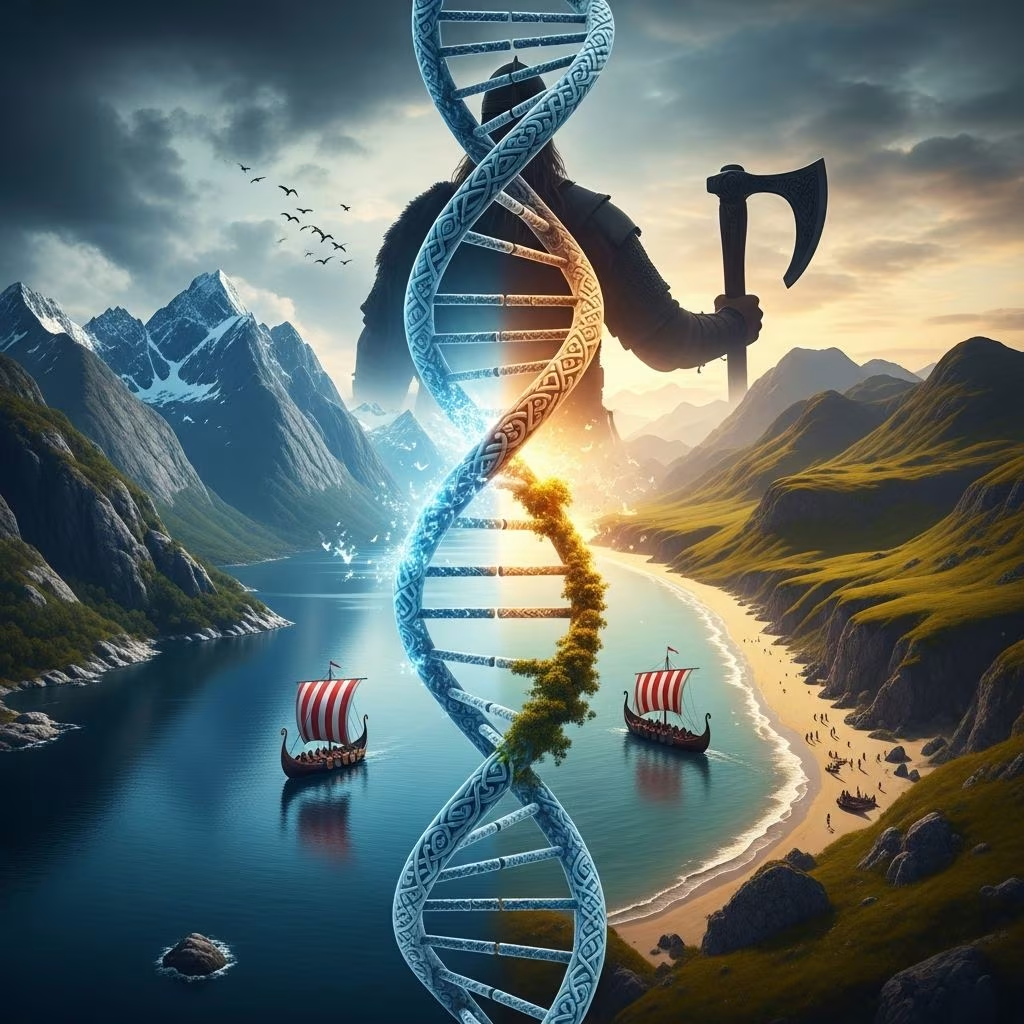
Explore how DNA analysis of Rollo's living relatives challenges historical claims, pitting Norwegian against Danish ancestry in the saga of Normandy's founder.
 Travel Essentials
The legendary Viking chieftain Rollo, founder of the Duchy of Normandy, has long been a figure shrouded in historical ambiguity. Traditional sagas and chronicles paint him as a formidable raider who terrorized Europe in the 9th and 10th centuries before forging a lasting legacy in France. But one enduring question persists: was Rollo Norwegian or Danish? Recent genetic testing on his purported modern descendants offers compelling evidence to settle this debate, revealing insights into Viking mobility and identity that challenge long-held assumptions.
Rollo’s story begins amid the chaos of Viking raids across the Frankish kingdoms. Around 911 CE, he secured a treaty with King Charles the Simple, gaining lands along the Seine River that would become Normandy. Medieval sources like Dudo of Saint-Quentin’s Historia Normannorum describe him as a Dane, while later Norwegian sagas, such as those by Snorri Sturluson, claim him as Hrolf Ganger from More in western Norway. This Norwegian-Danish divide mirrors broader tensions in Viking historiography, where national pride often colors interpretations.
Historians have wrestled with these accounts for centuries. Danish chronicles emphasize Rollo’s ties to Jelling, the heartland of Harald Bluetooth’s kingdom, while Icelandic annals link him to Norwegian royalty. Archaeological evidence from Normandy shows Scandinavian influences, but distinguishing Norwegian from Danish artifacts proves challenging due to cultural similarities. Enter modern genetics: by analyzing Y-chromosome DNA from men claiming descent from Rollo through male lines, researchers have pierced this veil.
In a breakthrough study, descendants from both Norwegian and British Norman families underwent Y-DNA haplogroup analysis. The results clustered overwhelmingly with Norwegian genetic markers, specifically the R1b-U106 subclade prevalent in western Norway. This haplogroup, rare in Denmark but common along Norway’s fjords, supports the saga tradition of Rollo as a Norwegian exile.
One key participant traced his lineage to Rollo via the Earls of Orkney, a Norwegian dynasty with documented ties to Normandy. His DNA matched profiles from Viking burials in Norway, including sites like Sunnmøre, Rollo’s alleged homeland. Conversely, Danish candidates showed different markers, aligning more with Jutland populations. These findings align with broader genomic studies debunking the myth of genetically uniform Vikings.
The largest Viking DNA project to date, sequencing 442 skeletons across Europe, confirmed that Viking groups were not purely Scandinavian. Many carried Southern European and Asian ancestry, indicating extensive gene flow. Norwegian Vikings, in particular, showed isolation from Danish and Swedish counterparts, with distinct genetic signatures from raids to Ireland and Iceland.
Far from the blonde, blue-eyed archetype, Vikings were a genetic mosaic. The 2020 Nature study by Eske Willerslev’s team revealed regional differences: Norwegian Vikings raided westward to the British Isles and Atlantic islands, carrying unique haplogroups like I1-M253 variants. Danish Vikings targeted England, while Swedes ventured eastward to the Baltic.
| Region | Primary Raid Targets | Key Genetic Markers |
|---|---|---|
| Norway | Ireland, Scotland, Iceland, Greenland | R1b-U106, high I1 |
| Denmark | England, Frisia | R1a-Z284 (less frequent), I1 |
| Sweden | Baltic, Russia | R1a, N1c influences |
This table summarizes patterns from ancient DNA, highlighting how geography shaped Viking expansion and genetics. Norwegian DNA persists today at 10% in Sweden but only 6% in the UK, reflecting targeted migrations.
A study of 45 Viking Age Norwegians (AD 550–1050) using mitochondrial DNA from skeletal remains showed close affinities to modern Norwegians, Icelanders, and Orkney Islanders. Haplogroups like H, U, and K dominated, with haplotypes shared with England, France, and Germany. Notably, ancient Norwegian mtDNA included lineages now rare in Scandinavia but persistent in Viking settler populations abroad.
Pairwise FST values placed ancient Norwegians nearest to modern Germans, English, and French, underscoring a cosmopolitan profile. This diversity arose from pre-Viking trade and admixture, setting the stage for figures like Rollo.
Rollo’s Norwegian DNA bolsters claims of his Møre origins, where local legends recall a giant outlaw banished for his size—earning the nickname Ganger-Hrolf (Walking Rollo). His descendants, including William the Conqueror, carried this lineage to Hastings in 1066, blending Norse and Frankish blood.
Yet, Viking identity transcended genetics. Orkney burials with swords yielded Pictish DNA, proving cultural adoption without ancestry shift. Rollo’s band likely included Danes, explaining mixed chronicles. Modern Normandy shows 2-5% Scandinavian DNA, diluted over generations.
These lineages, vetted by genealogists, underwent Big Y testing for deep subclades, pinpointing 9th-century Norwegian roots.
The DNA verdict favors Norway, irking Danish historians who cite Frankish annals calling Rollo ‘Dacian’ (a term for Dane). However, genetic evidence trumps textual bias. This mirrors broader Viking revisions: Estonia’s boat burial held four brothers of diverse origins, dying together.
Public ancestry tests often surprise with Scandinavian results, not always from Vikings but Iron Age migrations. Rollo’s case personalizes this, linking personal heritage to epic history.
DNA from multiple male-line descendants strongly indicates Norwegian origins, specifically western Norway, over Danish.
Y-DNA haplogroup analysis, combined with ancient comparisons, provides high confidence, backed by peer-reviewed studies.
No, they were genetically diverse with regional differences and external admixtures.
Autosomal and Y/mtDNA tests reveal Scandinavian signals, but interpret with historical context.
It affirms Norse foundations while highlighting multicultural Viking bands.
Rollo’s DNA underscores Vikings as mobile opportunists, not ethnic purists. Future excavations and sequencing will refine this picture, perhaps identifying Rollo’s actual grave. For now, genetics crowns him a son of Norway, reshaping how we view the Normans’ audacious saga.
