

 Travel Essentials
 Travel Essentials

Explore the journey of items voluntarily given up at TSA checkpoints, from collection to state auctions where everyday objects become bargains for buyers.
 Travel Essentials
Every day, millions of travelers pass through U.S. airport security, and prohibited items like knives, tools, and liquids are routinely discovered. Rather than being destroyed outright, many voluntarily surrendered objects follow a structured path to state-managed surplus programs, where they are cataloged, valued, and auctioned off to the public. This process ensures efficient handling while generating funds for state operations.
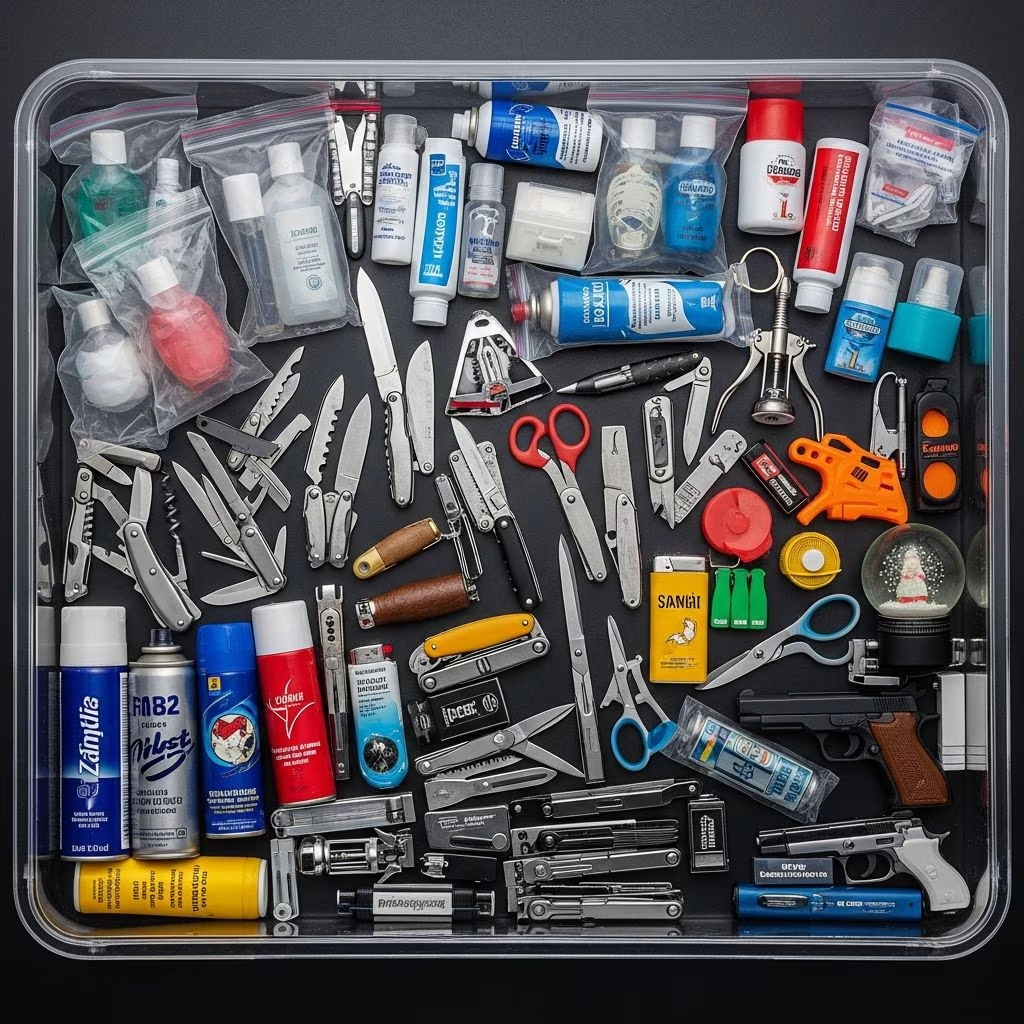
Airport security rules enforced by the Transportation Security Administration (TSA) ban sharp objects, certain tools, large liquids, and firearms from carry-on luggage to maintain safety. When scanners detect these, agents alert passengers, who then face immediate decisions. Common finds include pocket knives, multi-tools, sporting gear, kitchen utensils, and even unexpected items like snow globes or hiking poles.
Firearms represent a serious category, with TSA reporting averages of nine discoveries daily across nearly 440 airports screening over 2 million passengers. These require law enforcement intervention, often leading to fines up to $15,000, but legal items offer travelers options beyond surrender.
TSA does not confiscate items in the traditional sense; instead, it provides practical alternatives to avoid surrender:
These choices minimize losses, but opting to surrender shifts ownership immediately to state authorities. TSA’s role ends upon transfer, emphasizing that it retains no profit from subsequent handling.
Surrendered goods are packed into boxes—often repurposed glove compartments from security stations—and accumulated daily. Volumes peak during holidays, doubling typical daily weights of 100-150 pounds per checkpoint. Monthly or quarterly, state agencies collect these shipments from airports like Daniel K. Inouye International in Hawaii or facilities nationwide.
Agencies such as Hawaii’s Surplus Property Office, under the Department of Accounting and General Services, or Pennsylvania’s State Surplus Distribution Center, receive and store the influx. Estimates suggest warehouses hold up to 50,000 items at a time, spanning diverse categories from power tools to jewelry.
Upon arrival, staff meticulously sort items into categories: kitchenware, sporting equipment, hand tools, construction gear, electronics, and more. Each piece undergoes valuation research to set realistic auction starting points. Workers photograph lots, often bundling similar goods into "mystery boxes" for appeal—like earbuds with pencils or bulk knife collections.
This labor-intensive step transforms chaos into organized inventory. Knives top the frequent finds, followed by wrenches, corkscrews, umbrellas, and neck pillows. High-value surprises occasionally emerge, adding excitement to the daily routine.
Prepared lots hit public auctions weekly, typically running from Monday afternoons to the next. Platforms display photos and descriptions, attracting bidders seeking deals on bulk purchases. In Pennsylvania, online listings feature everything from dumbbells to keychains, with jewelry lots fetching bids as low as $53.
Revenue directly funds the surplus offices, which operate as self-sustaining entities. Buyers range from individuals hunting tools to resellers eyeing profit margins. Hawaii’s program, for instance, schedules consistent pickups from multiple islands, ensuring steady supply.
| Item Category | Common Examples | Auction Appeal |
|---|---|---|
| Kitchen & Utensils | Corkscrews, gadgets | Everyday utility |
| Tools & Hardware | Knives, wrenches, multitools | DIY projects |
| Sporting & Outdoor | Poles, umbrellas, canes | Adventure gear |
| Electronics | Cords, earbuds | Tech bargains |
| Miscellaneous | Jewelry, pillows, globes | Novelty finds |
While the core model is consistent, execution varies. Some states prioritize online bulk sales, others thrift store distribution. Liquids and aerosols often face destruction due to regulations, unlike solids. Neighboring islands in Hawaii receive quarterly collections versus monthly mainland hauls, adapting to logistics.
TSA stresses uniformity in options but delegates post-surrender fate to local governments, fostering tailored efficiency.
To sidestep this cycle, travelers should pack smartly:
Awareness reduces incidents; TSA encourages these steps to keep everyone moving.
Auctioning diverts waste from landfills, promoting reuse. Economically, self-funded offices cut taxpayer burdens, turning security byproducts into assets. Public access democratizes surplus, from hobbyists to businesses.
No, TSA transfers them to states without profit. States manage sales.
Lots are bulk or categorized; tracking individuals is impossible post-surrender.
Handled by law enforcement; not auctioned, with civil penalties applying.
Varies by state; funds sustain operations, no exact national figures released.
U.S. TSA follows this model; foreign security varies by country.
This system balances safety, efficiency, and resourcefulness. As travel rebounds post-pandemic, volumes may rise, testing agency capacities. Innovations like advanced scanners could shift item types, but the surrender-auction pipeline endures.
Travelers benefit from transparency: knowing items fuel public auctions rather than vanishing motivates compliance. States gain sustainable income streams, closing the loop on everyday oversights.
