

 Travel Essentials
 Travel Essentials

Explore the concealed bunk rooms on wide-body aircraft where flight crews rest on extended journeys. Learn about their design, regulations, and daily use for optimal performance.
 Travel Essentials
On extended flights spanning continents, pilots and flight attendants must remain alert despite grueling hours. Airlines equip wide-body jets with discreet rest zones tucked away from passengers, allowing crew members to take mandatory breaks in specialized compartments. These areas prioritize quick, restorative sleep while adhering to strict aviation safety standards.
Fatigue poses a significant risk in aviation, where split-second decisions impact hundreds of lives. Regulatory bodies like the Federal Aviation Administration (FAA) and European Union Aviation Safety Agency (EASA) mandate rest periods for crews on flights exceeding certain durations. For instance, on journeys over 14 hours, flight attendants require at least three hours of bunk time, extending to 4.5 hours for duties surpassing 18 hours.
Pilots follow similar protocols, rotating shifts to ensure at least two remain in the cockpit at all times. These breaks, often lasting two hours, occur in designated zones engineered for efficiency. Crews work in teams, with resting members awakened via interphone systems precisely when their shift resumes.
Rest areas are ingeniously hidden to maintain passenger comfort and security. On Boeing 777-300ER aircraft, they sit above economy seats, accessed via unmarked doors resembling galley panels or lavatory entrances. Pilots’ quarters typically occupy the forward section near first class, while flight attendants’ bunks are aft.
Airbus A350 models feature ladder-style access with sliding doors, positioning bunks over rear economy. Boeing 787 Dreamliners place them at the fuselage ends—pilots upfront, crew below cabin floors or overhead. This distribution balances weight and minimizes noise intrusion into passenger areas.
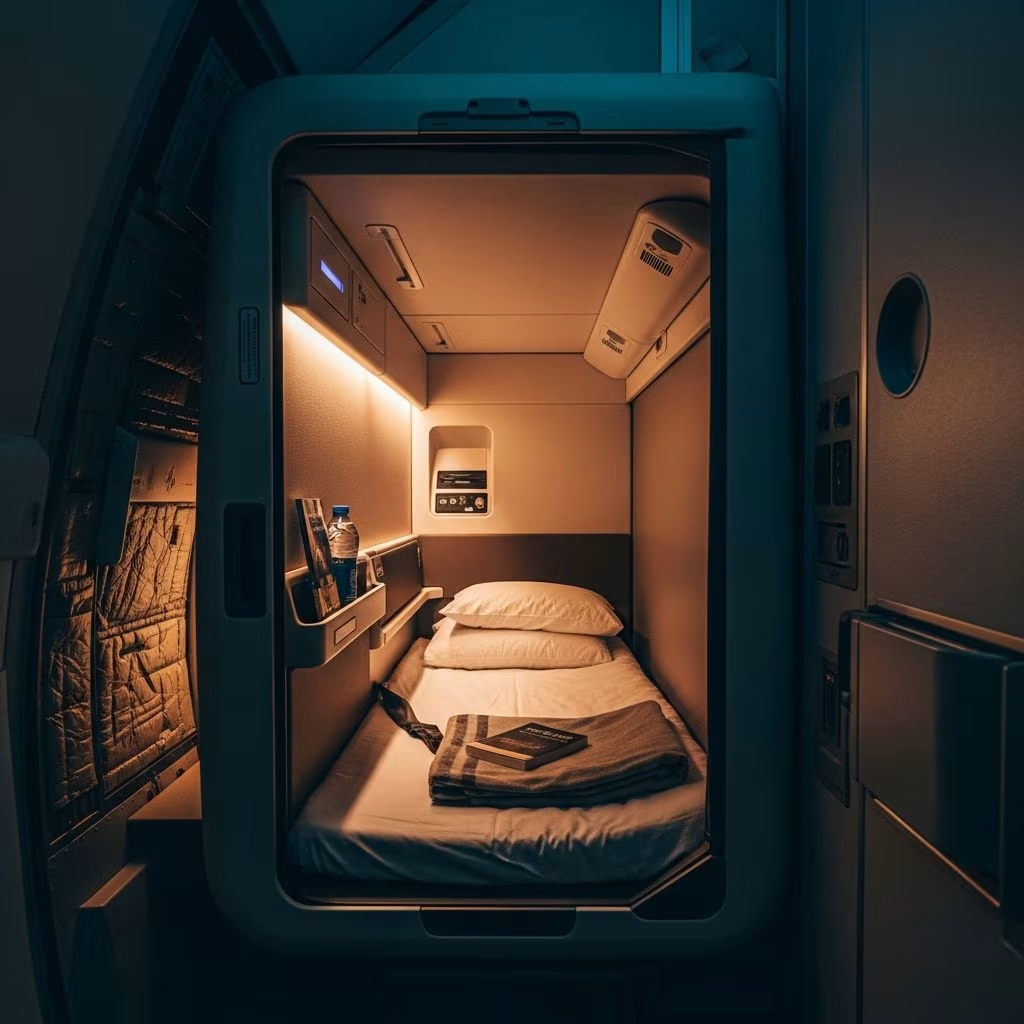
Pilot compartments accommodate two occupants, reflecting the need for alternating relief. Entry requires a passcode, leading to compact spaces with recliners and bunks. Leather seats face entertainment screens akin to business-class setups, offering brief diversion during downtime.
Beds feature adjustable lighting, temperature controls, privacy curtains, and waist belts for turbulence security. Overhead storage, cupholders, and uniform closets maintain organization. Interphones connect to the cockpit, lighting up for wake-ups that crew acknowledge before descending.
| Feature | Description | Purpose |
|---|---|---|
| Recliners | Two leather seats with TVs | Relaxation before bunk sleep |
| Beds | Two narrow berths with bedding | Full rest with safety restraints |
| Controls | Individual light/temp panels | Personalized comfort |
| Communication | Interphone stations | Emergency alerts and shift changes |
Crew rest areas house up to eight flight attendants in bunk-style stacks—two rows of four on Boeing 777s, or adjacent on Airbus A350-1000s. Narrow aisles separate partitions, with curtains for privacy. Unlike pilots, these lack recliners or TVs, prioritizing sheer capacity.
Each bunk includes oxygen masks, protective breathing equipment (PBE), flashlights, and dimmable lights. Phones enable inter-crew calls, and mirrors/storage aid grooming. Noise discipline is paramount; phones vibrate silently, triggering chain reactions where one awake member rouses others.
Allocation follows seniority—junior staff claim smaller bunks. Post-service timing favors second shifts, as fatigue peaks after meals.
These compartments double as safety havens. Prohibited during takeoff and landing (all crew must be stationed), they activate post-10,000 feet climb. Belts secure sleepers during turbulence, and PBEs guard against smoke.
Airlines customize per FAA/EASA rules, with breaks scheduled via pre-flight briefings. Timers ensure precision, preventing overlaps or gaps in cabin coverage.
A typical 19-hour flight sees crews rotating seamlessly. First group rests post-meal service; seconds follow. Blankets roll up quietly, uniforms donned from closets before descending.
Challenges include tight quarters akin to sleeping pods, jet lag, and irregular schedules. Yet, designs foster deep sleep through darkness controls and isolation.
Configurations vary:
Mysterious doors spark curiosity—often mistaken for storage. Rare tours reveal these vital spaces, underscoring crew humanity on long hauls.
Advancing tech promises enhanced ergonomics: improved noise cancellation, circadian lighting, and modular designs for efficiency. Sustainability drives lighter materials without compromising safety.
Functional yet compact, like premium pods—prioritizing rest over luxury with bedding, controls, and quiet.
No, secured by codes blending into bulkheads for privacy and security.
Minimum 3 hours over 14-hour duties; up to 4.5 for 18+ hours, in shifts.
Pilots enjoy recliners/TVs; crew focuses on bunk volume.
Waist belts and secure fixtures protect occupants.
