

 Travel Essentials
 Travel Essentials

A guide to Banksy’s surviving U.S. murals, from New York and Los Angeles to New Orleans and Park City, with locations and context.
 Travel Essentials
The pseudonymous British artist known as Banksy has left an indelible mark on the global street art scene, and the United States has become a significant canvas for his provocative and often satirical work. From densely populated urban centers to smaller mountain towns, Banksy’s murals serve as windows into contemporary social commentary, environmental concerns, and critiques of consumer culture. For art enthusiasts and curious travelers alike, tracking down these works offers a unique perspective on both the artist’s evolution and the cities that host his creations. This guide explores the major American destinations where Banksy’s work remains visible and accessible to the public.
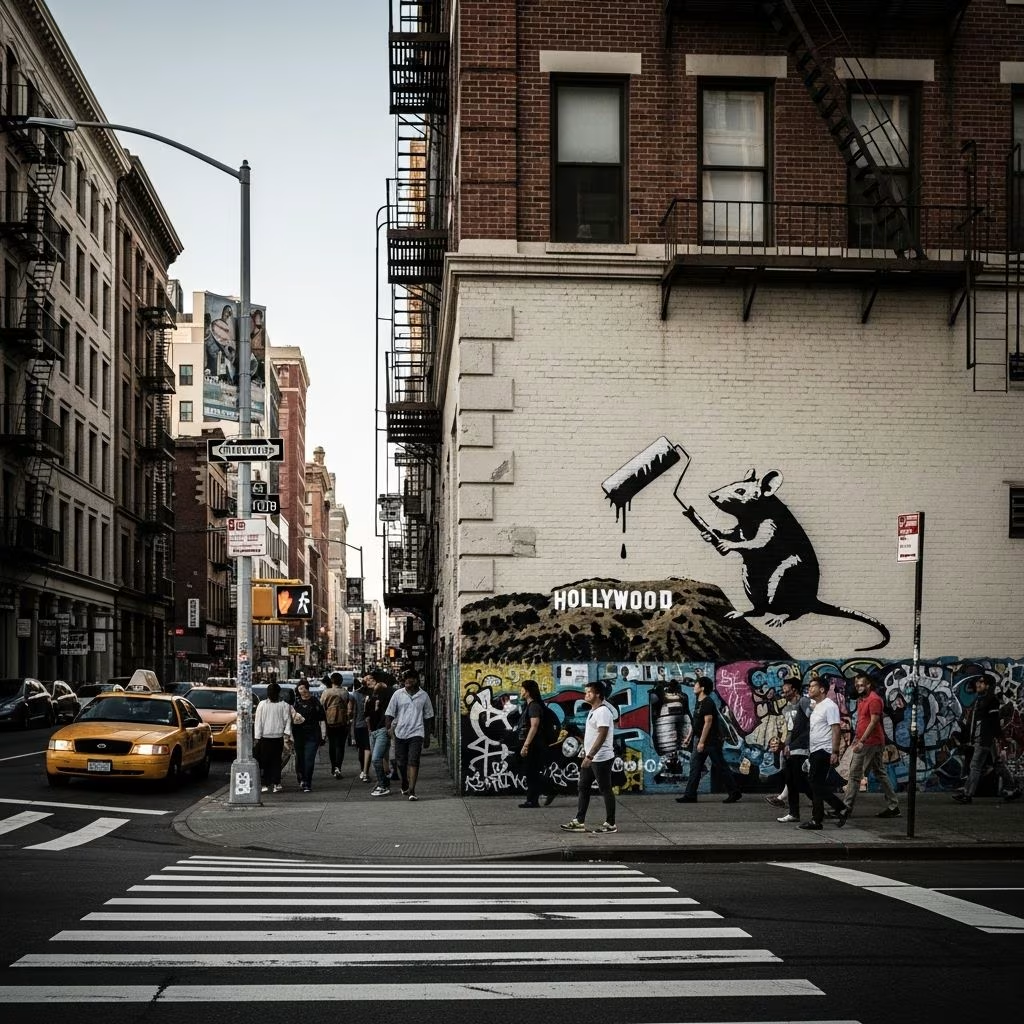
New York City holds a special place in Banksy’s artistic trajectory, serving as the stage for one of his most ambitious and celebrated projects. In October 2013, the artist launched a month-long residency titled “Better Out Than In,” a project that fundamentally changed how street art was perceived in the city that never sleeps. During this intensive period, Banksy created more than twenty-five distinct artworks across diverse neighborhoods, from the outer boroughs to Manhattan’s most iconic streets.
The residency represented a turning point in street art visibility, with each new piece generating significant media attention and public discourse. However, the ephemeral nature of street art means that many of these works have since been painted over, removed, or weathered away. The piece that has survived with the most protection is “Hammer Boy,” located at 233 West 79th Street in the Upper West Side. This silhouette depicts a young child wielding a hammer against a fire hydrant, capturing Banksy’s characteristic blend of innocence and subversion. The work remains shielded behind protective barriers, allowing viewers to contemplate the artist’s commentary on childhood, destruction, and urban life.
Beyond the Better Out Than In residency, New York also hosted other significant Banksy interventions. In 2008, the artist created “The Village Pet Store & Charcoal Grill,” an elaborate installation that took the form of a fake storefront. This work functioned as both street art and performance piece, featuring disturbing taxidermy-style displays that critiqued society’s relationship with animals and raised questions about factory farming practices and animal welfare.
For those seeking to experience Banksy’s work in New York today, the Banksy Museum offers an immersive alternative to street hunting. Located in Manhattan, this institution recreates street works, displays rare studio pieces, and provides interactive environments that explore the artist’s methods and messages.
San Francisco’s relationship with Banksy reflects the broader challenges of preserving street art in modern urban environments. When the artist visited in April 2010, he created at least six distinct murals throughout the city’s neighborhoods. These works showcased his characteristic style—combining stenciled imagery with layered meaning—yet most have since fallen victim to tagging, repainting, or removal.
Remarkably, one piece has endured: “Bird Singing in Tree,” located at the corner of Erie and Mission Streets in the Mission District. This deceptively simple composition features a tree trunk from which emerges a small bird playing a trumpet or horn. The work exemplifies Banksy’s ability to infuse whimsy into social commentary, as the musical bird might represent voices breaking through urban noise or art persisting amid chaos. Visitors can view this piece through a fence adjacent to Cafe Prague, though the surrounding walls have been transformed by subsequent artists, creating an unintended palimpsest of street art. Despite recent tagging incidents, portions of the original work remain visible, offering a window into the artist’s San Francisco period.
Los Angeles provides a different chapter in Banksy’s American narrative. In 2006, the city hosted the artist’s “Barely Legal” exhibition in an abandoned warehouse, an event that cemented Los Angeles as a significant stop on his touring portfolio. Although most works from this era have vanished, two pieces remain discoverable for determined art seekers.
“PARKING,” situated near the intersection of South Broadway and West 9th Street in downtown Los Angeles, depicts a young girl suspended mid-swing from the letter “A” in the word “Park.” When originally created, this mural overlooked an actual parking lot, making its social commentary about urban space and recreation immediately apparent. Today, the piece is nestled in a small alley between buildings, requiring visitors to navigate through downtown corridors to locate it. The work exemplifies Banksy’s playful approach to serious subjects—the juxtaposition of childhood joy against the mundane reality of urban parking infrastructure.
The second remaining Los Angeles piece is “Selfie Stick,” positioned on North La Brea Avenue near the TCL Chinese Theatre. This work features a couple holding an oversized selfie stick connected to a surveillance camera, a biting commentary on surveillance culture, narcissism, and the blurred lines between personal documentation and state monitoring. The piece’s location near one of Los Angeles’s most recognizable landmarks ensures it reaches a broad audience of tourists and locals alike.
In 2008, Banksy traveled to New Orleans to commemorate the third anniversary of Hurricane Katrina. Rather than creating celebratory or purely aesthetic work, the artist produced seventeen murals that functioned as political statements about government response, disaster recovery, and social inequality. These works represented some of Banksy’s most overtly activist endeavors, using the city’s trauma as a platform for social critique.
The vast majority of these New Orleans works have been lost to vandalism, weathering, or deliberate removal. Tragically, two of the most recognizable pieces were defaced only in 2020—more than a decade after their creation—suggesting that opposition to Banksy’s messaging remained persistent. However, two significant works remain protected and viewable today.
“Umbrella Girl,” also known as “Nola,” stands at the corner of St. Claude Avenue and Kerlerec Street near the French Quarter. This composition depicts a young girl extending her hand from beneath an umbrella into a deluge of rain, a metaphor for enduring hardship and the insufficiency of small protections against overwhelming forces. The image has become one of Banksy’s most iconic representations, reproduced extensively in popular culture while the original street work remains accessible to viewers.
“Graffiti Eradicator,” positioned at the intersection of Clio and Carondelet Streets, presents a recurring motif in Banksy’s work: the figure of authority attempting to suppress or erase artistic expression and dissent. In this case, a worker paints over graffiti, yet the act of painting itself becomes the very thing being erased—a paradoxical statement on censorship and artistic freedom. Together, these remaining New Orleans works testament to both the artist’s social conscience and the fragility of street art as a medium.
Park City, Utah, represents a unique case study in street art preservation and community engagement. When Banksy created three works in the town during the 2010 Sundance Film Festival period, local residents and city officials recognized their cultural and artistic value. Unlike many other locations where Banksy’s work has been lost, Park City implemented an active preservation strategy that ensured all three pieces would survive.
“Praying Boy,” located at 537 Main Street, depicts a young child kneeling with a pink halo and angelic wings. This work employs religious imagery in a characteristically Banksy manner—ambiguous in meaning, potentially satirical, yet also capable of sincere interpretation. The piece was nearly entirely painted over by vandals, but community members coordinated its restoration, and it now stands protected behind plexiglass framing with an informational plaque identifying it as significant art.
“Camera Man and Flower,” situated at 402 Main Street, shows a figure earnestly photographing or filming a single bloom emerging from concrete. The work comments on how technology mediates our relationship with nature and the obsessive documentation characteristic of contemporary culture. Like its companion piece, this mural is now permanently protected and clearly marked for visitors.
A third work was strategically removed from public display and secured in safe storage to ensure its complete preservation. This multi-faceted approach—combining protective barriers, restoration, and relocation—demonstrates how communities can honor street art while acknowledging its vulnerability to defacement and weathering.
The experience of tracking Banksy’s American works reveals fundamental tensions inherent in street art as a medium. Unlike gallery paintings or public sculptures, murals exist in a state of constant vulnerability. Weather, urban development, vandalism, and deliberate removal all threaten their survival. Additionally, the legal gray area surrounding unauthorized street art means that property owners may choose to paint over works at any time.
This impermanence raises important questions about artistic legacy, public space, and cultural preservation. Should street art be protected and formalized, potentially robbing it of its transgressive energy? Or should its temporary nature be embraced as inherent to its meaning? Different communities have answered these questions differently—from New Orleans’s relatively hands-off approach to Park City’s active preservation efforts.
Banksy’s forays into American cities reflect the artist’s commitment to using public space as a platform for social commentary on a global scale. Whether addressing disaster recovery in New Orleans, consumer culture in Los Angeles, or urban renewal in New York, these works transcend mere decoration to engage with immediate political and social contexts. The survival or loss of individual pieces becomes part of their narrative—a commentary on how societies value dissent, art, and public discourse.
For travelers and art enthusiasts, seeking out these works offers more than aesthetic appreciation. It provides a tangible connection to contemporary artistic movements challenging the boundaries between fine art and popular culture, between approved aesthetics and subversive intervention. The hunt itself becomes a form of engagement, requiring visitors to navigate cities differently, to pay attention to overlooked corners, and to contemplate the messages embedded in urban walls.
