

 Travel Essentials
 Travel Essentials

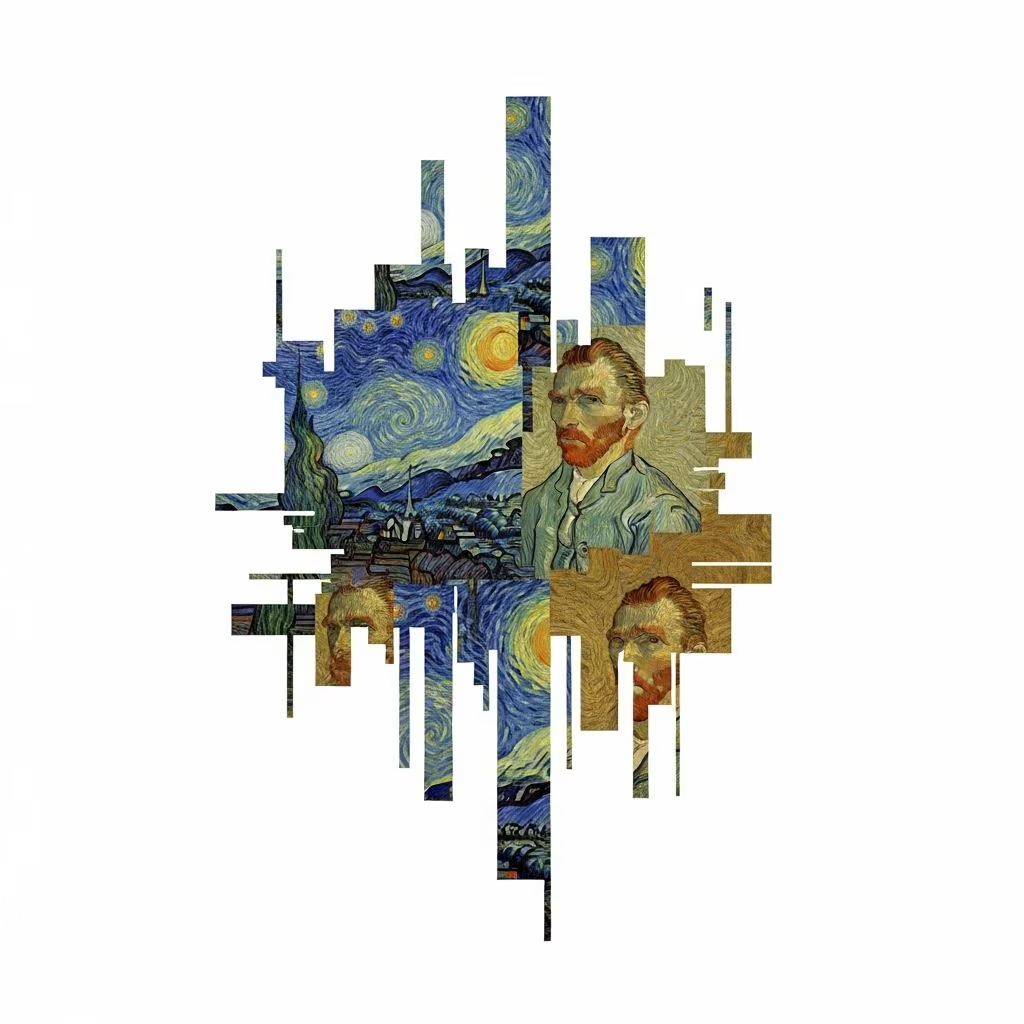
A comprehensive guide to the world's premier destinations for viewing Van Gogh paintings, from Amsterdam to Tokyo, including lesser-known venues.
 Travel Essentials
Vincent van Gogh’s artistic legacy spans continents, with his works housed in prestigious institutions from the Netherlands to South America, Asia, and beyond. Understanding where to encounter these masterpieces in person requires knowledge of the world’s most significant art collections. This guide illuminates the diverse destinations where visitors can connect with the revolutionary artist’s most celebrated and lesser-known creations.
Europe remains the primary custodian of Van Gogh’s output, reflecting both his European residency and the continent’s historic role in art preservation. The concentration of his works across multiple nations creates an opportunity for dedicated pilgrims to trace his artistic evolution through geography.
The Van Gogh Museum in Amsterdam houses the world’s most extensive collection of the artist’s work, containing approximately 600 paintings alongside numerous drawings and letters. This institution serves as the authoritative repository for understanding Van Gogh’s complete artistic journey. Visitors encounter seminal works representing every phase of his career, including The Potato Eaters, considered his inaugural significant composition, alongside iconic pieces such as Sunflowers, Self-Portrait, and The Yellow House. The museum’s chronological arrangement enables visitors to witness the artist’s stylistic transformation from his dark Dutch period through his luminous Provence years.
Musée d’Orsay in Paris preserves critical works from Van Gogh’s most productive period in France. The collection features Starry Night Over the Rhone, an intricate composition inspired by the river’s nocturnal beauty, alongside Self-Portrait, Le Meridien, and Room in Arles. These paintings document his revolutionary approach to color and emotional expression during his time in Provence. The museum’s setting within a converted railway station adds historical context to viewing works created during the artist’s final, most frenetic years.
The Kröller-Müller Museum in Otterlo, Netherlands, represents the second most significant Van Gogh collection globally. Helene Kröller-Müller’s discerning acquisitions between 1908 and 1922 yielded an extraordinary 88 paintings and 172 drawings. Essential works include a self-portrait from 1887 and Café Terrace at Night from 1888. Notably, a substantial portion of this collection is on international exhibition loan from September 2025 through August 2026, though significant works remain accessible to visitors.
Beyond the primary repositories, Van Gogh’s presence enriches collections across Europe. The National Gallery of Art in London houses seven Van Gogh paintings displayed in Room 43 on the gallery’s second floor. Madrid’s Museo Thyssen-Bornemisza showcases works from multiple artistic phases, including Les Vessenots in Auvers, exemplifying his later landscape work. These complementary collections provide nuanced perspectives on his artistic development.
The United States emerged as a significant destination for Van Gogh’s works during the twentieth century, particularly through major acquisitions by prominent institutions and collectors. This transatlantic migration reflects the artist’s posthumous recognition and America’s cultural investment in European modernism.
The Museum of Modern Art in New York displays The Starry Night, perhaps Van Gogh’s most universally recognized masterpiece. Created while the artist resided at a mental asylum in Saint-Rémy-de-Provence, France, this painting synthesizes his emotional turbulence with technical brilliance. Viewing this iconic work in person reveals dimensionality and impasto technique that photographs cannot convey, connecting visitors directly to the artist’s hand and vision.
South America hosts Van Gogh’s work in two primary locations, with São Paulo’s institution representing one of the continent’s most innovative museum experiences. The geographic distance from Europe elevates these collections’ significance as cultural bridges across the Atlantic.
The Museu de Arte de São Paulo houses four Van Gogh paintings, more than any other South American institution. Notably, The Stone Bench in the Asylum at Saint-Rémy depicts the garden sanctuary where Van Gogh retreated during his institutional period, acquired for the collection in 1954. The museum’s distinctive architecture presents paintings on “crystal easels”—glass stands mounted on concrete bases displayed across gallery floors rather than hung conventionally on walls. This revolutionary approach transforms the viewer’s relationship with the artwork, permitting intimate lower-perspective engagement impossible with traditional wall presentation.
Beyond São Paulo, the Museu de Arte de Sao Paulo features paintings from Van Gogh’s Saint-Rémy period, including Portrait of Camille Roullin, A Walk in the Twilight, and The Arlésienne. These works document his engagement with Provençal subjects and his exploration of portraiture during his most experimental years.
Japan and South Korea have emerged as unexpected repositories for Van Gogh’s work, reflecting both cultural appreciation and significant institutional investments. These Asian collections demonstrate the artist’s universal transcultural resonance.
Japan hosts several Van Gogh locations across distinct geographic regions. The Hakone museum features three paintings, including The Gleize Bridge over the Vigueirat Canal from March 1888 and Flower Vase with Thistles from June 1890. The museum is hosting a special exhibition titled The Impact of Van Gogh: A Renewal of Passion running from May 31 through November 30, 2026, examining Van Gogh’s influence on Japanese artists.
The Sompo Museum of Art in Tokyo preserves one of Van Gogh’s iconic Sunflower paintings, owned by Japanese insurance company Sompo. The museum’s 2020 relocation provided street-level public access to this previously corporate-housed masterpiece, democratizing viewing opportunities. Hiroshima’s museum collection includes Daubigny’s Garden from July 1890, one of Van Gogh’s final works created in Auvers-sur-Oise. This painting was purchased by Hiroshima Bank in 1974 from the widow of New York banker Siegfried Kramarsky.
Van Gogh’s presence extends into venues that defy conventional museum expectations, revealing the artist’s spiritual resonance across religious and cultural contexts.
The Vatican Museums, renowned for Renaissance masterpieces, houses Pièta within its Modern and Contemporary Art collection. This work, inspired by French artist Eugène Delacroix’s print and depicting the dead Christ with the grieving Virgin, was donated by the Catholic Archdiocese of New York in 1973 for the museum’s creation. Another painted version resides in Amsterdam’s Van Gogh Museum, yet the Vatican’s interpretation carries distinct spiritual weight within religious institutional context.
Poland’s single Van Gogh resides in an extraordinary location: 26 meters above ground in the dome of Warsaw’s Temple of Divine Providence, inaugurated in 2016. Country Huts among Trees from September 1883 was donated in 1987 to the Archdiocese of Warsaw by Polish-born British collector Charles Carroll-Porczynski. This placement within sacred space transforms the artwork’s meaning, connecting Van Gogh’s rural imagery to spiritual contemplation. However, this painting is scheduled to move to the Family Home of John Paul II in Wadowice near Krakow after April 27, 2026.
The Honolulu Museum of Art, opened in 1927 in Hawaii’s city center, houses a single Van Gogh: Wheat Field from June 1888. This harvest scene painted during his Arles period was donated in 1946 by the Cooke family, who established the museum. The painting’s presence in Hawaii’s tropical environment creates unexpected cultural juxtaposition, linking European agricultural imagery to Pacific institutional contexts.
Understanding Van Gogh’s dispersal requires recognizing the comprehensive catalog of his surviving works. The Van Gogh Worldwide platform provides an invaluable research tool, containing data on more than 1,100 paintings, drawings, and prints from approximately 2,000 known total works. This database documents pieces housed in nearly 200 institutions and private collections internationally, enabling researchers and enthusiasts to locate specific paintings and understand their provenance.
The Van Gogh Museum in Amsterdam houses the world’s largest collection with approximately 600 paintings and numerous drawings.
Yes, The Starry Night is permanently displayed at the Museum of Modern Art in New York.
Only two South American cities have Van Gogh collections: Buenos Aires with one painting and São Paulo with four paintings.
Rather than hanging on walls, São Paulo’s paintings are displayed on crystal easel stands mounted on concrete bases across gallery floors, permitting viewers to experience artwork from varied perspectives.
Japan hosts multiple Van Gogh works across several institutions including Hakone, Tokyo’s Sompo Museum of Art, and Hiroshima Museum.
Much of the collection is on loan through August 2026, though significant paintings remain on display.
Van Gogh’s artistic output, once revolutionary and underappreciated during his lifetime, now commands presence across the globe’s most prestigious institutions. From Amsterdam’s comprehensive holdings to unexpected locations in Warsaw’s sacred dome and Honolulu’s Pacific setting, the artist’s works connect viewers across continents and cultures. Planning a pilgrimage to view Van Gogh paintings requires awareness of diverse collection locations, exhibition schedules, and institutional contexts that shape how viewers encounter these transformative masterpieces. Whether visiting a single iconic work or undertaking a comprehensive global tour, engaging with Van Gogh’s paintings in person reveals dimensions of technique, emotion, and artistic vision that digital reproduction cannot convey.
