

 Travel Essentials
 Travel Essentials

Alaska leads with millions of lakes, followed by Minnesota and Michigan. Explore rankings, lake facts, and why these watery wonders draw adventurers nationwide.
 Travel Essentials
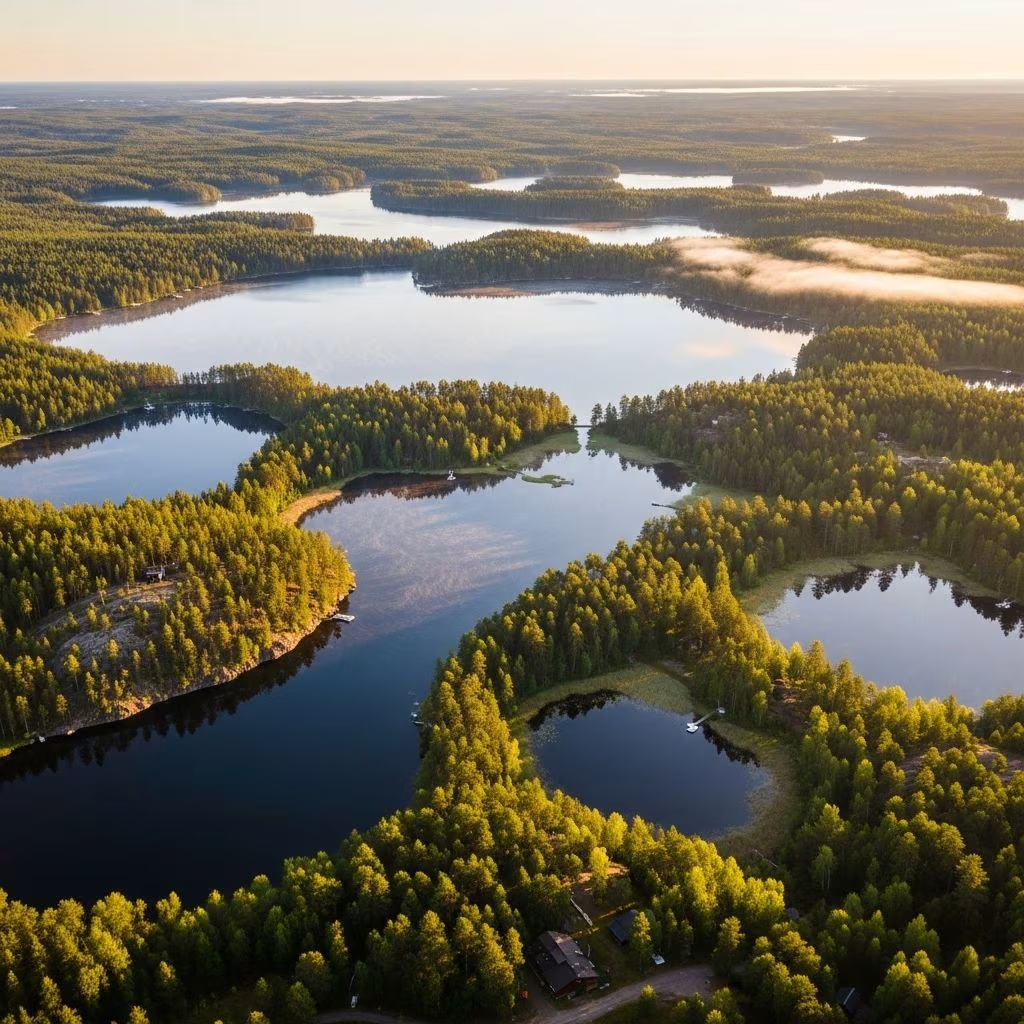
Across the United States, lakes dot the landscape in staggering numbers, shaping ecosystems, economies, and recreational opportunities. While popular lore highlights certain states, data reveals a clear leader: Alaska holds the crown for the most lakes, far surpassing contenders with its estimated three million bodies of water. This vast collection stems from glacial activity, permafrost, and immense terrain, creating a watery paradise unmatched elsewhere.
Ranking states by lakes requires defining terms—natural vs. man-made, named vs. unnamed, size thresholds. Official counts vary, but consistent patterns emerge from reliable datasets. Alaska dominates, while Lower 48 states show different leaders depending on criteria.
| Rank | State | Estimated Lakes | Notes |
|---|---|---|---|
| 1 | Alaska | 3,000,000+ | Includes unnamed natural lakes over 5 acres |
| 2 | Minnesota | 14,380 | Named natural lakes; ‘Land of 10,000 Lakes’ |
| 3 | Wisconsin | 15,000 | Debated with Minnesota on natural counts |
| 4 | Michigan | 11,000 | Inland lakes; borders 4 Great Lakes |
| 5 | Florida | 7,712-30,000 | Many man-made; Lake Okeechobee highlight |
| 6 | Washington | 8,000 | Glacial and volcanic origins |
| 7 | New York | 7,600 | Freshwater lakes, ponds, reservoirs |
These figures highlight discrepancies: broad counts favor Alaska, while stricter Lower 48 analyses elevate Texas or Florida. Michigan State University’s LAGOS-US database catalogs 479,950 lakes in contiguous states, excluding Great Lakes, with Texas leading at 43,343.
Alaska’s staggering lake density arises from its glaciated history. Retreating ice sheets left countless depressions filled by meltwater, forming over 3 million lakes greater than 20 acres—about half the U.S. total surface water. Officially named lakes number 3,197, including gems like Lake Clark (430 square miles) in Lake Clark National Park and Iliamna Lake, Alaska’s largest at 1,259 square miles, teeming with salmon.
Remote and pristine, many Alaskan lakes remain unexplored, accessible only by floatplane or bush plane. They support vital fisheries, bird migrations, and subsistence living for Indigenous communities. Challenges include permafrost thaw altering shorelines and climate impacts on water levels.
Minnesota earns its ‘Land of 10,000 Lakes’ moniker, though precise counts exceed this: 11,842 larger than 10 acres, up to 14,380 including border lakes with Canada. Glacial scouring created these kettle lakes, surrounded by pine forests ideal for cabin life and angling.
Wisconsin counters with 15,000 lakes per state records, sparking friendly rivalry over natural lake supremacy. The Wisconsin Department of Natural Resources emphasizes stricter natural criteria, edging out Minnesota in some tallies. Both states boast clear waters, walleye fisheries, and trails like the North Country National Scenic Trail linking thousands of lakes.
Michigan surrounds four Great Lakes—Superior, Michigan, Huron, Erie—comprising 41.5% of its area, the highest water percentage nationally. Inland, 11,000 lakes add to the tally, with over 60,000 if tiny ponds count; 2,700 are government-mapped. Torch Lake, famed for Caribbean-like turquoise hues, stretches 18 miles.
The ‘Great Lakes State’ thrives on boating, with 3,000 miles of shoreline. Lakes drive tourism, shipping (iron ore, grain), and biodiversity, hosting 28% of global Great Lakes surface freshwater.
Florida’s 7,712 to 30,000 lakes cover three million acres, blending natural sinkholes and man-made quarries. Lake Okeechobee (734 square miles) anchors the Everglades ecosystem, vital for flood control and bass fishing.
Texas claims 7,000 lakes, mostly reservoirs like Toledo Bend (185,000 acres). MSU data ranks it tops in Lower 48 with 43,343 under specific definitions, fueled by dams for agriculture and hydropower.
Disparities stem from definitions: USGS often requires 25+ acres for ‘lake’; states tweak for ponds or reservoirs. Alaska includes remote tarns; Minnesota excludes sub-10-acre waters. MSU’s peer-reviewed LAGOS database standardizes at one hectare minimum, reshaping rankings.
Man-made vs. natural also factors: Florida and Texas lead artificial lakes, while northern states dominate glacial naturals.
Lakes sustain fisheries yielding billions annually, filter water, and host migratory birds. Threats include invasive species (zebra mussels in Great Lakes), algal blooms from farm runoff, and warming reducing ice cover.
Conservation shines: Minnesota’s Clean Water Fund restores habitats; Alaska’s wilderness protections preserve remoteness. Recreation booms—$100B+ yearly from boating, fishing nationwide.
Plan visits seasonally: northern lakes for summer cabins, Florida for year-round warmth.
Alaska, with over 3 million unnamed natural lakes, dwarfs others.
Yes, but actually around 14,000+ depending on size criteria.
Typically no for inland counts; Michigan borders four separately.
Glacial erosion and thousands of years of ice melt.
Michigan at 41.5%, due to Great Lakes dominance.
From Alaska’s wild expanses to Michigan’s industrial waterways, U.S. lakes offer boundless adventure. Rankings evolve with better mapping, but Alaska’s lead endures. Whether kayaking secluded tarns or fishing bass-filled reservoirs, these waters define American landscapes.
