

 Travel Essentials
 Travel Essentials

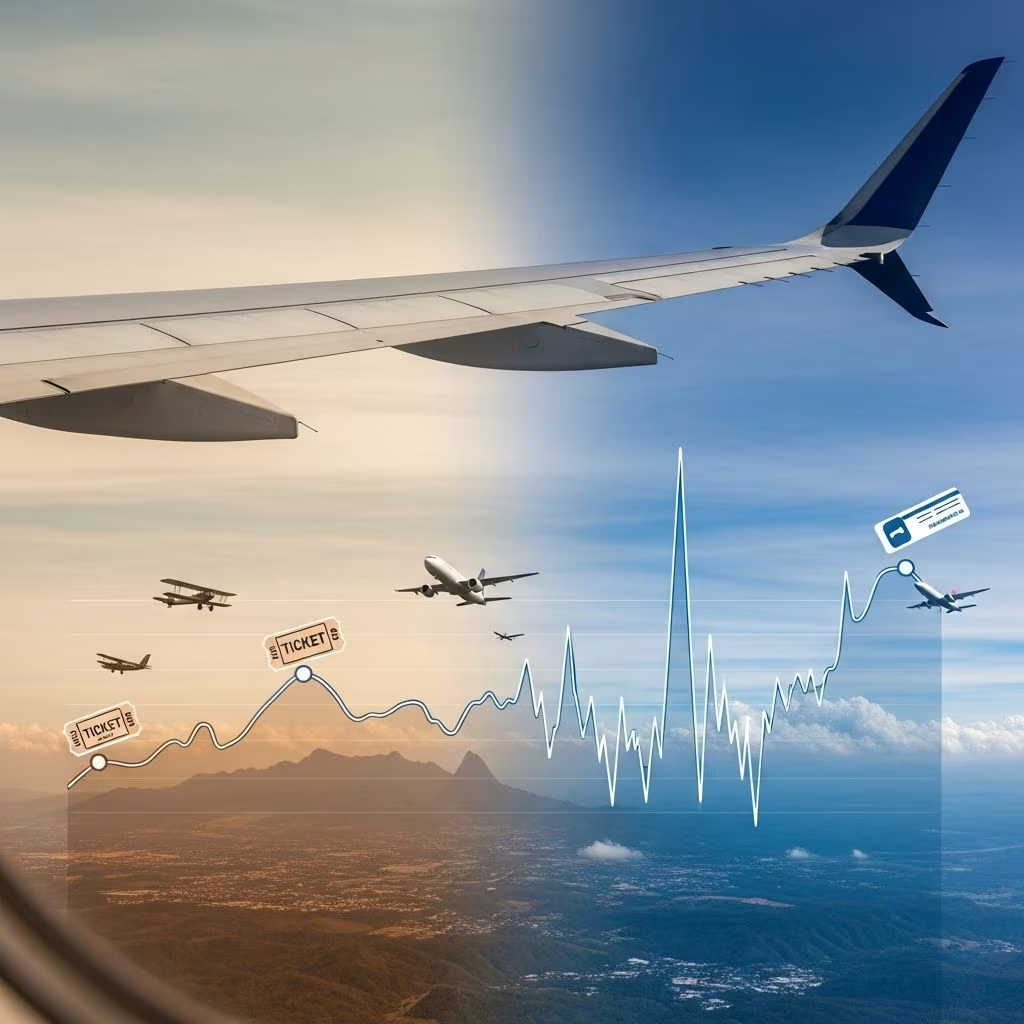
Explore the dramatic decline in flight prices since the 1970s, driven by deregulation, competition, and technology, making air travel accessible to millions.
 Travel Essentials
Airline ticket prices have undergone a remarkable transformation since the mid-20th century, shifting from a premium service reserved for the affluent to a widely accessible mode of transportation. In the 1970s, a domestic round-trip flight could cost as much as $550 from New York to Los Angeles, equivalent to about $3,500 today when adjusted for inflation. Today, similar routes are available for under $300, reflecting profound changes in regulation, competition, and operational efficiencies.
During the 1970s, air travel embodied luxury and exclusivity. Tickets were priced steeply, positioning flying as a status symbol rather than a routine choice. For instance, a one-way transatlantic flight from New York to London exceeded $300, translating to over $2,000 in current dollars. This high cost stemmed from strict government regulations under the Civil Aeronautics Board (CAB), which controlled fares, routes, and market entry, limiting competition and keeping prices elevated.
Passengers enjoyed perks like complimentary meals and spacious seating, but the expense deterred most middle-class travelers. International journeys were particularly prohibitive; a New York to Paris one-way ticket at $250 equated to more than $1,500 today. This era’s pricing made aviation a privilege, with airlines operating more like upscale services than mass transit.
The Airline Deregulation Act of 1978 marked a pivotal shift, dismantling CAB oversight and unleashing market forces. Airlines could now set their own fares and enter new routes freely, sparking fierce competition. Low-cost carriers emerged, introducing no-frills models that slashed prices dramatically.
By the 1980s and 1990s, fares began plummeting. What once cost thousands in real terms became affordable for families and budget travelers. This competition forced legacy carriers to adapt, leading to hub-and-spoke systems and yield management techniques that optimized pricing based on demand. The result? Air travel volume exploded, with domestic U.S. passenger numbers rising from millions to hundreds of millions annually.
To grasp the scale of change, consider specific routes adjusted for inflation using a factor of approximately 7.1 from the 1970s to 2024.
| Route | 1970s Price (One-Way) | Inflation-Adjusted (2024) | Current Average (2024) | Price Drop (%) |
|---|---|---|---|---|
| New York (JFK) to Los Angeles (LAX) | $150 | $1,065 | $300 | 72% |
| San Francisco (SFO) to Honolulu (HNL) | $200 | $1,420 | $400 | 72% |
| Chicago (ORD) to Miami (MIA) | $138 | $980 | $250 | 74% |
| Boston (BOS) to San Juan (SJU) | $160 | $1,136 | $350 | 69% |
| Dallas (DFW) to New York (JFK) | $125 | $888 | $275 | 69% |
These figures highlight how today’s fares represent a fraction of historical costs, even accounting for economic shifts. International routes show similar trends: a 1970s U.S.-Europe one-way at $250 now costs about $500 round-trip.
Beyond deregulation, advancements in aircraft technology played a crucial role. Modern jets like the Boeing 787 and Airbus A350 offer superior fuel efficiency, reducing operating costs per passenger. Larger planes carry more seats, spreading fixed expenses thinner.
Airlines also optimized operations: fewer crew per flight, streamlined ground handling, and data-driven scheduling minimize delays and waste. These efficiencies, combined with high load factors—often over 80%—keep base fares low despite rising fuel prices.
As base fares dropped, airlines innovated with unbundled services to boost profits. Starting in the 2000s, extras like checked bags, seat selection, and onboard meals became paid add-ons. This à la carte model allows passengers to pay only for what they need, theoretically keeping tickets cheap.
However, these fees have complexified. Baggage charges evolved from flat rates to dynamic pricing based on demand, route, and timing. Change and cancellation fees once reached $200 per ticket but have been reduced or eliminated for many fares, though basic economy often incurs $50-$100.
This shift generated billions in revenue; U.S. airlines collected over $10 billion in ancillaries in recent years. Critics call them ‘junk fees’ for obscuring total costs, prompting calls for transparency rules.
While airfares have stabilized or declined in real terms, other travel elements like hotels and dining have surged. Airlines achieve this through scalability: bigger planes and automation cut labor needs, unlike labor-intensive hospitality.
Fuel hedging, route optimization, and global supply chains further insulate airlines. Yet challenges persist—pandemics, geopolitical tensions, and sustainability mandates could pressure prices upward.
While U.S. deregulation set the template, similar trends unfolded worldwide. Europe’s liberalization in the 1990s birthed Ryanair and easyJet, dropping intra-continental fares. Asia’s open skies agreements fueled budget booms with AirAsia and IndiGo.
Developing markets saw the sharpest gains, with low-cost carriers connecting remote areas. Globally, IATA reports passenger numbers doubling every decade post-1990s, affordability as the driver.
Looking ahead, AI-driven dynamic pricing will refine fares in real-time. Sustainable aviation fuels (SAF) may raise costs short-term but enable long-term efficiency. Electric and hydrogen planes promise further reductions for short-haul.
Regulatory scrutiny on fees grows; the U.S. DOT pushes for all-in pricing displays. Competition from high-speed rail and hyperloop could cap airline dominance on regional routes.
Deregulation increased competition, while efficient aircraft and high occupancy lowered costs per seat.
Base fares dropped more than fees rose for many; total spend often remains lower, but transparency varies.
From $150 one-way (1970s, ~$1,065 adjusted) to ~$300 today—a 72% real-term drop.
Likely stable or slight rises due to green tech, but competition should maintain accessibility.
Yes; 1970s $250 U.S.-Europe one-way now ~$500 round-trip.
