

 Travel Essentials
 Travel Essentials

Discover why flights east are faster than west due to jet streams and planetary rotation, with real-world examples and tips for smarter travel planning.
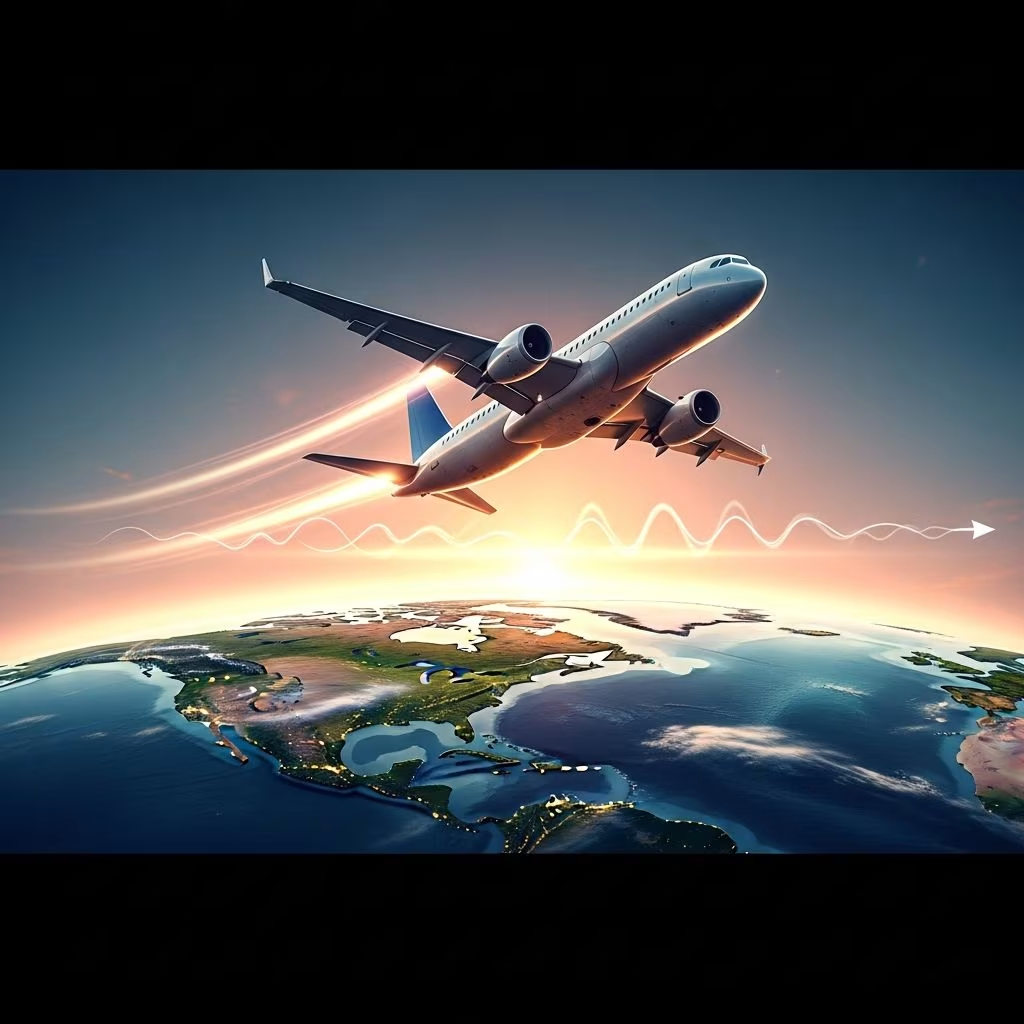 Travel Essentials
Travelers often notice that journeys heading east, such as from New York to London, arrive quicker than the reverse trip, sometimes by a full hour or more. This isn’t due to pilot skill alone but stems from powerful natural forces at play high in the atmosphere.
At the heart of this phenomenon lies the **jet stream**, a fast-moving ribbon of air circling the globe at altitudes between 30,000 and 39,000 feet—precisely where commercial jets cruise. These narrow bands of wind, typically 5 to 10 miles wide and several thousand miles long, blow predominantly from west to east in both hemispheres, driven by temperature contrasts between polar and equatorial air masses.
Jet stream speeds routinely exceed 200 mph, peaking over 250 mph during winter months when temperature gradients sharpen. An eastbound aircraft riding this tailwind sees its ground speed surge: a jet with an airspeed of 500 mph might hit 700 mph or more over the ground, slashing flight duration. Conversely, westbound flights battle headwinds, dropping effective speeds below 400 mph and extending travel time.
| Direction | Wind Effect | Typical Speed Boost/Loss | Example Impact |
|---|---|---|---|
| Eastbound | Tailwind | +100-200 mph | NYC-London: 6-7 hrs |
| Westbound | Headwind | -100-200 mph | London-NYC: 7-8 hrs |
This table illustrates the stark contrast using transatlantic routes, where data from airline records confirms consistent patterns.
While airplanes aren’t flung eastward by the planet’s spin like objects on a merry-go-round, Earth’s west-to-east rotation at about 1,040 mph at the equator profoundly shapes global wind patterns. This rotation deflects moving air masses via the Coriolis effect, reinforcing the west-to-east flow of upper-level winds.
In the Northern Hemisphere, prevailing winds at cruising altitudes align with this rotational momentum, amplifying jet streams. Southern Hemisphere routes show similar biases, though weaker due to less extreme temperature differences. Pilots don’t feel a direct “push” from rotation—aircraft fly relative to the air mass—but the resulting wind regime provides the real advantage.
Consider U.S. domestic flights: Los Angeles to New York often clocks 4.5 hours, while the return stretches to 5.5 hours, thanks to the polar jet stream arcing over the Midwest. Transatlantic hops from the U.S. East Coast to Europe leverage the North Atlantic jet stream, a seasonal powerhouse that peaks in winter.
These optimizations rely on real-time weather data from satellites and balloons, allowing dispatchers to plot great-circle routes adjusted for wind.
Beyond speed, tailwinds cut fuel burn dramatically—a boon in an industry where fuel is the largest operating cost. Eastbound flights consume up to 20% less fuel per hour, enabling airlines to schedule tighter turnarounds and offer competitive fares. Headwind-plagued westbound legs demand more power, hiking costs and emissions.
Modern flight planning software integrates NOAA forecasts, predicting jet stream positions days ahead. This precision has evolved with AI-driven models, further enhancing efficiency on long-haul routes.
Speed comes at a price: eastward flights disrupt circadian rhythms more severely. Advancing your internal clock (shortening the day) confuses melatonin production, leading to insomnia, fatigue, and digestive woes. Westward travel delays sleep, easier to adapt as humans are wired for slight extensions.
Flight operations centers monitor jet streams via tools like the Aviation Weather Center’s graphical forecasts. Captains file flight plans curving north or south to “ride the river,” balancing speed, fuel, and turbulence avoidance. Seasonal shifts prompt route tweaks—polar routes in summer dodge weaker streams.
Advancements in continuous descent approaches further amplify savings, but wind remains king. Passengers benefit indirectly through reliable ETAs and occasional early arrivals.
Jet streams strengthen in winter, widening the eastbound advantage; summers see milder effects as polar air warms. Climate change may disrupt patterns, with models predicting a poleward shift and potential weakening, altering future flight dynamics.
Some attribute speed solely to Earth’s rotation, overlooking that planes launch into the same rotating airframe—no inertial boost occurs. Others ignore southern hemisphere parity. Facts confirm winds as primary, rotation as enabler.
No direct boost, but it shapes jet streams providing tailwinds.
Generally yes on mid-latitude routes; equatorial or southern paths vary less.
30 minutes to 2 hours on transoceanic flights, per airline data.
Possibly, with shifting streams potentially equalizing times.
Pilots optimize automatically; passengers influence via flexible scheduling.
