

 Travel Essentials
 Travel Essentials

Japanese whisky faces a severe shortage due to reduced production in the 1980s-90s, booming global demand, and maturation delays. Learn impacts, new distilleries, and alternatives.
 Travel Essentials
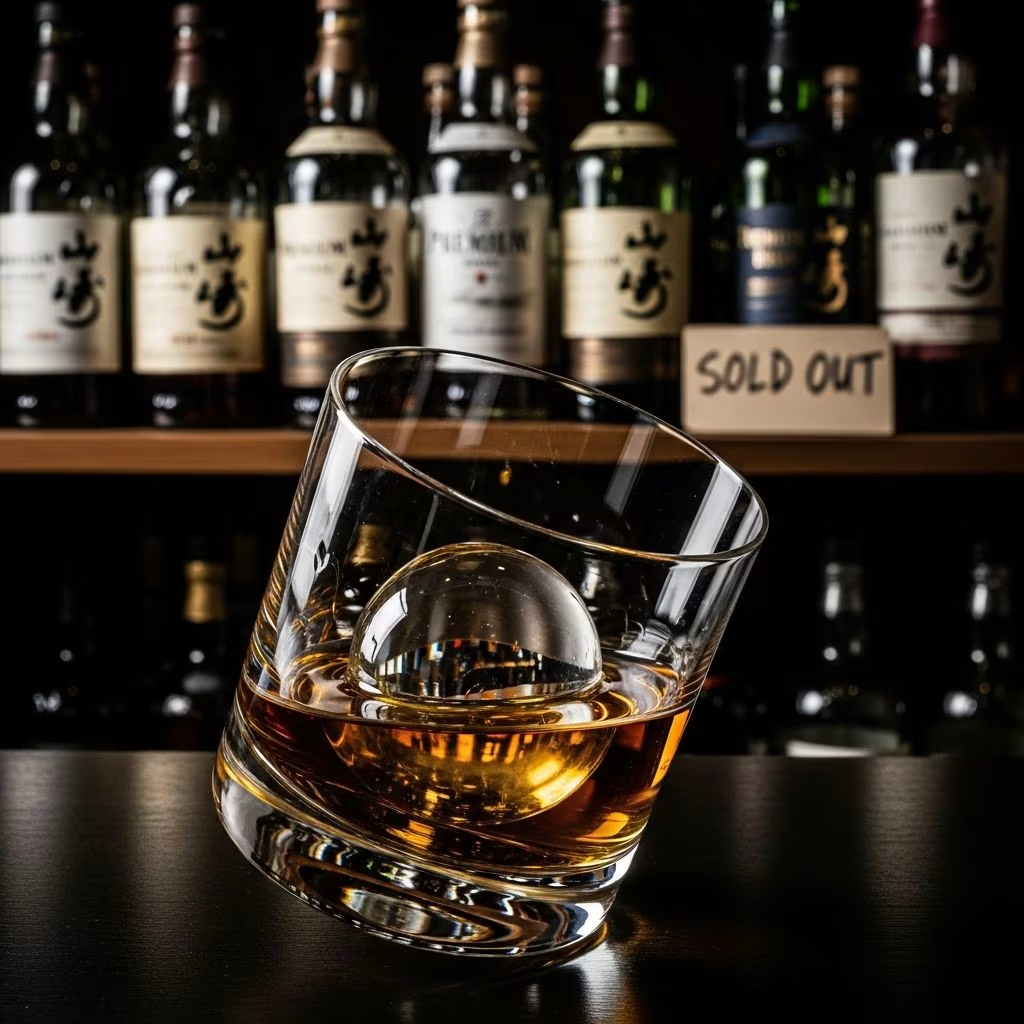
The Japanese whisky market is grappling with a profound supply crunch that has driven prices skyward and left shelves bare worldwide. This crisis stems from a mix of historical production decisions, explosive global popularity, and the inherent time required for spirit maturation.
Japanese whisky production peaked in the early 1980s but plummeted thereafter as consumer tastes shifted toward lighter spirits like shochu and beer during Japan’s economic stagnation. Major producers such as Suntory and Nikka responded by scaling back operations dramatically. Between 1995 and 2005, overall output dropped by nearly 60%, creating a vast shortfall in aged inventory precisely when demand would later surge.
Suntory closed its Hakushu No. 2 still in 1990, while Nikka idled the Miyagikyo Coffey still in 1999 and curtailed production at Yoichi. These moves ensured short-term survival but left warehouses depleted of mature stock by the 2010s. When international acclaim hit—capped by Whisky Bible naming Yamazaki 12 the world’s best in 2013—distillers had little to offer beyond pre-allocated reserves for domestic and key export markets.
A perfect storm of cultural and media influences ignited worldwide obsession. The 2003 film Lost in Translation spotlighted Suntory’s Hibiki blend, while the 2014 Japanese TV drama Massan—chronicling Nikka founder Masataka Taketsuru—sparked a domestic renaissance. Suntory’s savvy revival of the highball (whisky-soda cocktail) around 2008 further boosted consumption, transforming whisky from a dated “dad drink” to a trendy staple.
Awards poured in: Japanese expressions topped global lists alongside Scotch and emerging Tasmanian rivals, fueling exports that grew for 15 straight years until a 2023 dip. Export volumes fell 9% to 12.9 million liters (1.4 million cases), with value dropping 11% to ¥50 billion (US$318.5 million), per Japan Customs data. Premium single malts like Yamazaki and Hakushu faced the tightest allocations, often vanishing from stock entirely.
Unlike some spirits, whisky demands years in oak for flavor development—minimum three years by Japanese standards, but premium age-stated bottles require 12, 17, or more. Stock slashed in the 1990s matured into the exact shortfall now hitting markets in 2015–2025.
Rare casks exacerbate this: Mizunara oak, Japan’s fragrant native species from Hokkaido, grows slowly with under 100 harvestable trees yearly, yielding just 2–3 hogsheads each. Suntory controls most processing, dedicating under 5% of purchases to it. Ex-sherry butts from Spain and first-fill bourbon barrels from the US are also scarcer amid global whiskey booms and EU regulations.
| Constraint | Effect on Production | Resolution Timeline |
|---|---|---|
| Past production cuts (1980s–2000s) | Depleted aged stocks | 10–20+ years (new spirit maturing) |
| New distillery outputs | Increased new-make spirit | 10–25 years for age-stated premiums |
| Mizunara oak scarcity | Limits unique flavors | 30+ years (tree growth cycle) |
| Bourbon/sherry cask supply | Higher costs, tighter availability | 5–10 years (global adjustments) |
This table illustrates key hurdles; even aggressive expansions can’t shortcut biology or regulations.
Industry giants are investing heavily without compromising quality. Suntory allocated ¥10 billion (US$63.5 million) to upgrade Yamazaki and Hakushu, adding floor maltings and boosting storage over 50% since 2016. They’ve discontinued age-stated favorites like Hakushu 12 (cut globally post-2018) and Hibiki 17 (phased out in 2018), shifting to no-age-statement (NAS) options like Hibiki Harmony.
Nikka followed suit, halting ultra-aged lines in favor of younger, creative variants. Both ramp up distillation, but experts predict shortages persisting 10 years or more until new stocks mature.
Over 30 new distilleries have launched since 2015—Chichibu (2008 pioneer), Akkeshi, Furano, Nohda, Ontake, and revived Karuizawa—joining fewer than 10 in 2010. These craft innovative young whiskies, partnering with retailers like Dēkanta, but can’t yet supply premium aged volumes.
Scarcity has ballooned values: a standard 12-year Yamazaki now auctions for $1,200–$2,500; a 55-year Karuizawa hit £378,000 in 2023. Everyday bottles once under ¥10,000 fetch 10–20 times that on secondary markets. Hibiki 17 retails around $200, Hakushu 12 at $66 (pre-shortage benchmark).
While waiting, explore:
Japan’s whisky trail thrives despite stock woes. Yamazaki and Hakushu offer enhanced tours post-upgrades; book months ahead. Yoichi and Miyagikyo showcase Nikka heritage. Newer spots like Chichibu provide intimate tastings of experimental makes. Pair with izakaya highballs or onsen retreats for immersive trips.
Production rises steadily, but full recovery hinges on maturation timelines. By 2030–2035, expanded capacities and new players may ease pressures, potentially lowering prices if demand stabilizes. Until then, patience defines fandom—quality endures over quantity, as Suntory affirms.
Decades-low production in the 1990s left insufficient aged stock for today’s demand boom.
Not before 10+ years; new spirit needs time to mature into premium bottles.
Try NAS blends like Hibiki Harmony or young malts from Chichibu and Akkeshi.
Awards and nuanced flavors (Mizunara spice, silkiness) affirm its elite status.
Limited; duty-free or specialty shops occasionally stock allocations—arrive early.
