

 Travel Essentials
 Travel Essentials

Explore why certain oceans shimmer turquoise: light physics, clear waters, white sands, and low algae create breathtaking blues in places like the Caribbean.
 Travel Essentials
Pure water appears transparent, yet ocean surfaces display a spectrum of colors from deep navy to vibrant turquoise. This variation arises primarily from how sunlight interacts with water molecules and environmental factors. In tropical regions like the Caribbean, the striking turquoise hue captivates beachgoers, stemming from selective light absorption where longer wavelengths vanish first, leaving blues dominant.
Sunlight comprises all visible colors, each with distinct wavelengths. Red light, possessing the longest wavelength around 700 nanometers, gets absorbed swiftly by water—within the first few meters. Orange and yellow follow, absorbed progressively deeper. Blue light, at shorter wavelengths of about 450-495 nanometers, travels farther, penetrating up to 100 meters in clear conditions. Violet scatters even more but contributes less to the overall hue due to lower intensity.
This selective absorption explains why deeper oceans appear darker blue: only blue light remains and scatters via Rayleigh scattering, similar to the sky’s blue. In shallower zones, additional factors enhance turquoise tones. Particles and molecules scatter shorter blue-green wavelengths, creating the cyan appearance perceived as turquoise.
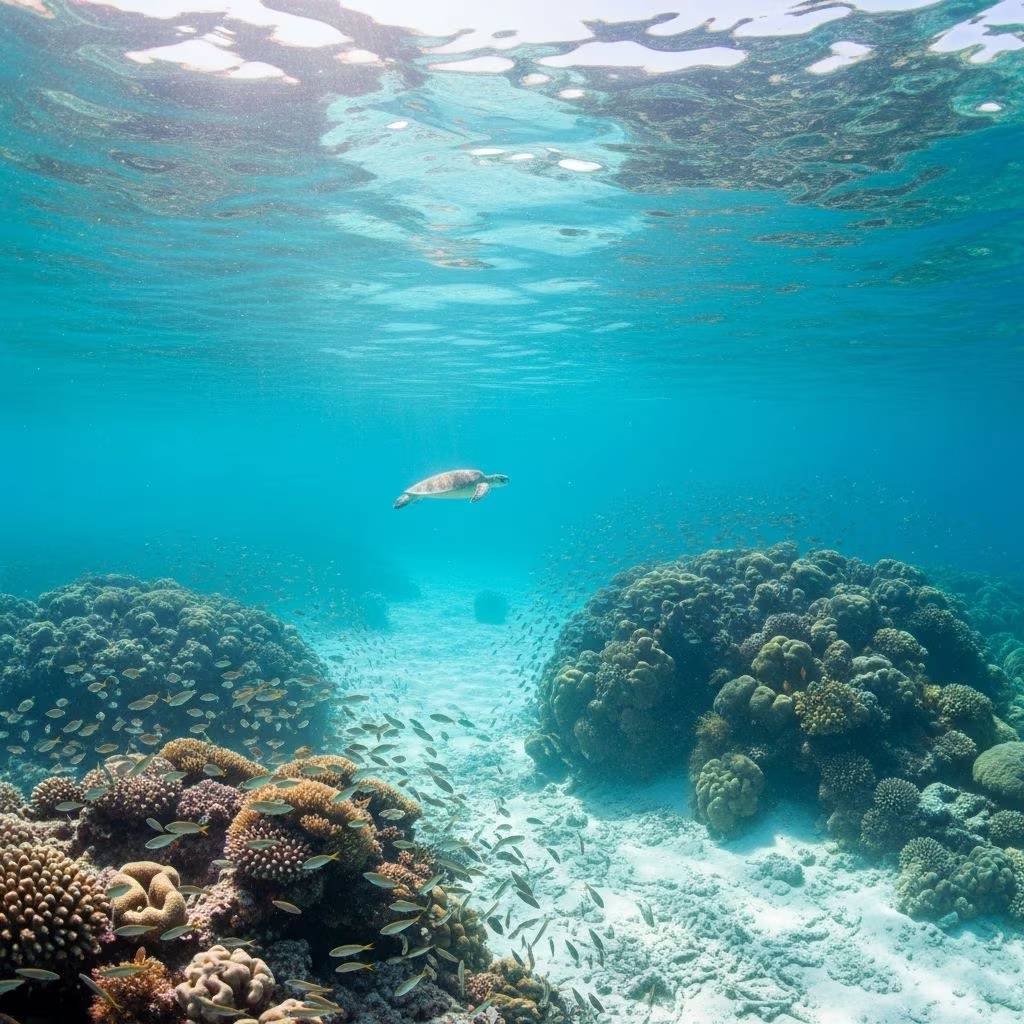
Turquoise brilliance thrives in shallow coastal areas, typically under 20 meters, where sunlight reaches the seafloor. White or light-colored sands, common in the Caribbean and Bahamas, reflect blue-green light back through the water column. This reflection amplifies the turquoise effect, as the pale bottom contrasts with the filtered light above.
Consider Bahamian beaches: powdery white sand from coral and shell fragments bounces light upward, mingling residual green wavelengths with dominant blues for that signature hue. Darker volcanic sands elsewhere reflect less, yielding greener or browner waters.
| Factor | Effect on Color | Example Locations |
|---|---|---|
| White sandy bottom | Enhances turquoise by reflecting blue-green light | Caribbean, Maldives |
| Dark sediment bottom | Mutes blues, adds brown/green tones | Pacific volcanic coasts |
| Shallow depth (<20m) | Allows full light penetration to floor | Bahamas, Cancun |
| Deep water (>50m) | Absorbs all but deep blue | Open Atlantic |
Crystal-clear water is essential for vivid turquoise. Strong tidal currents in the Caribbean sweep away sediments, preventing murky buildup. Unlike nutrient-rich coastal zones elsewhere, these areas have low phytoplankton—microscopic algae that bloom in fertile waters.
Caribbean salinity around 36 parts per thousand scatters light subtly, enhancing perceived clarity. Haloclines—sharp salinity gradients—can create visible color bands where fresher and saltier waters meet, though rare in uniform tropical seas.
Beyond physics, dynamic factors shift ocean colors. Sun angle matters: midday overhead rays maximize penetration for brighter turquoise; low-angle sunrises add orange warmth.
Temperature gradients form thermoclines, layering warm surface water over cooler depths, sometimes visibly separating hues. The Gulf Stream’s warm turquoise meets colder North Atlantic blues, forming subtle boundaries.
Stormy weather churns sediments, dulling clarity to gray-brown. Calm conditions restore vibrancy. Bioluminescence in deeper zones adds nighttime glows, but daytime turquoise relies on surface dynamics.
Certain spots epitomize turquoise perfection due to ideal conditions.
These locales share shallow bathymetry, carbonate sands, and oceanic currents flushing impurities.
Climate change and pollution threaten turquoise paradises. Warming waters spur algal blooms, greening clear seas. Coastal development increases sediment runoff, clouding shallows. Coral bleaching darkens seabeds, reducing reflectivity.
Conservation via marine protected areas preserves clarity. Reduced fertilizer use curbs nutrient pollution. Tourists aid by choosing eco-friendly operators avoiding anchor damage to reefs.
Depth, sediments, and plankton vary globally. Deep open oceans absorb more light, appearing navy; coastal nutrient loads foster green.
Salt aids clarity by inhibiting algae but doesn’t directly color water—light physics dominates.
Yes: unnatural greens or browns signal blooms or pollution; persistent turquoise indicates health.
Typically to 15-30 meters where light hits white bottoms; beyond, pure blue prevails.
Clarity suggests low bacteria from minimal runoff, but test advisories for jellyfish or currents.
Next beach vacation, observe how light dances on waves, revealing nature’s palette. Snorkel shallows to see sands glowing below. Understanding these phenomena deepens appreciation for fragile ecosystems. Protect them: use reef-safe sunscreen, avoid touching corals, support local conservation.
Turquoise oceans remind us of Earth’s optical wonders, blending physics, geology, and biology into postcard perfection. From Cancun’s lagoons to Bahamian banks, these hues beckon adventurers to witness science in serenity.
