

 Travel Essentials
 Travel Essentials

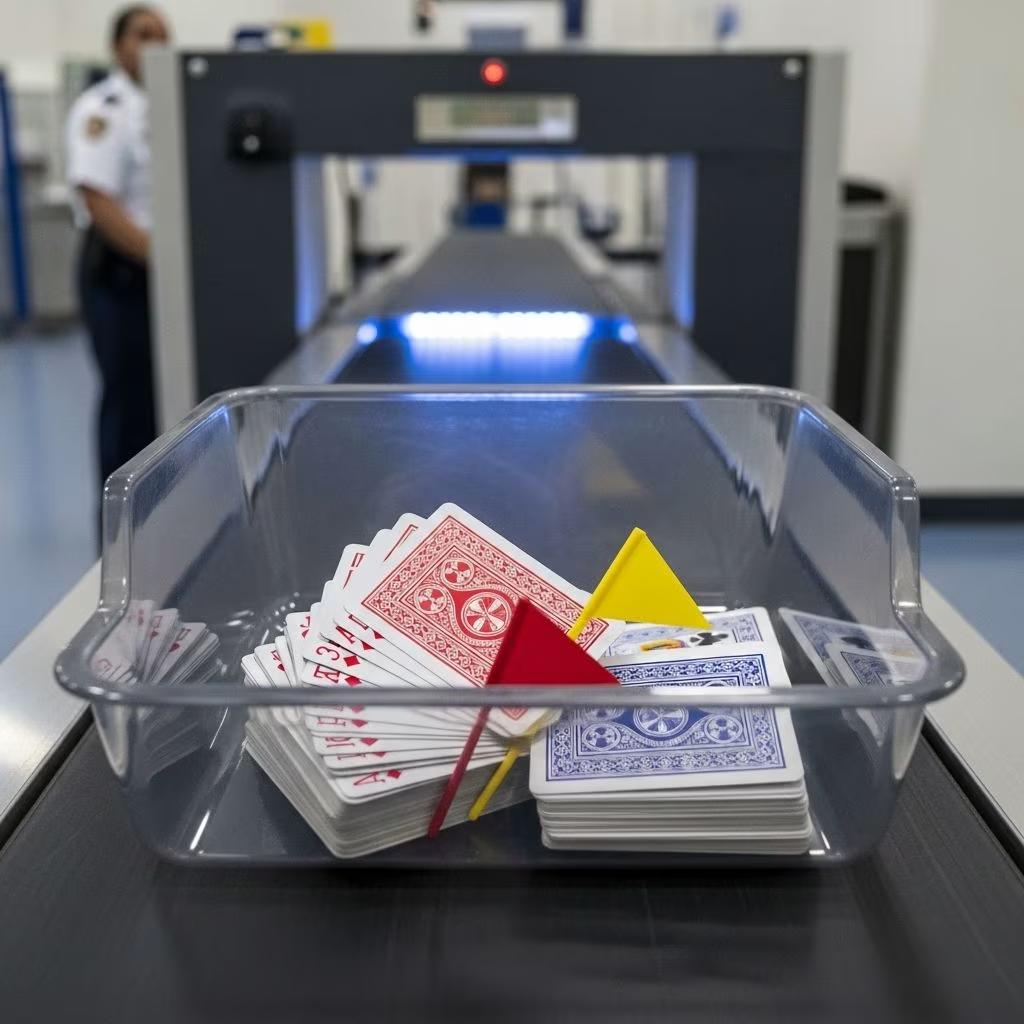
A deck of playing cards might seem harmless, but it often gets flagged at airport security due to X-ray density issues. Here's how to avoid surprises and tips for smooth travel.
 Travel Essentials
Travelers often pack familiar items like a deck of playing cards for entertainment during flights, but this innocent choice can lead to unexpected scrutiny at airport security checkpoints. The Transportation Security Administration (TSA) has noted that stacked cards create a dense image on X-ray scanners, mimicking potentially restricted materials and prompting secondary inspections. This article explores the science behind this issue, practical strategies to mitigate delays, and broader insights into modern airport screening protocols.
Airport security relies on advanced X-ray technology to detect threats in carry-on luggage. These machines emit low-energy X-rays that penetrate bags at different rates based on material density and atomic composition. Organic materials like paper appear in shades of orange, while metals show as blue or green. A tightly packed deck of 52 playing cards forms a solid rectangular block, which scanners interpret as unusually dense for paper products.
This density arises from the layered structure: each card is about 0.3mm thick, and when bundled, they create an opacity similar to concealed electronics or other anomalies. TSA officers view these as potential risks until verified otherwise. In high-volume screening areas, such ambiguities slow down lines, affecting thousands of passengers daily.
Recent reports from 2026 highlight playing cards as a recurring culprit. Passengers carrying poker sets, collectible decks, or even tarot cards have faced manual checks. One traveler at a major U.S. hub described placing a new bicycle deck in their bag, only for it to halt the line for a full hand inspection. Security personnel unpacked the deck, fanned the cards, and confirmed no hidden items before allowing passage.
Collectible card enthusiasts, such as those with rare Magic: The Gathering or sports trading cards, encounter amplified issues due to protective sleeves and boxes increasing density. Professionals like magicians or dealers traveling with multiple decks report routine flags, emphasizing the need for proactive measures.
| Item Type | Common Flagging Reason | Average Delay |
|---|---|---|
| Standard Poker Deck | Dense stack opacity | 5-10 minutes |
| Collectible Cards | Sleeves + box density | 10-20 minutes |
| Tarot Deck | Thicker card stock | 7-15 minutes |
The TSA permits playing cards in carry-ons without quantity limits, classifying them as non-hazardous. Official advice urges passengers to remove such items from bags for separate bin placement, akin to laptops or large liquids. This allows direct visual confirmation, bypassing X-ray ambiguities.
For packed decks, loosening the stack or using breathable packaging reduces density. Avoid shrink-wrap or tight rubber bands, which exacerbate the problem. TSA spokespeople recommend arriving early, especially at peak hours, to accommodate potential checks.
To sidestep issues entirely, consider digital alternatives. Smartphone apps replicate card games with no physical bulk, while e-readers or tablets provide diverse entertainment. Noise-canceling headphones with downloaded podcasts offer immersion without screening hassles.
Physical backups like travel-sized Uno or miniature decks exist, but they still pose minor risks. Puzzle books or soft-cover novels scan cleanly due to irregular shapes. Balancing portability and security-friendliness enhances the journey.
Flagging innocuous items like cards underscores challenges in balancing security with throughput. Airports process millions daily, and minor delays compound into hours lost. Innovations like computed tomography (CT) scanners, rolling out in 2026, promise 3D imaging to reduce manual checks by identifying contents precisely.
Passenger education plays a key role. Campaigns highlighting common flags empower travelers, easing officer workloads. International airports adopt similar protocols, so these tips apply globally.
Frequent travelers optimize by pre-screening mental checklists. Group similar low-risk items together, but isolate potential flags. Use transparent pouches for cards, allowing X-ray clarity. For valuables, insure and document via photos.
Family packs complicate matters: multiple decks for kids amplify risks. Distribute singly or opt for shared digital play. Business travelers with branded decks should pack in checked luggage if feasible, though carry-on is preferred for valuables.
Yes, unlimited decks are permitted in carry-ons and checked bags. Flags stem from imaging, not prohibition.
Tarot cards are thicker and often boxed elaborately, increasing density on scans.
Yes, but carry-ons protect against loss. Checked bags face less scrutiny for small items.
Declare value to officers; allow extra time. Consider shipping valuables separately.
Emerging tech improves detection, potentially reducing flags for paper items like cards.
As AI integrates with scanners, pattern recognition will distinguish card stacks from threats automatically. Millimeter-wave body scanners complement baggage checks, minimizing pat-downs. Travelers benefit from faster lines, but vigilance remains essential.
Global harmonization via ICAO standards ensures consistency. U.S. airports lead with AI pilots, projecting 20% efficiency gains by 2027.
