

 Travel Essentials
 Travel Essentials

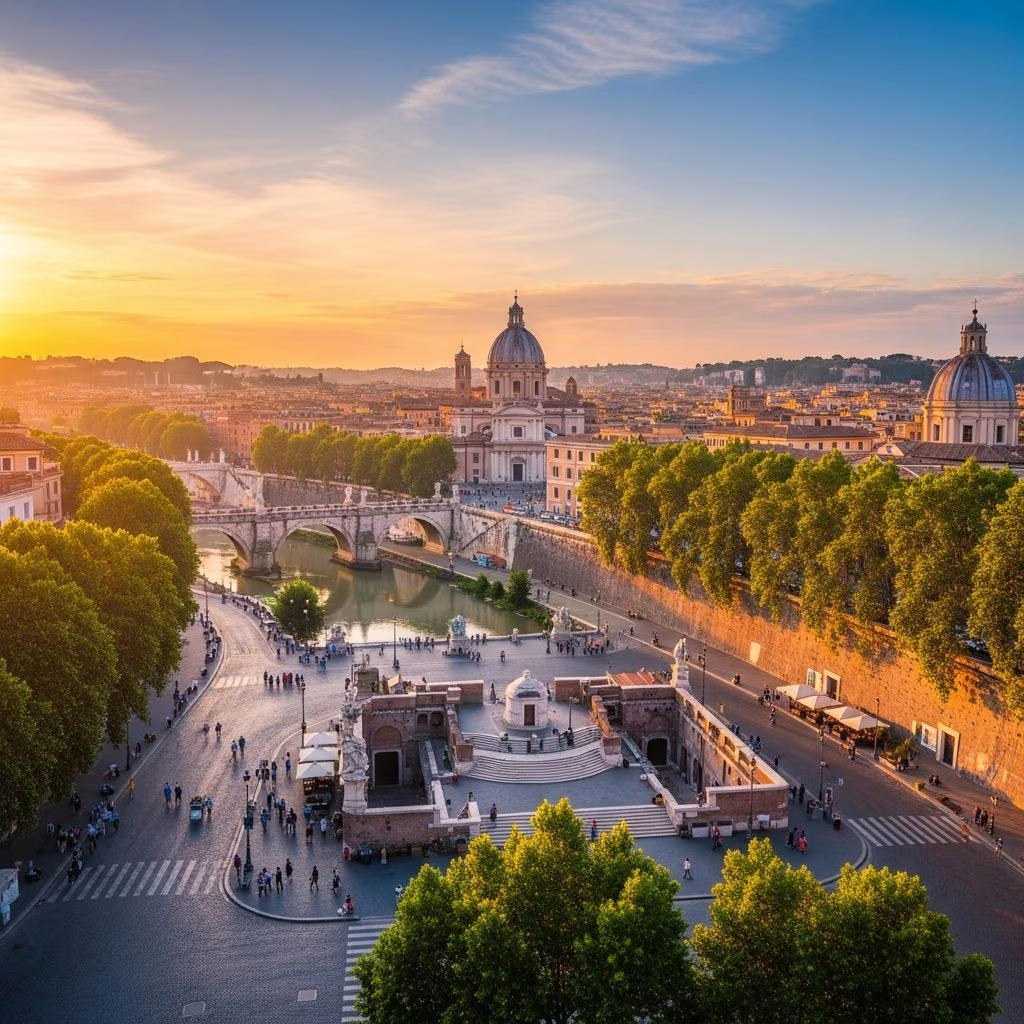
Rome stands out as one of the world's most walkable cities, offering tourists and residents alike exceptional opportunities to explore on foot with minimal transportation needs.
 Travel Essentials
Urban planners and travel analysts have increasingly recognized certain cities for their exceptional pedestrian infrastructure and walkability metrics. Rome, Italy’s historic capital, has garnered significant attention for its status as one of the world’s premier destinations for foot-based exploration. This recognition reflects both the city’s intentional urban design and its naturally compact geography that encourages visitors and residents to traverse the streets on foot rather than rely on motorized transportation.
The designation of Rome as among the most walkable cities worldwide underscores a broader global trend toward understanding urban environments through a pedestrian lens. Cities that prioritize foot traffic create safer, more vibrant communities while simultaneously preserving historical character and reducing vehicular congestion. Rome exemplifies these principles through its labyrinthine medieval streets, expansive piazzas, and interconnected neighborhoods that reward explorers willing to navigate without modern transportation aids.
Walkability assessments employ various methodologies to evaluate how conducive cities are to pedestrian movement and exploration. These evaluations typically consider multiple factors including street density, topographical variation, safety perceptions, public transit accessibility, and the concentration of attractions within reasonable walking distances. Different organizations may weight these factors differently, resulting in varying rankings across studies.
One comprehensive approach examines elevation changes and terrain difficulty, recognizing that flat, accessible cities generally score higher for pedestrians with varying mobility levels. Another methodology focuses on resident and visitor perceptions, surveying actual users about their comfort and frequency of walking. Still others analyze infrastructure elements such as sidewalk quality, crossing safety, and the availability of pedestrian zones.
Rome possesses several inherent characteristics that contribute substantially to its walkability credentials. The historic center occupies a relatively compact area where most major attractions cluster within achievable walking distances. The Colosseum, Roman Forum, Vatican, Spanish Steps, Trevi Fountain, and Pantheon—among countless other landmarks—can be connected through pedestrian routes rather than requiring extensive public transportation networks.
The city’s street network, developed organically over millennia, creates a dense pattern of intersecting pathways that encourage exploratory walking. Unlike grid-pattern cities designed with motorized vehicles in mind, Rome’s medieval and Renaissance street layouts naturally prioritize foot traffic. Narrow cobblestone streets, pedestrian plazas, and historic districts actively discourage automobile dominance.
Topographically, Rome sits on relatively rolling terrain without the extreme elevation changes present in many mountainous European cities. While hills certainly exist, they rarely present insurmountable obstacles to pedestrians. The Tiber River, despite its significance historically and geographically, does not fragment the walkable center into disconnected sections thanks to numerous bridges and crossing points.
One defining characteristic of highly walkable cities is the concentration of points of interest accessible within 15-30 minute walking periods. Rome excels in this metric, offering extraordinary density of cultural, historical, and recreational attractions throughout its central districts.
Perceptions of safety significantly influence walkability assessments and actual walking behaviors. Rome maintains relatively strong safety credentials for a major metropolitan area, particularly in central tourist districts and residential neighborhoods frequented by pedestrians. The presence of other walkers, businesses, and cultural activity throughout the day and into evening hours creates the “eyes on the street” phenomenon that urban theorists identify as essential to pedestrian safety.
Infrastructure supporting pedestrian movement includes clearly marked crossings, maintained sidewalks in most central areas, and traffic management strategies that minimize conflicts between pedestrians and vehicles. While Rome’s traffic congestion is legendary, central districts often employ pedestrian-priority policies, limited vehicle access, and restricted traffic zones that reduce automobile pressure on walking routes.
Walkable cities typically offer robust public transportation networks that complement rather than compete with pedestrian movement. Rome’s metro system, bus network, and streetcar lines provide connections between neighborhoods, enabling efficient transit that reduces reliance on individual automobiles. However, within the historic center, public transportation often complements walking rather than replacing it, since many attractions occupy pedestrian-only zones or areas where transit access proves limited.
This integration creates a synergistic effect where visitors and residents can combine walking with transit strategically, maximizing coverage while maintaining the pedestrian experience that defines the city’s character. Tourists can walk extensively through historical quarters, then use public transportation to access more distant neighborhoods, creating an optimal balance between exploration and efficiency.
Rome’s walkability experience varies considerably across seasons and times of day. Summer months attract massive tourist crowds that can transform pleasant pedestrian experiences into congested navigation challenges. The combination of extreme heat and crowding may discourage walking during peak hours, though early morning or evening walks remain pleasant throughout the year.
Spring and fall offer optimal walking conditions with moderate temperatures, manageable crowds, and excellent visibility for sightseeing. Winter rarely presents severe weather obstacles in Rome, though occasional rainfall can impact pedestrian comfort. Evening strolls (passeggiata) form part of Roman culture, with pedestrian activity often intensifying as temperatures cool and social activity increases.
Different Roman neighborhoods offer varying walkability experiences and attract different types of pedestrians. Centro Storico (Historic Center) represents the quintessential walking district with maximal density of attractions and pedestrian-only streets. Trastevere appeals to visitors seeking authentic neighborhood character while maintaining walkability. San Lorenzo attracts younger visitors and students willing to walk through student-oriented districts. Testaccio provides working-class authenticity combined with emerging culinary destinations.
Each neighborhood encourages exploration at a human pace, revealing layers of history, contemporary life, and unexpected discoveries that motorized movement would obscure. This granular walkability at the neighborhood level contributes to Rome’s overall designation as a pedestrian destination.
Global rankings of walkable cities include various contenders with different strengths. Amsterdam scores exceptionally high for flat terrain and bicycle infrastructure integration. Venice achieves ultimate walkability through complete automobile elimination. Florence ranks prominently due to its compact size and pedestrian-focused center. Copenhagen combines Nordic urban planning principles with pedestrian-friendly infrastructure.
Rome distinguishes itself through the combination of extreme historical density, cultural significance, and organic street patterns that create walkability not through contemporary design but through accumulated urban development spanning centuries. Where Amsterdam prioritizes cycling and Copenhagen emphasizes modern pedestrian design, Rome achieves walkability through the sheer gravitational pull of its attractions and the practical impossibility of vehicular transit through its labyrinthine medieval core.
Despite its overall pedestrian advantages, Rome faces challenges that impact walking experiences. Vehicular traffic in non-pedestrian zones creates noise, pollution, and safety concerns. Uneven sidewalks and cobblestone surfaces present obstacles for people with mobility limitations. Crowding during peak seasons strains capacity of narrow streets. Inadequate directional signage can frustrate walkers unfamiliar with the city’s layout. Ongoing construction and maintenance often impacts pedestrian routes.
Nevertheless, these challenges remain manageable within the context of a 2,800-year-old city attempting to accommodate 21st-century visitation levels while preserving historical integrity. Many walkability advantages actually stem from this historical preservation, as streets designed for foot traffic millennia ago continue serving that function effectively.
Rome’s recognition as a premier walkable city carries implications for urban policy and development strategy. The success of pedestrian-focused environments encourages other cities to prioritize walking infrastructure and reduce automobile dominance. Rome demonstrates that extreme historical and cultural density creates natural walkability that attracts visitors willing to invest significant time in foot-based exploration.
Cities seeking to enhance walkability face a choice between retrofitting contemporary automobile-centric infrastructure with pedestrian amenities or, as Rome exemplifies, embracing historical patterns that naturally encourage walking. Rome’s approach—accepting limitations on vehicular access while protecting pedestrian precincts—creates pedestrian-friendly environments through constraint and preservation rather than costly infrastructure investment.
Visitors interested in maximizing Rome’s walkability should consider several strategic approaches. Starting explorations in specific neighborhoods allows deep familiarity rather than rushed surveying of the entire city. Utilizing early morning hours provides better walking conditions with reduced crowds. Wearing comfortable footwear proves essential given cobblestone surfaces and extended distances. Carrying maps or using navigation apps helps navigate complex street patterns. Taking breaks in cafes and piazzas transforms walking from mere transit into cultural participation.
Understanding that Rome rewards wanderers more than those following rigid itineraries encourages the exploratory walking that reveals unexpected discoveries—a hidden church, a neighborhood trattoria, a quiet garden—that scheduled tourism often misses.
As cities worldwide grapple with sustainability, congestion, and quality-of-life issues, Rome’s model of walkable urban environments gains relevance. Continuing efforts to expand pedestrian zones, improve infrastructure for people with varying mobility levels, and manage vehicular traffic will determine whether Rome maintains and enhances its walkability credentials.
The challenge involves balancing preservation of historical character with contemporary accessibility standards, accommodating growth in visitation without overwhelming pedestrian infrastructure, and ensuring that walkability benefits residents as well as tourists. Rome’s future as a walkable city depends on thoughtful policy balancing these competing priorities.
While Rome’s historic center is extensively walkable, visiting all major attractions would require impractical distances on foot alone. Public transportation effectively extends walkability by connecting distant neighborhoods while encouraging pedestrian exploration within districts.
Spring (April-May) and fall (September-October) offer ideal walking conditions with moderate temperatures and manageable crowds. Summer heat and crowding can discourage extended walking, though early morning walks remain feasible.
Cobblestones require appropriate footwear but pose manageable challenges for most pedestrians. People with mobility limitations may find them more difficult, though many major streets include smoother surfaces and accessibility accommodations.
Rome combines exceptional historical density with organic medieval street patterns that naturally encourage walking. While cities like Amsterdam and Copenhagen offer superior contemporary pedestrian infrastructure, Rome achieves walkability through historical character and gravitational attraction of attractions.
Well-traveled pedestrian areas and neighborhoods maintain reasonable safety for nighttime walking. Standard urban precautions apply, and avoiding poorly-lit peripheral areas proves advisable, though Rome’s culture of evening social activity supports walking during evening hours.
Rome’s designation as one of the world’s most walkable cities reflects not primarily contemporary urban planning but rather the fortunate convergence of historical preservation, extreme cultural density, and organic urban development spanning millennia. The city’s medieval and Renaissance street patterns, combined with the unparalleled concentration of historical attractions within compact geography, create an environment where walking represents not merely a transportation option but the primary means through which visitors and residents experience Rome’s layered urban identity.
Understanding Rome’s walkability requires moving beyond infrastructure metrics to appreciate how centuries of accumulated development naturally prioritize pedestrian experience. The city demonstrates that walkability emerges from density, historical character, and the human-scale geography that centuries of foot-based movement inscribed into urban form. As cities worldwide seek to enhance pedestrian environments and reduce automobile dependence, Rome offers compelling historical evidence that such environments flourish when rooted in authentic urban patterns developed through human use rather than imposed through contemporary planning alone.
