

 Travel Essentials
 Travel Essentials

How national park closures during health crises are decided, what partial shutdowns mean, and the economic and ecological impacts on nearby communities.
 Travel Essentials
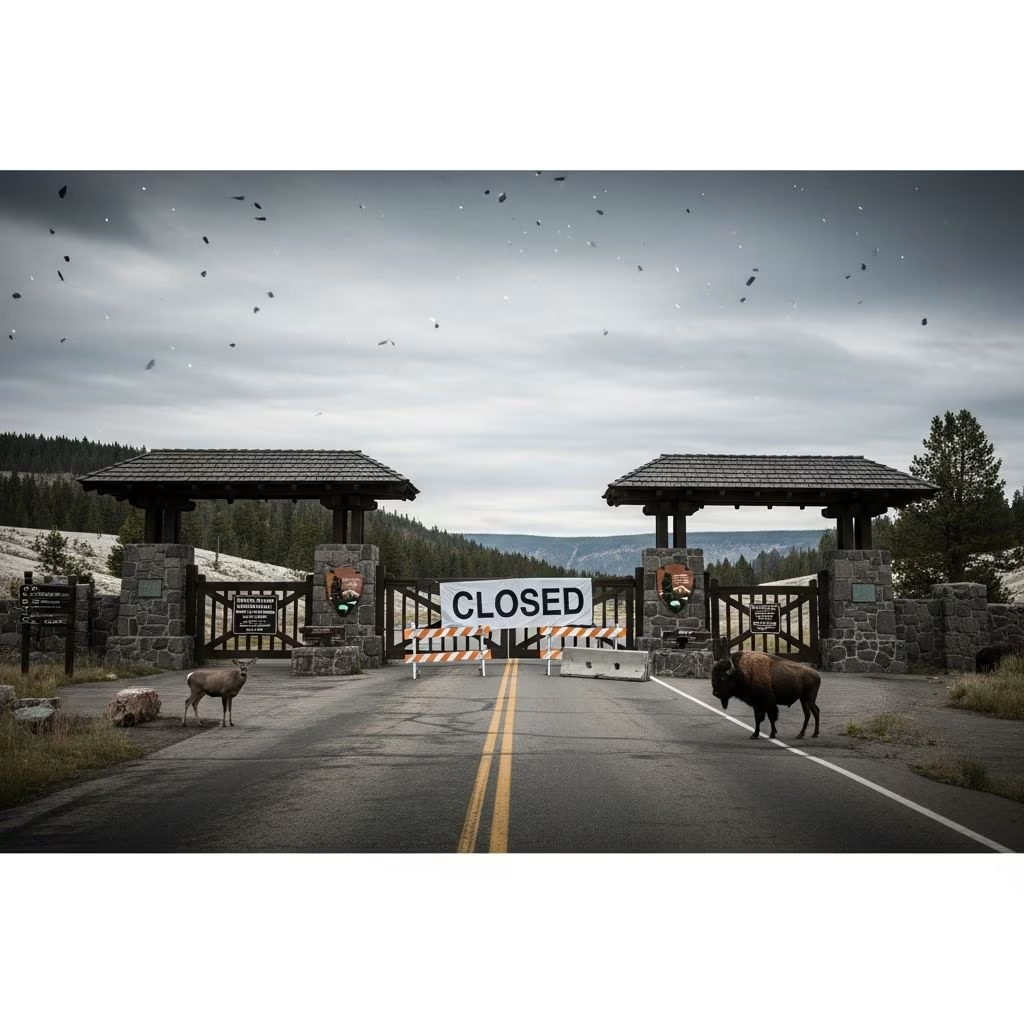
When public health emergencies strike the United States, few institutions feel the immediate ripple effects as visibly as the National Park System. These sprawling landscapes, designed to welcome millions of visitors annually, sometimes must close their gates entirely to protect both guests and the delicate ecosystems they harbor. Understanding why parks shut down, how these decisions are made, and what communities experience during extended closures reveals the complex intersection of recreation, environmental stewardship, and crisis management.
The National Park Service doesn’t make closure decisions in isolation. Rather, these determinations emerge from collaborative efforts involving multiple stakeholders, including local health departments, state officials, and park management teams. When health threats escalate, county health officers and hospital administrators typically petition the NPS to limit or eliminate public access, citing capacity concerns, transmission risks, or strain on emergency services.
Park superintendents evaluate these requests alongside their mandate to protect resources and ensure visitor safety. The decision to close a major attraction like Yosemite or Rocky Mountain requires careful consideration of economic consequences, logistical challenges, and alternative options. In many cases, facilities close in phases rather than all at once—visitor centers might shut while trails remain accessible, or camping areas close while day-use areas operate under restrictions.
The closure timeline varies significantly depending on circumstances. Some parks implement immediate shutdowns at the request of local authorities, while others provide advance notice, allowing visitors to adjust travel plans and employees to prepare for operational changes.
National park closures operate on a spectrum rather than a binary on-off switch. Understanding these distinctions helps visitors and communities prepare for disruptions.
| Closure Type | Definition | Examples |
|---|---|---|
| Complete Park Closure | All public access prohibited; gates locked; all facilities shuttered | Arches, Grand Canyon, Glacier National Parks |
| Facility-Specific Closure | Certain areas remain accessible while visitor centers, campgrounds, or specific trails close | Grand Canyon (specific trail restrictions) or Everglades (access limitations by county) |
| Operational Modification | Parks remain open but with capacity limits, modified hours, or restricted activities | Badlands (visitor centers closed, trails open) or Big Bend (full closure) |
| Water-Based Access Retention | Land areas close while waterways remain open for recreation | Dry Tortugas and Biscayne (boat access continued) |
During significant health emergencies, closures don’t happen in isolation. Instead, they cascade across entire regions as communities and health authorities recognize similar threats. What begins with a single park’s closure often accelerates into system-wide shutdowns within days.
Geographic clustering of closures demonstrates how regional health crises prompt coordinated responses. In the Rocky Mountain West, multiple parks received simultaneous closure requests from county health departments coordinating responses to surge in case numbers. Similarly, along the Colorado Plateau, neighboring parks implemented closures after consulting with the same health authorities.
This clustering creates amplified effects on regional economies. Small communities surrounding national parks—places like Moab, Utah or towns near Yellowstone—depend heavily on visitor spending. When multiple attractions close simultaneously, these economies face compound losses from accommodation cancellations, restaurant closures, and workforce reductions.
While closure decisions prioritize human health and safety, the absence of human activity creates unexpected ecological changes. Trails left unmaintained can erode or become overgrown, requiring intensive remediation when reopening occurs. Visitor infrastructure deteriorates without regular inspection and upkeep, potentially compromising safety systems when facilities reopen.
Paradoxically, some ecosystems experience temporary benefits from reduced human disturbance. Wildlife becomes more visible in abandoned areas as fear of human contact diminishes. Trails recover from compression damage, and vegetation regenerates in trampled areas. However, these benefits prove temporary once visitation resumes to normal levels.
The uncertainty of extended timelines complicates environmental management planning. Park rangers and maintenance crews struggle to prioritize resources when closure duration remains unknown. Should they focus on emergency repairs or prepare for eventual reopening? This ambiguity strains already stretched operational budgets.
National park closures trigger economic shockwaves extending far beyond park boundaries. Tourism-dependent businesses experience revenue collapses almost immediately when parks shut.
Seasonal workers face particular hardship. Many tourism-sector positions deliberately concentrate during peak seasons, with workers relying on compressed earnings across extended closure periods. Extended shutdowns eliminate these already-limited earning windows, creating financial crises for individuals and families dependent on seasonal income.
Communities with limited economic diversification prove most vulnerable. Towns that evolved specifically around park visitation lack alternative industries to absorb displaced workers or replaced spending. Economic recovery lags significantly in these locations compared to diversified metropolitan areas.
Managing park operations during closures creates persistent administrative burdens. The National Park Service must maintain essential functions—resource protection, emergency response capacity, and infrastructure preservation—while furloughing many staff members.
This staffing paradox creates operational complications. With reduced personnel, park maintenance backlogs accumulate. Roads deteriorate without regular repair, facilities fall into disrepair, and resource monitoring diminishes. However, even closed parks require some operational presence for security, emergency response, and environmental protection.
Communication challenges intensify when closure timelines extend beyond initial expectations. Park leadership must provide regular updates about reopening prospects, answer visitor inquiries about refund policies, and coordinate with tourism boards and local governments about messaging. Unclear guidance creates frustration among stakeholders who struggle with planning and financial forecasting.
Rather than implementing complete closures, parks sometimes implement protective measures that balance access with safety concerns. These alternatives reflect efforts to maintain some economic activity while addressing health risks.
Capacity restrictions limit visitor numbers through reservation systems or timed entry permits. This approach maintains some revenue while reducing crowding in sensitive areas. Enhanced sanitation protocols address facility-based transmission risks, though their effectiveness depends on consistent implementation and adequate resources.
Trail modifications restrict access to lower-traffic areas while closing heavily-used routes where social distancing proves impossible. Campground closures often proceed independently of day-use closures, affecting overnight visitors while allowing daytime recreation. These partial restrictions attempt to preserve economic benefits while addressing specific transmission vectors.
Time-based restrictions offer another approach, limiting park hours or creating visitor windows that reduce peak crowding. Some parks implemented one-way trail systems or directional flow restrictions to minimize face-to-face encounters on popular routes.
Widespread park closures revealed vulnerabilities in crisis response systems and highlighted the need for improved planning protocols. Park administrators now recognize that sudden operational shutdowns require advance contingency frameworks addressing staffing, communication, and resource allocation.
Better coordination mechanisms between health authorities and park leadership could accelerate decision-making during future emergencies. Regional coordination protocols enable consistent policies across park clusters rather than inconsistent, piecemeal responses. This approach reduces confusion for visitors while supporting equitable economic support for affected communities.
Technology investments in capacity monitoring systems could help parks implement restrictions gradually rather than suddenly implementing complete closures. Real-time visitor tracking, advance reservation systems, and dynamic scheduling allow flexibility in adjusting operations as circumstances change.
Investment in park infrastructure resilience—including enhanced sanitation systems, improved ventilation in visitor facilities, and technology upgrades—can help parks operate safely during future health threats without requiring complete shutdowns.
National park closures represent difficult compromises between competing interests: protecting public health and environmental resources versus maintaining economic viability for dependent communities and preserving public access to natural treasures. These decisions affect millions of visitors, thousands of workers, and countless businesses whose prosperity depends on park visitation.
Understanding the decision-making processes, consequences, and potential improvements helps stakeholders navigate these challenges more effectively. While complete closures prove necessary during severe crises, better planning, technology, and coordination could potentially minimize disruptions during future health emergencies, protecting both human welfare and economic stability.
