

 Travel Essentials
 Travel Essentials

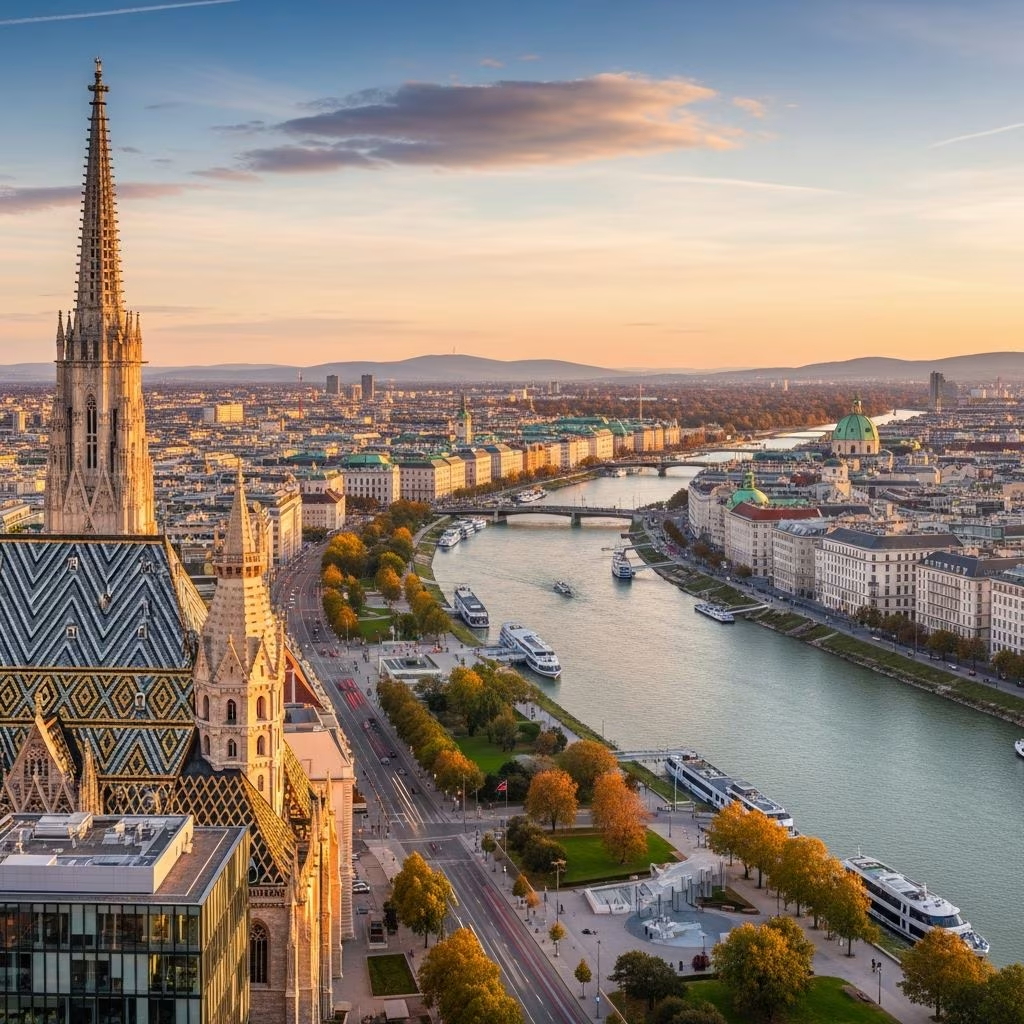
Vienna blends safety, excellent healthcare, efficient transit, green space, and affordable housing to deliver outstanding urban livability.
 Travel Essentials
The Austrian capital has established itself as one of Europe’s most desirable places to call home, earning international recognition for its exceptional living conditions and urban development. Year after year, Vienna continues to demonstrate that a thriving metropolitan area can seamlessly blend historical significance with modern convenience, cultural richness with practical infrastructure, and environmental consciousness with urban density.
Vienna’s prominence in global city rankings stems from rigorous evaluation methodologies that assess multiple dimensions of urban life. The Economist Intelligence Unit (EIU), which maintains the most widely recognized Global Liveability Index, evaluates 173 cities across 30 distinct indicators spanning five fundamental categories: stability, healthcare, culture and environment, education, and infrastructure. Each city receives scores on a 100-point scale, providing a comprehensive framework for comparison.
The Austrian capital has consistently secured the top position, with its most recent score of 98.4 demonstrating remarkable consistency in maintaining exceptionally high standards across all measured dimensions. This achievement represents more than a single accomplishment—it reflects a sustained commitment to urban excellence and thoughtful governance.
A cornerstone of Vienna’s livability ranking involves its exceptional stability and security. The city earned a perfect score of 100 in the stability category, reflecting consistently low crime rates and a secure environment that residents and visitors can depend upon. This stability extends beyond mere statistics; it creates a psychological foundation where individuals can pursue their daily activities without the anxiety that plagues many major metropolitan areas.
The stability factor also encompasses political reliability, low corruption, and predictable governance. Vienna’s government has demonstrated a commitment to maintaining these conditions through consistent policy implementation and transparent administration.
Vienna’s healthcare system represents one of its most significant advantages, earning a maximum score of 100 in medical categories. The city boasts world-class hospitals, comprehensive medical coverage, and accessible healthcare services that extend to all residents. This excellence ensures that individuals receive quality medical attention when needed, a fundamental requirement for quality of life.
The healthcare achievement reflects Austria’s broader commitment to social welfare and accessible medical services. Residents benefit from preventive care initiatives, specialized medical facilities, and healthcare professionals trained to international standards.
Education stands as another pillar of Vienna’s appeal, with the city achieving perfect scores in educational categories. The capital offers access to prestigious universities, well-funded public schools, and educational institutions that attract scholars and students from across Europe and beyond. Vienna’s educational infrastructure supports both traditional academic pursuits and vocational training pathways.
The quality of education extends beyond classroom instruction to encompass cultural education through museums, galleries, and historical institutions that provide lifelong learning opportunities for residents of all ages.
Vienna’s infrastructure achievements earned another perfect score of 100, reflecting comprehensive planning and execution in transportation, utilities, and public facilities. The city’s public transportation network represents a particularly notable achievement, with environmentally friendly services operating throughout the day and into the night.
The local Wiener Linien train services provide comprehensive coverage, while bus networks ensure accessibility to remote districts. Most impressively, Vienna operates five subway lines that run night service on Friday and Saturday evenings, allowing residents to travel safely during late hours. These services operate at remarkably reasonable prices, making public transit an economically viable option for daily commuting.
Vienna’s water infrastructure deserves special attention. The city maintains extraordinary standards for drinking water quality, sourced from mountain springs via two pipelines from the Lower Austrian-Styrian Alps. Approximately 400,000 cubic meters of fresh spring water flow to the city daily—sufficient to fill 2.5 million bathtubs. Vienna became the first city globally to have its water supply protected by constitutional provisions, reflecting the historical importance residents place on this essential resource. Throughout the city, 1,800 drinking fountains provide free access to this high-quality water.
Nearly half of Vienna’s urban area comprises green spaces, creating an unusually verdant metropolitan environment. This extensive greenery includes prominent parks along the Ringstrasse, the expansive Prater park, and portions of the Donau-Auen National Park within city limits. The Lobau wetland area represents one of Europe’s last unspoiled natural zones, while the Vienna woods provide a biosphere reserve hosting various endangered species.
While Vienna’s culture and environment category score of 93.5 proved slightly lower than perfect scores in other categories, this reflects primarily the absence of major sporting events rather than environmental shortcomings. The city compensates through its rich cultural heritage and vibrant entertainment offerings.
The city has adopted innovative urban planning concepts, including the ‘Supergrätzl’ model adapted from Barcelona’s ‘Superblock’ concept. The first Supergrätzl, spanning 1.5 square kilometers in the 10th district, specifically prioritizes pedestrian movement, cycling infrastructure, and public transportation while reducing vehicular traffic and pollution.
Vienna’s commitment to environmental excellence extends to ambitious future targets. The city aims to achieve climate neutrality by 2040 while simultaneously improving quality of life for all residents. This dual objective recognizes that environmental progress and human flourishing represent complementary rather than competing goals.
One distinguishing feature of Vienna’s approach involves its approach to housing policy. The city maintains a large social housing market with strong tenant protections, recognizing that affordable, secure housing forms the foundation for broader quality of life improvements. Building regulations require that two-thirds of new apartment construction meet affordability standards, ensuring housing accessibility across socioeconomic levels.
Vienna has functioned for many years as an international role model in social housing provision, demonstrating that metropolitan areas need not sacrifice affordability for quality. This commitment ensures that the benefits of urban living extend across all income levels rather than concentrating among the wealthy.
Vienna’s cultural offerings provide endless enrichment and entertainment opportunities for residents. The city’s museums, galleries, theaters, and concert halls represent centuries of accumulated artistic achievement. From classical music traditions to contemporary art installations, Vienna provides cultural experiences that few cities can match. This cultural abundance contributes to the vibrancy and sophistication that characterize daily urban life.
Beyond statistical measures, Vienna’s appeal rests on its practical functionality as a place to live. The city is beautiful, clean, functional, and highly walkable, with a concentrated density of cultural institutions, green spaces, and architectural excellence. These qualities combine to create an environment where daily activities become pleasurable rather than merely utilitarian.
The walkability factor proves
