

 Travel Essentials
 Travel Essentials

Learn why airlines ask passengers to open window shades during takeoff and landing, including emergency visibility, crew coordination, and passenger eye adjustment.
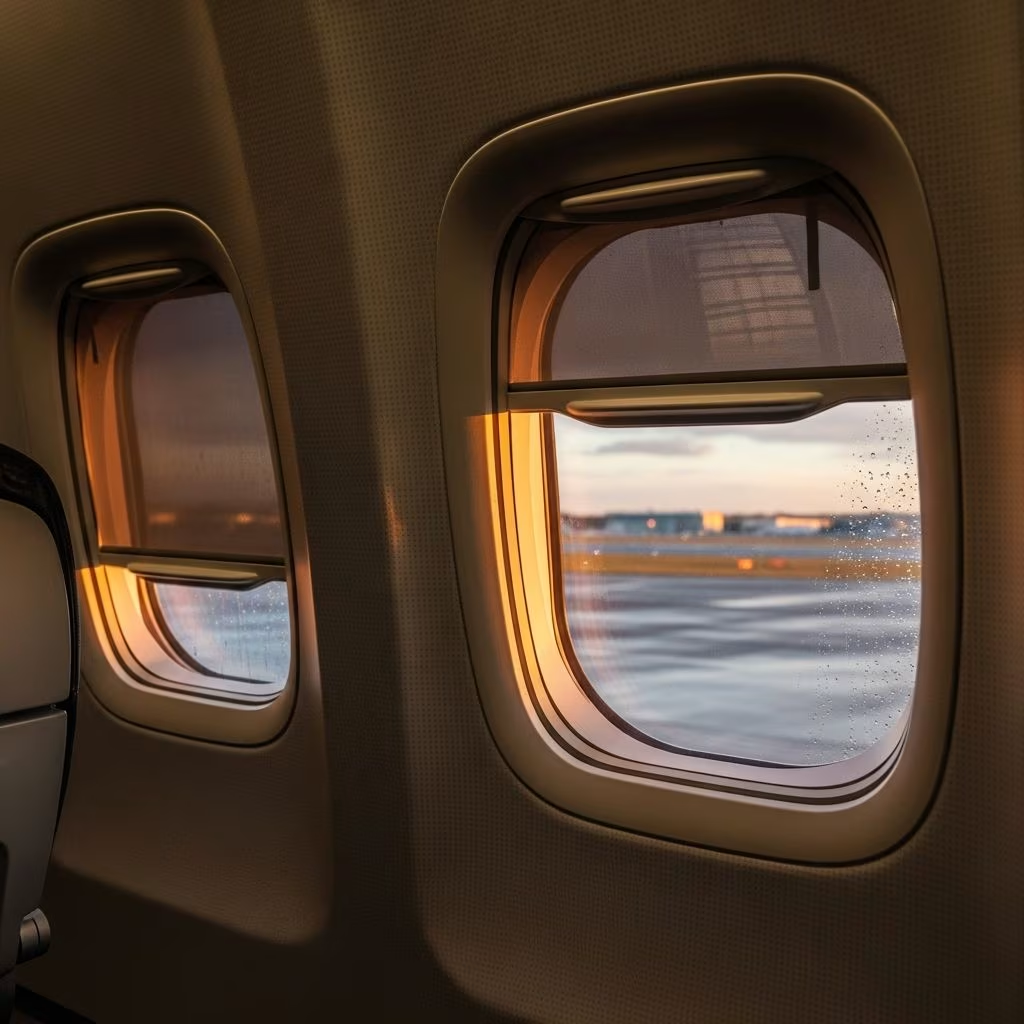 Travel Essentials
During your next flight, a flight attendant may walk through the cabin before departure asking passengers to raise their window shades. While this might seem like an arbitrary request, this procedure serves several critical safety functions that have been established through international aviation standards and decades of operational experience. The practice of maintaining open window shades during takeoff and landing represents a fundamental aspect of modern aviation safety protocols.
Takeoff and landing represent the most statistically critical phases of any commercial flight. During these periods, aircraft operate at lower altitudes, lower speeds, and in complex operating environments where numerous factors must be carefully managed. The International Civil Aviation Organization, a specialized agency of the United Nations responsible for international air navigation and aviation safety, has established recommendations supporting open window shades during these phases. Similarly, the International Air Transport Association, representing more than 300 airlines globally, recommends keeping window shades open as best practice during takeoff and landing.
These recommendations exist because aviation authorities recognize that visibility during critical flight phases can directly impact passenger safety outcomes. The practice reflects accumulated knowledge from thousands of flights and incident investigations conducted across the global aviation industry.
One of the primary reasons for maintaining open window shades involves enabling crew members to detect external aircraft conditions that might indicate mechanical or operational problems. Flight attendants and crew members use available windows to monitor the aircraft’s exterior during critical phases. If engine problems, hydraulic system issues, or structural concerns manifest as visible damage, smoke, or fluid leakage, open windows provide early warning signals.
This visual monitoring capability has proven valuable in real-world situations. In 2017, a passenger noticed fuel leaking from an aircraft wing through an open window and notified crew members, potentially preventing a serious in-flight incident. Such observations demonstrate how passenger awareness through open windows contributes to overall flight safety.
On certain regional aircraft, such as the CRJ-900 commonly operated by regional carriers, first-class passengers may be specifically asked to maintain open window shades because flight attendants lack full-size windows in the galley area. These passengers effectively serve as additional observation points for crew members who need to monitor external conditions.
In emergency situations requiring aircraft evacuation, open window shades provide multiple critical functions. First, passengers and crew can assess external conditions to determine which exits are safe for evacuation. If one side of the aircraft has fire, smoke, or other hazards, evacuees need immediate visual confirmation to select appropriate exit routes. Open windows provide this essential information instantaneously.
Emergency services on the ground also benefit significantly from open window shades. Fire and rescue personnel can see through cabin windows to assess whether smoke, fire, or other emergency conditions exist inside the aircraft. This external visibility enables emergency coordinators to make informed decisions about evacuation procedures and resource deployment.
Most airlines enforce particularly strict window shade policies at emergency exits, ensuring that these critical windows remain open during takeoff and landing regardless of their general policies for other cabin windows. Airlines like KLM specifically mandate that shades at emergency exits remain open during these phases to ensure rapid assessment of external conditions in emergency scenarios.
Open window shades provide an important physiological benefit that passengers might not immediately recognize. When emergency evacuation becomes necessary, passengers must transition from the aircraft cabin to the external environment. If outside conditions are bright and sunny, eyes accustomed to darkness will require time to adjust, potentially slowing evacuation procedures. Conversely, if outside conditions are dark, eyes accustomed to bright cabin lighting face similar adjustment challenges.
By maintaining open window shades during takeoff and landing, passengers’ eyes gradually acclimate to external light conditions. This pre-adjustment means that if evacuation becomes necessary, passengers can move more quickly and safely because their vision has already adapted to exterior lighting conditions. This principle explains why airlines simultaneously dim cabin lighting during takeoff and landing—both practices work together to optimize passenger visual adaptation.
Evacuation procedures must typically be completed within 90 seconds under Federal Aviation Administration regulations. Every second saved through improved passenger mobility directly impacts the safety and success of the evacuation process.
Window shade policies vary significantly depending on airline operating jurisdiction and company procedures. The Federal Aviation Administration does not mandate open window shades, allowing U.S. airlines to establish their own policies. This regulatory flexibility has resulted in different approaches across carriers.
Most major U.S. airlines including Delta, American, Alaska, and Southwest typically encourage rather than require passengers to open window shades. United Airlines briefly implemented a requirement in 2022 but quickly rescinded the mandate to align with industry norms and reduce passenger confusion. These carriers frame open shades as a recommendation supporting better visibility rather than a strict operational requirement.
International airlines, particularly those based in Europe, Asia, and the Middle East, tend to enforce open shade policies more consistently. Carriers including British Airways, Lufthansa, Singapore Airlines, and Emirates regularly have flight attendants verify that shades are open before departure and prior to landing. These airlines align their procedures more closely with International Civil Aviation Organization recommendations.
| Airline Category | Policy Approach | Enforcement Level |
|---|---|---|
| Major U.S. Carriers | Encouraged but not required | Low to moderate |
| Regional U.S. Carriers | Case-by-case basis | Moderate |
| European Airlines | Standard operating procedure | High |
| Asian Airlines | Standard operating procedure | High |
| Middle Eastern Airlines | Standard operating procedure | High |
Passengers who prefer closed window shades for personal comfort should understand that crew member requests regarding window shades typically relate to safety procedures. When flight attendants ask passengers to open their shades during critical flight phases, these requests reflect training protocols established through safety analysis and incident investigation.
Passengers traveling frequently on international routes may notice more consistent enforcement of open shade policies. This variation occurs because international airlines often maintain procedures more closely aligned with formal aviation authority recommendations. Frequent international travelers should anticipate these requests and understand their safety rationale.
For passengers with sensitivity to bright sunlight or those seeking privacy, the open shade requirement applies specifically to takeoff and landing—typically just minutes at the beginning and end of flights. Once the aircraft reaches cruise altitude, passengers generally have greater discretion regarding window shade position.
The window shade requirement represents one of numerous safety procedures that have evolved through aviation history. Early aviation operations identified critical flight phases and developed procedures to address associated risks. As commercial aviation expanded globally, these procedures were formalized into international standards developed through consensus among aviation authorities, airlines, and safety organizations.
Modern window shade policies reflect this accumulated experience. While individual incidents might not directly trace to window shade requirements, the procedure addresses systemic vulnerabilities identified across thousands of flights. Aviation safety operates on a principle of redundancy and defense-in-depth, where multiple systems and procedures work together to prevent accidents.
Window shades directly support multiple safety functions including crew visibility, passenger eye adjustment, external condition assessment, and emergency coordination with ground services. In aviation, procedures addressing even small risk factors are standardized across the industry because safety gains accumulate across millions of flights.
If a crew member specifically requests that you open your window shade, complying with this request represents following established safety procedures. Flight attendants receive training emphasizing window shade requirements, and their requests reflect safety protocols rather than personal preferences.
Open window shades benefit multiple individuals beyond the window seat passenger—flight attendants, crew members, emergency personnel, and other passengers all potentially benefit from external visibility during critical flight phases.
These two procedures work synergistically. Dimming cabin lights while opening window shades allows passenger eyes to gradually adjust to external lighting conditions, improving response capabilities if emergency evacuation becomes necessary.
The window shade requirement, while sometimes seeming inconvenient, represents a practical application of aviation safety principles. The procedure costs passengers nothing, requires minimal effort, and provides multiple safety benefits during the statistically riskiest flight phases. Understanding the reasoning behind this requirement helps passengers appreciate how aviation maintains its exceptional safety record.
When flight attendants request open window shades, they represent organizations and regulatory authorities committed to passenger safety. Complying with these requests demonstrates understanding of aviation safety priorities and contributes to the systematic safety culture that makes commercial aviation statistically safer than most ground transportation methods.
