

 Travel Essentials
 Travel Essentials

Explore Wind Cave National Park's vast cave system, unique boxwork formations, rich history, and diverse wildlife in this comprehensive guide.
 Travel Essentials
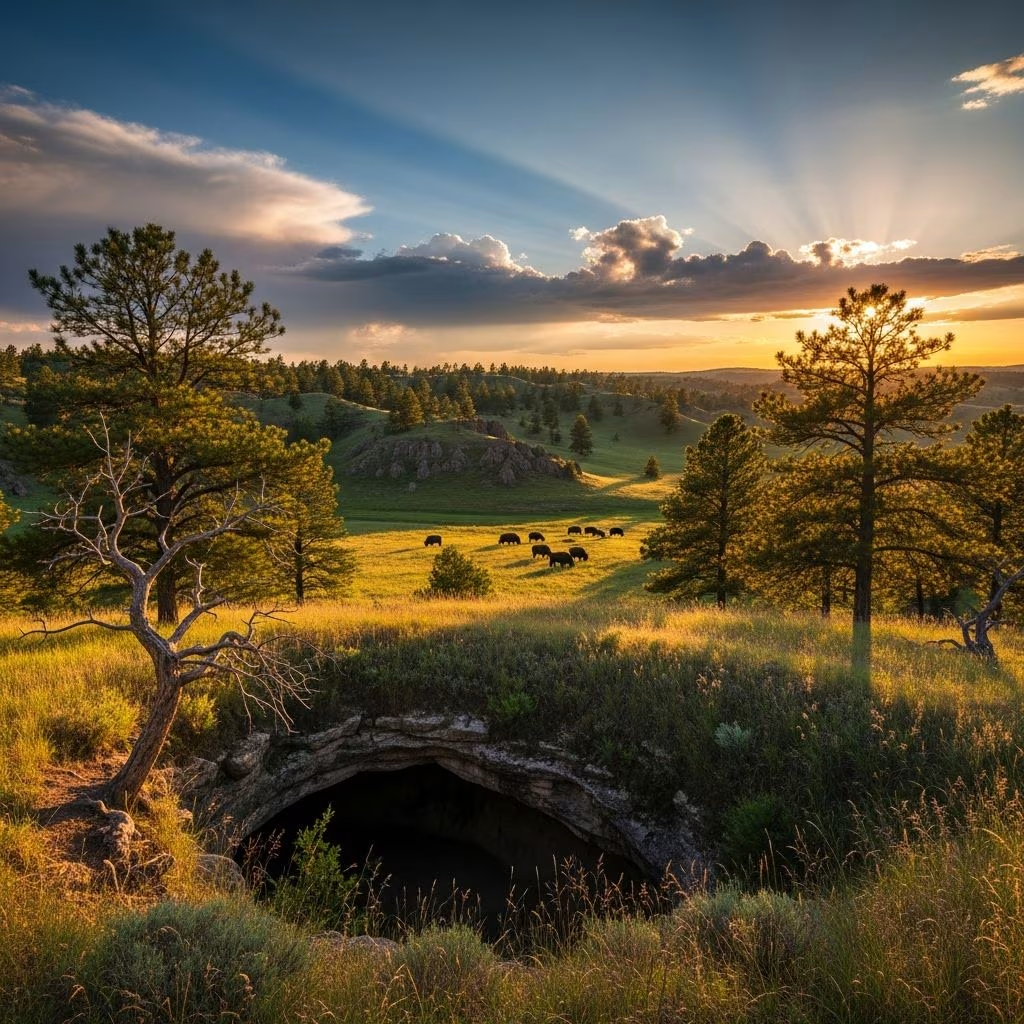
Wind Cave National Park, nestled in the southwestern corner of South Dakota, offers a captivating blend of subterranean geological marvels and expansive surface ecosystems. Established in 1903, it stands as one of the United States’ earliest national parks and the first ever dedicated to preserving a cave system. Spanning approximately 33,847 to 33,918 acres, the park protects a third-longest cave in the U.S., with over 167 miles mapped as of recent surveys, alongside pristine mixed-grass prairies teeming with native wildlife.
The park’s namesake, Wind Cave, derives from powerful air currents at its sole natural entrance, where pressure differences create gusts strong enough to knock off hats, as recounted in its 1881 discovery by brothers Jesse and Tom Bingham. This phenomenon, felt by Lakota people for centuries who call it “Maka Oniye” or “breathing earth,” underscores its spiritual significance as a portal to the spirit world.
Geologically, the cave formed in limestone deposits dating back 350 million years, carving an intricate karst network through dissolution processes. It houses about 95% of the world’s known boxwork formations—delicate, honeycomb-like calcite blades protruding from walls, alongside frostwork resembling icy spikes and popcorn-like textures. Over 40 smaller backcountry caves dot the landscape, adding to the subterranean diversity.
Long before European settlers, the Black Hills region, including Wind Cave, served as a vital area for American Indian tribes like the Lakota, providing resources and holding deep spiritual value. The cave’s natural opening was revered in Lakota emergence legends. Non-indigenous discovery came in 1881, leading to commercial exploitation until President Theodore Roosevelt’s 1903 proclamation protected it as the seventh-oldest U.S. national park.
Early explorers like Alvin McDonald mapped initial passages, transitioning the site from tourism ventures to a conserved wildlife preserve by 1912. Today, it balances preservation with recreation, attracting around 500,000 visitors annually, 120,000 of whom tour the cave.
Located 10 miles north of Hot Springs, South Dakota, at the southern edge of the Black Hills, the park borders Custer State Park to the north and Black Hills National Forest to the west. Access via U.S. Highway 385; the visitor center at the cave entrance offers maps, exhibits, and tour bookings.
Ranger-led tours are the primary way to experience the cave, revealing passages inaccessible otherwise. Tours vary by difficulty and focus:
| Tour Name | Duration | Length | Highlights | Accessibility |
|---|---|---|---|---|
| Introductory | 1 hour | 0.6 miles | Boxwork, basic formations | Wheelchair-friendly option |
| Classic | 1.5 hours | 1.25 miles | Frostwork, popcorn balls | 300+ stairs |
| Natural Entrance | 1.5 hours | 1 mile | Wind phenomenon, history | Steep stairs |
| Fairgrounds | 2 hours | 1.75 miles | Rare boxwork galleries | Moderate stairs |
| Wild Cave | 4 hours | 1.5 miles | Crawling, off-trail adventure | Strenuous, ages 16+ |
Reservations recommended via recreation.gov, especially summer weekends. Tours emphasize Leave No Trace principles to protect fragile formations.
Above ground, 34,000 acres of mixed-grass prairie—one of the last intact examples—host bison, elk, pronghorn, mule deer, coyotes, and prairie dogs. The park maintains one of the few genetically pure, free-roaming bison herds.
Hiking trails span over 30 miles:
Scenic drives like the 13-mile Wildlife Loop Road offer prime viewing. Night skies are exceptional for stargazing, with minimal light pollution.
Inside the park, Elk Mountain Campground (61 sites) provides electric hookups; prairie-view sites fill quickly. Backcountry camping requires permits for designated zones.
Nearby options in Hot Springs or Custer include RV parks and lodges. Adjacent Custer State Park offers 200+ sites and resorts.
The park’s prairie ecosystem supports reintroduced native species, managed through controlled burns and grazing to mimic natural processes. Bison herds fluctuate seasonally; visitors must maintain 100-yard distance. Challenges include invasive species and climate impacts on karst systems.
Combine with nearby Jewel Cave (longest U.S. cave) or Mount Rushmore for a Black Hills itinerary.
Yes, for its unique boxwork (95% of global supply) and prairie wildlife.
Over 167 mapped miles, sixth-longest worldwide.
Introductory tours suit ages 5+; Wild Cave 16+.
Yes, on Wildlife Loop; keep distance.
Yes, Elk Mountain and backcountry.
