

 Travel Essentials
 Travel Essentials

How a 1886 gold discovery transformed South Africa, launched Johannesburg, and reshaped the nation’s economy, politics, and landscape.
 Travel Essentials
The discovery of vast gold deposits in the Witwatersrand region in 1886 ignited one of the most profound transformations in modern African history, propelling South Africa onto the world stage as a mining juggernaut and laying the foundations for urban and political upheaval.
Long before the explosive events of the late 19th century, traces of gold had tantalized explorers in what is now South Africa. Alluvial deposits, where gold particles settle in riverbeds after erosion from primary sources, were first noted in earnest during the 1850s. In 1853, prospector Pieter Jacob Marais extracted gold from the Jukskei River, north of modern Johannesburg, sparking minor interest but no sustained boom. Similarly, in 1873, significant alluvial finds at Pilgrim’s Rest in Mpumalanga marked the onset of organized, large-scale production, though these were surface-level and quickly depleted.
Local tribes and early settlers had shared legends of an “El Dorado” hidden in the interior, fueling persistent searches. By the early 1880s, prospectors like Graham Barber uncovered quartz lodes in the De Kaap Valley, hinting at deeper riches, but the true game-changer lay further west in the Transvaal’s Witwatersrand ridge. These preliminary strikes built anticipation, drawing itinerant miners and setting the stage for the seismic shift to come.
The Witwatersrand Gold Rush truly erupted on May 20, 1886, when Australian prospector George Harrison stumbled upon a promising outcrop of gold-bearing conglomerate reef on Langlaagte Farm near Krugersdorp. Harrison, a modest digger with little formal training, pegged the first claim but underestimated its magnitude, selling it for a mere £10 before heading east. This reef, part of the Main Reef formation, proved to be an ancient sedimentary layer from a prehistoric inland lake, rich in low-grade but vast gold reserves stretching over 100 kilometers in a “Golden Arc” from Johannesburg to Welkom.
Word spread rapidly through diggers’ camps. Within weeks, the modest Ferreira’s Camp ballooned into Ferreira Township as hundreds arrived. By year’s end, the population surged, birthing what would become Johannesburg—the 19th century’s quintessential boomtown. Skilled miners from Cornwall, Wales, Australia, and California mingled with locals, injecting trade-union traditions and international flair. The Transvaal Republic, previously an agrarian Afrikaner stronghold, faced an influx of predominantly British “uitlanders” (foreigners), altering its demographic fabric overnight.
Johannesburg’s growth was meteoric. In just four years from 1886 to 1890, its population exploded tenfold, surpassing Cape Town—the longstanding regional hub—for the first time in over two centuries. Makeshift tents gave way to corrugated iron shacks, then brick buildings, as Randlords—shrewd entrepreneurs like Cecil Rhodes and Barney Barnato—consolidated claims into powerhouse companies. The first major firm, Consolidated Gold Fields of South Africa, emerged from early land purchases, symbolizing the rush’s corporate evolution.
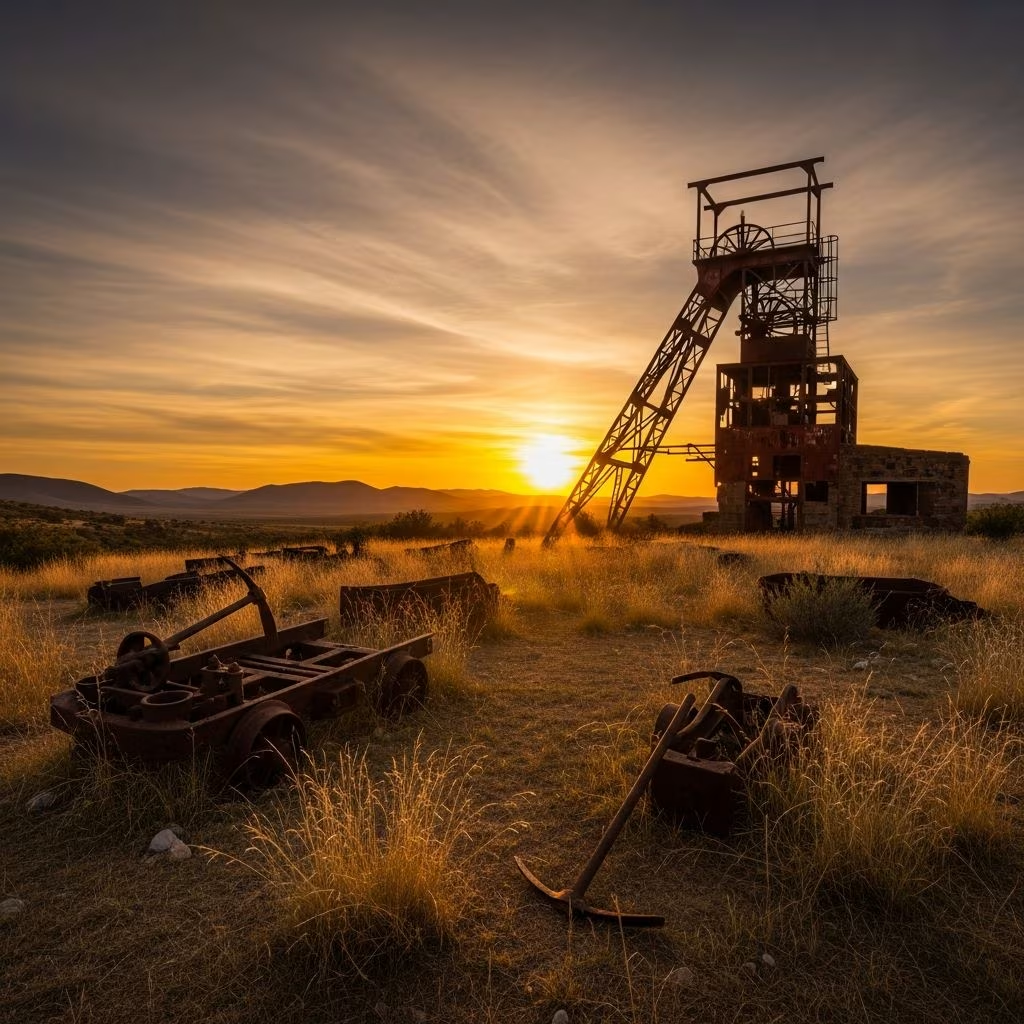
Urban challenges mounted swiftly. Slums like Brickfields and Vrededorp housed destitute Afrikaner farmers displaced by drought and debt, while affluent mining barons built opulent mansions on the Rand’s hilltops. Infrastructure strained under the boom: tent cities lacked sanitation, leading to outbreaks, yet railroads and telegraphs soon linked the Rand to global markets. By 1900, Johannesburg was Africa’s largest city, its skyline defined by headgears and poppet heads piercing the Highveld sky.
The Witwatersrand’s gold was notoriously stubborn—embedded in pyritic ore within low-grade conglomerates requiring tons of rock processed for mere ounces. Early methods like mercury amalgamation faltered against this refractory material, stalling progress in the 1880s. Salvation came in 1888-1890 with the MacArthur-Forrest cyanide process, devised by John Stewart MacArthur and the Dingus brothers. By suspending crushed ore in a dilute cyanide solution, they extracted up to 96% of the gold, revolutionizing deep-level mining.
This innovation triggered an investment frenzy. Deeper shafts plunged hundreds, then thousands, of feet—eventually over two miles, creating the world’s deepest mines. Production peaked in the 1970s at over 1,000 tonnes annually, cementing South Africa’s dominance, supplying up to 40% of global gold at its height. Yet profitability hinged on fixed gold prices and escalating costs, foreshadowing future woes.
The gold rush reshaped society profoundly. A new elite of Randlords wielded immense power, while black migrant laborers from across southern Africa formed the backbone of underground toil under harsh pass laws and compounds. White unionism flourished among immigrant miners, clashing with Afrikaner authorities. Tensions peaked as uitlanders, denied voting rights despite economic contributions, chafed under President Paul Kruger’s policies.
These frictions catalyzed the Second Boer War (1899-1902). Britain, eyeing the Rand’s wealth, backed uitlander grievances to justify invasion, leading to the Transvaal’s fall and the Union of South Africa in 1910. The rush’s legacy intertwined with apartheid’s roots, as gold revenues funded segregationist structures, and abandoned mines later scarred landscapes with toxic waste—producing 562,000 times more tailings than gold by 2013.
| Rush | Date | Peak Production | Legacy City | Global Impact |
|---|---|---|---|---|
| Witwatersrand | 1886 | 1,000+ tonnes/year | Johannesburg | S.A. world leader |
| California | 1848 | ~1,000 tonnes total | San Francisco | U.S. expansion |
| Klondike | 1896 | ~500 tonnes total | Dawson City | Canada’s Yukon |
From 1900 to the 1970s, the Rand epitomized prosperity. World Wars boosted demand, with production soaring as technology tamed ever-deeper reefs. South Africa eclipsed all rivals, its mines funding industrialization and infrastructure. Yet by the 1980s, shallower deposits waned, costs skyrocketed, and global competition from open-pit operations elsewhere eroded dominance. Reserves dwindled, fatalities dropped to historic lows by 2016 amid safety reforms, but environmental hauntings persist—acid mine drainage polluting waterways.
Modern travelers can trace the rush’s footsteps. Johannesburg’s Gold Reef City recreates 1880s mining life with underground tours of No. 14 Shaft. Nearby, the Apartheid Museum contextualizes socio-political fallout. In Krugersdorp, Harrison’s claimed Langlaagte offers interpretive sites. Pilgrim’s Rest, the 1873 precursor, preserves a living museum village with digger-era architecture. Deeper dives include Sterkfontein Caves, revealing geological origins, or Soweto tours highlighting labor heritage.
George Harrison’s 1886 find on Langlaagte Farm uncovered the Main Reef, sparking a global influx unmatched in scale.
Ferreira’s Camp evolved into a 100,000-person city by 1890, driven by mining claims and infrastructure.
Low-grade pyritic ore required cyanide leaching, a breakthrough enabling deep mining.
Yes, uitlander tensions fueled British designs, culminating in the 1899-1902 Second Boer War.
Production has declined, but legacy mines persist amid environmental challenges.
The rush industrialized South Africa, birthing a mineral-based economy that persists. Gold funded railways, ports, and cities, but left scarred earth: billions of tons of tailings pose ongoing risks, with remediation efforts lagging. Culturally, it infused Jo’burg with cosmopolitan energy, evident in its jazz scenes and diverse neighborhoods. Politically, it sowed seeds of conflict resolved only post-apartheid.
Today, as reserves dwindle, the focus shifts to sustainable tourism and heritage preservation, ensuring the gold rush’s story endures not just in history books but in living landscapes.
