

 Travel Essentials
 Travel Essentials

Explore the world's busiest national parks by visitor density, led by Gateway Arch, and top U.S. parks by total visits like Great Smoky Mountains. Insights on overcrowding and tips for visiting.
 Travel Essentials
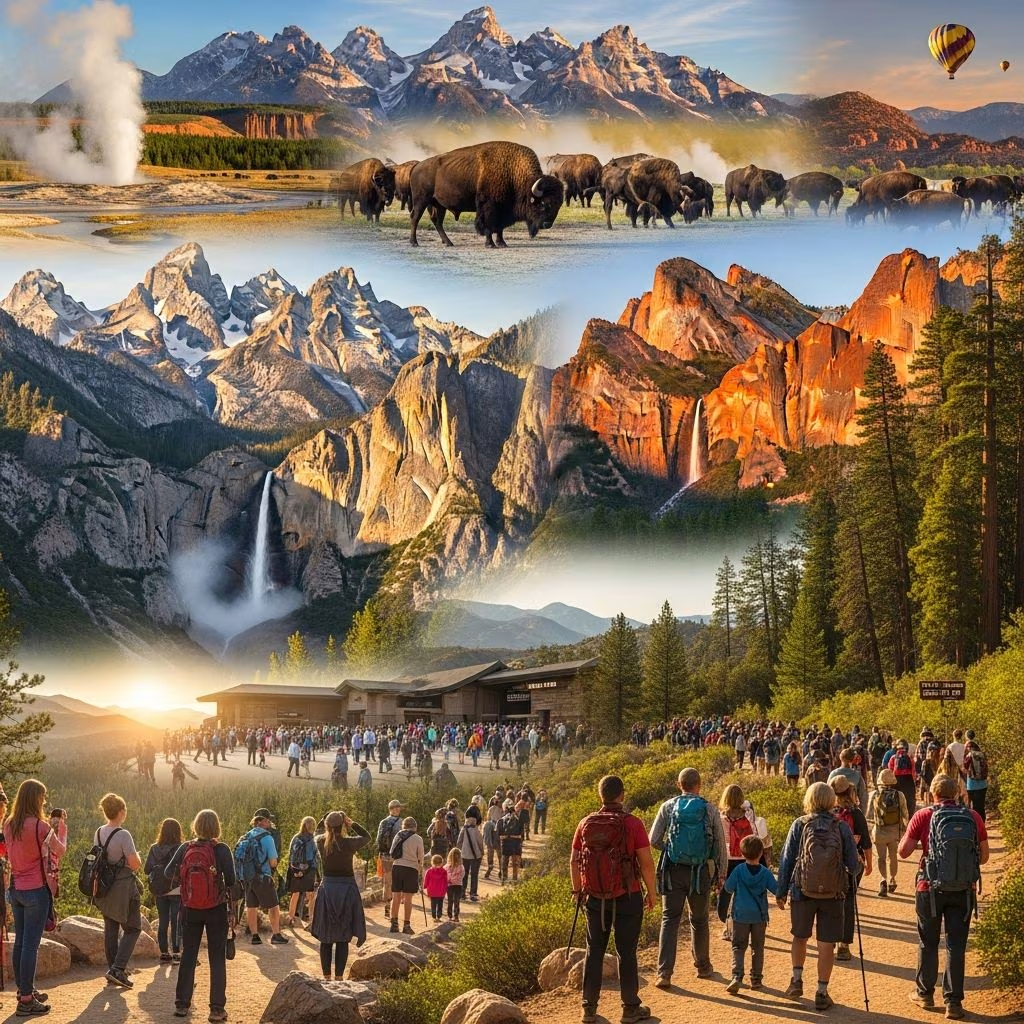
National parks attract millions seeking nature’s beauty, but overcrowding varies dramatically by size and appeal. While vast parks like Yellowstone handle high numbers comfortably, compact sites face intense pressure from tourists per square kilometer. This analysis dives into global rankings, focusing on density metrics that highlight true busyness, alongside total visitation leaders in the U.S.
Measuring a park’s busyness requires distinguishing between raw visitor counts and density—visitors divided by area. Large parks absorb crowds easily, but small ones become congested quickly. For instance, a tiny urban park can rank as the world’s busiest despite fewer overall visitors than sprawling wilderness areas.
Density reveals hidden pressures on ecosystems and visitor experiences. High-density parks often implement timed entries, shuttles, or caps to manage flows. Total visits, tracked annually by agencies like the U.S. National Park Service (NPS), show popularity but overlook spatial strain.
Gateway Arch National Park in St. Louis, Missouri, holds the title of the world’s busiest by density, with nearly 7 million visitors per square kilometer. Spanning just 0.37 square kilometers, it welcomed 2.56 million people annually, drawn to its 630-foot stainless steel monument symbolizing westward expansion.
Visitors ride tram pods to the top for panoramic views of the Mississippi River and city skyline. Its urban location boosts accessibility, unlike remote parks requiring long drives. Despite crowds, efficient queuing and exhibits on Lewis and Clark keep experiences smooth.
Following Gateway Arch, China’s Zhangjiajie National Forest Park ranks second with 124,611 visitors per square kilometer. Its towering sandstone pillars, inspiration for Avatar‘s floating mountains, span limited space, causing trails to overflow during peak seasons.
In the U.S., Hot Springs National Park in Arkansas places third at 109,000 visitors per square kilometer. Thermal springs and historic bathhouses attract wellness seekers to its compact 23 square kilometers.
| Rank | Park | Country | Visitors per sq km |
|---|---|---|---|
| 1 | Gateway Arch | USA | ~7 million |
| 2 | Zhangjiajie National Forest Park | China | 124,611 |
| 3 | Hot Springs | USA | 109,000 |
Africa’s national parks blend safaris with natural wonders, but smaller reserves lead in density. Victoria Falls National Park in Zimbabwe tops the continent at 4,883 visitors per square kilometer across 23.4 square kilometers, fueled by the massive waterfall—a UNESCO site and natural wonder.
Nairobi National Park in Kenya follows with 3,679 visitors per square kilometer. Unique for its proximity to Nairobi city, it offers urban-adjacent wildlife viewing of lions, rhinos, and giraffes.
Larger icons like South Africa’s Kruger National Park see 1.8 million visitors yearly but only 93 per square kilometer due to its 19,455 square kilometers, allowing space for both humans and animals.
| Rank (Africa) | Park | Country | Size (sq km) | Visitors per sq km |
|---|---|---|---|---|
| 1 | Victoria Falls | Zimbabwe | 23.4 | 4,883 |
| 2 | Nairobi | Kenya | 117.21 | 3,679 |
| 3 | Mosi-oa-Tunya | Zambia | 66 | 1,878 |
| 4 | Lake Nakuru | Kenya | 188 | 1,559 |
| 5 | Pilanesberg | South Africa | 572 | 535 |
While density crowns small parks, total visits spotlight U.S. giants. Great Smoky Mountains National Park led 2024 with 12,191,834 visits, straddling North Carolina and Tennessee. Free entry, misty peaks, and biodiversity—over 19,000 species—draw families and hikers.
Zion National Park followed at 4,946,592 visits, its red rock canyons and Angels Landing trail magnetizing adventurers. Grand Canyon notched 4,919,163, with rim views and river rafting.
Recent NPS data shows system-wide records: 331.9 million recreation visits in 2024 across 400+ sites.
High density strains trails, wildlife, and air quality. In compact parks, footsteps erode paths, and noise disrupts animals. Gateway Arch manages via timed tickets; Zhangjiajie uses cable cars to disperse crowds.
Visitor frustrations include long waits and diminished solitude. Parks combat this with reservations, like Yosemite’s lottery for peak hikes, and education on Leave No Trace principles.
Escape crowds at remote U.S. parks. Gates of the Arctic in Alaska saw just 11,907 visits in 2024—pure wilderness above the Arctic Circle. North Cascades (16,485 visits) offers jagged peaks sans throngs.
These low-visitation sites preserve pristine conditions, ideal for solitude seekers willing to trek farther.
With visitation rising—NPS hit records amid post-pandemic travel booms—parks innovate. Expanded shuttle fleets, AI crowd forecasting, and infrastructure upgrades aim to sustain 400 million annual visits by 2030 without degradation.
Global trends mirror this: African parks cap safari vehicles; European sites like Italy’s Cinque Terre limit daily entries. Travelers play a role by choosing responsibly.
Gateway Arch National Park in the U.S., with about 7 million visitors per square kilometer.
Great Smoky Mountains, recording 12,191,834 visits in 2024.
Smaller parks have higher density despite lower totals, leading to quicker overcrowding.
Visit off-season, use shuttles, and explore secondary trails.
Yes, including reservations, caps, and sustainable tourism initiatives by park services.
