

 Travel Essentials
 Travel Essentials

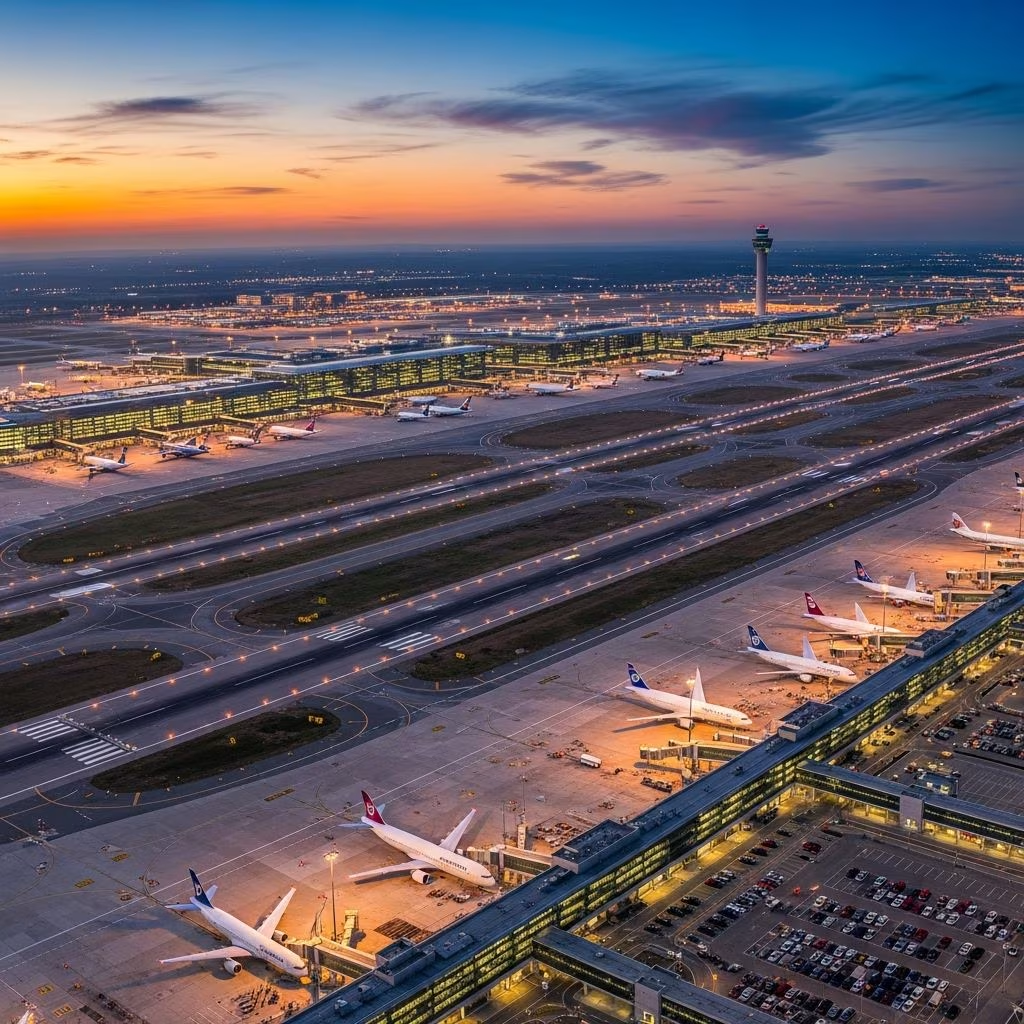
Discover the largest airports globally by land area, from Saudi Arabia's King Fahd to Denver International, and learn how size impacts aviation operations.
 Travel Essentials
The aviation industry operates across a vast network of facilities that vary dramatically in size, capacity, and scope. While many travelers focus on passenger traffic and flight frequency when evaluating airports, the physical footprint of these facilities tells an equally compelling story about infrastructure investment and operational capability. Understanding which airports occupy the largest geographic areas provides insight into how nations approach aviation development, economic expansion, and future growth projections.
Airport size serves as a fundamental indicator of long-term infrastructure vision and investment capacity. When measured by total land area rather than passenger volume or flight operations, airports reveal diverse patterns of development strategy. Some of the world’s largest airports by geographic footprint were designed decades ago with expansive master plans, while others reflect recent construction incorporating modern design principles and technological innovations.
The distinction between airport size and airport activity proves particularly instructive. A sprawling airport complex may accommodate fewer passengers annually than a compact urban facility, yet its land area reflects different operational priorities, including cargo handling, maintenance facilities, and future expansion capabilities.
King Fahd International Airport in Dammam, Saudi Arabia holds the undisputed position as the world’s largest airport by land area. Spanning 776 square kilometers (299.61 square miles or 191,754 acres), this facility dwarfs most competitors by a substantial margin. To contextualize this expanse, the airport’s total area roughly equals the combined land area of New York City’s five boroughs, providing a tangible reference point for understanding its immense scale.
Despite its enormous geographic footprint, King Fahd International accommodated approximately 12 million passengers in 2024, demonstrating that size and passenger volume do not necessarily correlate. The airport handled 99,000 flight operations during that same year. This apparent discrepancy between land area and traffic volume reflects Saudi Arabia’s strategic vision for aviation infrastructure designed to accommodate substantial future growth and expansion.
King Fahd International earned recognition in the Guinness World Records in 2013, officially documenting its status as the world’s largest airport by land area. The facility’s design incorporates extensive ground infrastructure supporting diverse aviation operations and future development initiatives.
Saudi Arabia’s second major airport, King Khalid International Airport near Riyadh, ranks as the second-largest airport globally by land area, covering 375 square kilometers (92,664.52 acres). Located 35 kilometers north of Riyadh, this facility demonstrates significant operational activity with 37.2 million passengers and 269,000 flight operations recorded in 2024. King Khalid serves as a major hub for Saudia and Flynas airlines, processing substantially more passenger traffic than King Fahd despite occupying less than half the land area.
Denver International Airport in Colorado represents North America’s largest airport by land area, covering 137.8 square kilometers (53.09 square miles or 33,531 acres). Opened in 1995, this facility has evolved into one of the world’s busiest airports, serving 82,358,744 passengers in 2024—representing a 5.8 percent increase from the previous year. The airport managed 694,900 flight operations during 2024, underscoring its role as a critical continental transportation hub.
Denver International’s extensive runway system and taxiway infrastructure accommodate high flight volumes while maintaining operational efficiency. The airport’s significant land area provides capacity for potential future expansion and infrastructure development to support anticipated growth in air travel.
Dallas/Fort Worth International Airport in Texas occupies 69.6 square kilometers (26.88 square miles) of land area, positioning it among the world’s largest airport complexes. This facility serves as a major hub for American Airlines and connects the Dallas-Fort Worth metropolitan region with domestic and international destinations. The airport’s strategic location in north-central Texas makes it a critical transportation gateway for the region’s substantial population and business community.
Orlando International Airport covers 69.6 square kilometers (20.78 square miles), matching Dallas/Fort Worth in total land area. However, MCO demonstrates substantially higher passenger activity, serving approximately 50 million travelers in 2024. Originally established as a military installation, Orlando International evolved into a major civilian airport serving the region’s tourism industry, with proximity to Disney World and Universal Studios driving significant passenger demand. The airport handled 400,090 flight operations during 2024, reflecting its role as a major domestic and international aviation gateway.
Washington Dulles International Airport serves the nation’s capital region with approximately 52.6 square kilometers of land area (12,997.28 acres). The facility accommodated roughly 24 million passengers in 2024 while managing 250,000 flight operations. Dulles’s extensive space supports long-haul international flights, diplomatic travel, and cargo operations. The airport’s iconic terminal, designed by renowned architect Eero Saarinen, represents a landmark of mid-twentieth-century transportation design and continues to define the airport’s visual identity.
Beijing Daxing International Airport in China spans 47 square kilometers (18 square miles or 11,614 acres) and represents contemporary airport design philosophy. Known as the “Starfish” due to its distinctive architectural form, Beijing Daxing features the world’s largest single-terminal building, encompassing 700,000 square meters of interior space. The facility processed 45 million passengers in 2024 and managed 262,100 flight operations. As an emerging key Asian aviation hub, Beijing Daxing projects passenger volumes approaching 70 million for 2025, demonstrating rapid expansion in traffic and market importance.
Shanghai Pudong International Airport covers 40 square kilometers (15.4 square miles) and handles major international and domestic aviation traffic, serving China’s primary economic center and establishing itself as a critical link in Asia’s aviation network.
Suvarnabhumi International Airport in Bangkok, Thailand occupies 32.4 square kilometers (12.51 square miles) and serves as a major Southeast Asian aviation hub, connecting regional and international destinations. Kuala Lumpur International Airport in Malaysia covers 100 square kilometers, positioning it as the third-largest airport globally by land area and serving as a critical hub for Southeast Asian aviation connectivity.
Beyond the primary global leaders, several other major airports contribute significantly to international aviation infrastructure. George Bush Intercontinental Airport in Houston covers 44.5 square kilometers (17.19 square miles) and serves as a major U.S. hub. Cairo International Airport encompasses 36.3 square kilometers (14 square miles) and provides critical connectivity across Africa and the Middle East. Istanbul Airport in Turkey spans 76.5 square kilometers, establishing itself as a major European and Asian aviation gateway.
European facilities including Paris Charles de Gaulle Airport (32.38 square kilometers) and Madrid-Barajas Airport (30.50 square kilometers) represent established transportation infrastructure serving major metropolitan regions. Dubai International Airport covers 29 square kilometers and reflects the United Arab Emirates’ strategic investment in aviation connectivity.
Airport land area represents only one dimension of aviation facility evaluation. The relationship between geographic footprint and operational metrics varies substantially across global facilities. Some airports with enormous land areas accommodate modest passenger volumes and flight operations, while compact urban airports manage extraordinary traffic levels through efficient terminal design and operational procedures.
Land area availability influences several operational factors: runway quantity and orientation, taxiway configuration, cargo facility placement, maintenance hangar capacity, and future expansion potential. Airports designed with expansive master plans anticipate decades of growth and development, while urban facilities optimize existing constrained space through technological advancement and operational innovation.
The largest airports worldwide continue investing in infrastructure improvements, terminal renovations, and capacity enhancements. These facilities serve as critical economic assets for their regions, driving employment, facilitating commerce, and supporting tourism development. As global air travel demand continues evolving, these major airport complexes will play increasingly important roles in international connectivity and regional economic growth.
King Fahd International Airport in Dammam, Saudi Arabia is the world’s largest airport by land area, covering 776 square kilometers.
Land area influences runway capacity, taxiway configuration, terminal expansion possibilities, cargo handling facilities, and long-term operational capabilities. Larger airports can accommodate future growth without major relocation or renovation constraints.
No. Airport size and passenger volume do not correlate directly. Compact urban airports often handle more passengers than sprawling regional facilities through efficient terminal design and operational procedures.
Denver International Airport in Colorado is the largest airport in the United States by land area, covering 137.8 square kilometers.
Relatively few airports exceed 100 square kilometers globally. Primary examples include King Fahd International, King Khalid International, Denver International, and Kuala Lumpur International.
