

 Travel Essentials
 Travel Essentials

Explore the top airports crowned as the world's most beautiful by Prix Versailles in 2025, featuring cutting-edge designs, natural integrations, and passenger-focused innovations from San Francisco to Yantai.
 Travel Essentials
Airports have evolved far beyond mere transit points. In 2025, the prestigious Prix Versailles awards, held in partnership with UNESCO, spotlighted terminals that fuse breathtaking architecture with practical innovation, earning them the title of the world’s most beautiful airports. These laureates demonstrate how design can elevate the travel experience, turning layovers into moments of awe.
Prix Versailles stands as a global benchmark for excellence in architecture and interior design, emphasizing beauty that inspires progress and inclusion. For 2025, their World’s Most Beautiful Airports list recognizes terminals that harmonize form, function, and cultural resonance. Unlike traditional awards, this honor celebrates spaces that enhance passenger well-being through light, space, and sustainability.
Administered under UNESCO’s auspices, the awards draw from thousands of submissions, judged by international panels of architects and designers. Winners exemplify how airports can reflect local heritage while embracing futuristic elements, influencing global standards in aviation infrastructure.
The 2025 roster features standout terminals from diverse regions, each pushing boundaries in aesthetic and utility. Here’s a closer look at the key winners:
These selections highlight a shift toward biophilic design—incorporating nature to reduce travel stress—and sustainable materials that lower environmental impact.
At the forefront is SFO’s Harvey Milk Terminal 1, named after the trailblazing LGBTQ+ rights advocate. Opened in phases through 2025, it spans 1.5 million square feet with vaulted ceilings mimicking California’s rolling hills. Massive skylights flood the space with daylight, reducing reliance on artificial lighting by 40% while creating a serene atmosphere.
Key features include:
SFO officials noted the terminal’s design prioritizes passenger flow, cutting congestion by 25% during peak hours. It’s not just beautiful—it’s engineered for efficiency, with energy-efficient systems earning LEED Platinum certification.
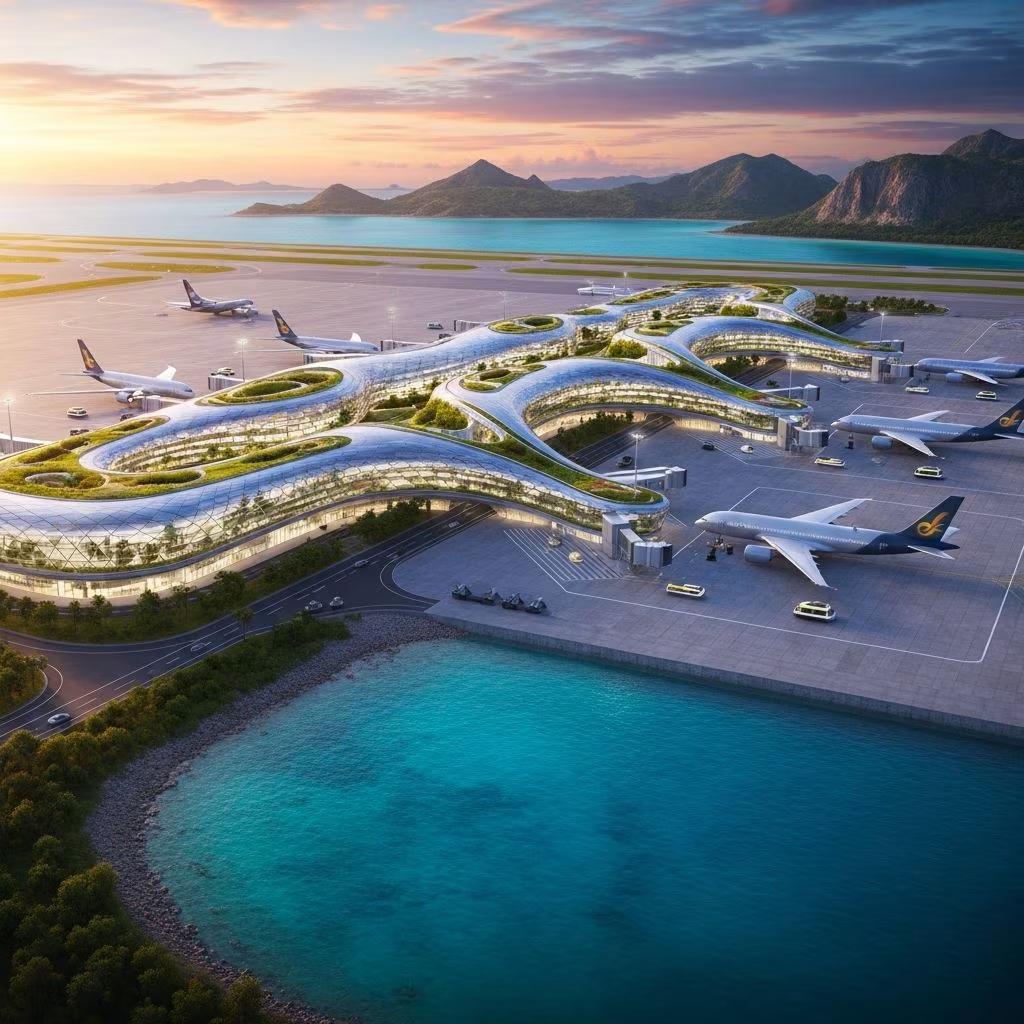
In China’s Shandong Province, Yantai Penglai International Airport’s Terminal 2 emerges as a poetic tribute to its coastal roots. The structure’s flowing lines resemble surging waves, achieved through advanced parametric design software. Spanning over 500,000 square meters, it handles 20 million passengers annually with grace.
Highlights encompass:
This terminal exemplifies Asia’s rise in aviation design, blending high-tech fabrication with traditional aesthetics to foster a sense of journey’s wonder.
Comparing standout elements reveals common threads:
| Airport | Signature Feature | Sustainability Metric | Passenger Capacity |
|---|---|---|---|
| SFO Harvey Milk T1 | Vaulted skylight ceilings | LEED Platinum | 25M/year |
| Yantai Penglai T2 | Wave-inspired facade | Net-zero energy | 20M/year |
| Marseille Provence | Provencal light wells | 50% energy savings | 10M/year |
This table underscores how beauty aligns with eco-responsibility, a core Prix Versailles criterion.
France’s Marseille Provence Airport channels the region’s azure skies and lavender fields into its expanded terminal. Light shafts mimic sunlight filtering through olive groves, paired with stone accents evoking ancient ports. The design accommodates 10 million travelers with intuitive layouts and wellness zones featuring mist gardens.
Innovations include biometric gates and modular furniture for flexibility during surges. By prioritizing natural ventilation, it slashes HVAC energy use by half, setting a model for European hubs.
Beyond individual winners, the 2025 list signals broader shifts:
These trends respond to post-pandemic demands for healthier, more engaging transit spaces. Airports now rival museums, with dwell times increasing 15-20% as travelers linger.
Stunning architecture yields tangible benefits. Studies show aesthetically pleasing environments lower cortisol levels by 11%, easing travel anxiety. Economically, award-winning terminals boost regional tourism; SFO reported a 7% visitor uptick post-renovation.
Moreover, sustainability is non-negotiable. Winners average 30% lower carbon footprints through smart materials like recycled glass and low-emission concretes. This holistic approach ensures beauty endures.
Looking to 2026, Prix Versailles hints at expanded categories, potentially including urban mobility hubs. Emerging projects in Doha and Singapore promise holographic displays and vertical forests. As air travel rebounds to 4.7 billion passengers yearly, these designs will define gateways to the world.
A UNESCO-partnered award honoring top global architecture and design since 2015, with airport-specific accolades since 2025.
SFO’s Harvey Milk Terminal 1 headlined, alongside Yantai Penglai T2 and Marseille Provence.
Beautiful terminals reduce stress, improve navigation, and promote sustainability.
Yes, most offer public art walks and observation decks outside flight hours.
As of 2025 announcements, nominations are open; check prix-versailles.com for updates.
