

 Travel Essentials
 Travel Essentials

A comprehensive guide to the world's smallest inhabited and uninhabited islands, featuring unique ecosystems, cultural experiences, and adventure opportunities.
 Travel Essentials
The allure of island travel traditionally conjures images of sprawling tropical paradises with endless beaches and resort amenities. However, some of the most captivating destinations on our planet exist as diminutive specks of land barely visible on standard maps. These miniature islands offer travelers an entirely different perspective on exploration, combining intimate natural environments with the novelty of visiting places where human development exists in delicate balance with pristine wilderness. From the remote Atlantic archipelagos to densely populated Asian waters, the world’s smallest islands reveal how even the tiniest patches of earth can sustain remarkable ecosystems and compelling human stories.
When discussing the world’s smallest islands, precision in measurement becomes essential. Islands are typically classified by their surface area, measured in square kilometers or hectares. The distinction between inhabited and uninhabited islands further complicates rankings, as does the definition of what constitutes a “building” or “settlement” on such diminutive landmasses. International organizations like Guinness World Records have established specific criteria for recognizing records related to island size and inhabitancy, though these designations sometimes shift as automated systems replace human residents or natural erosion alters geographical boundaries.
Understanding these classifications helps contextualize why certain islands achieve prominence in global discourse about extreme geography. An island measuring less than one hectare occupies a footprint equivalent to roughly two American football fields, yet some of these tiny parcels support permanent human habitation alongside thriving wildlife populations.
The Atlantic Ocean hosts several remarkably small inhabited islands that have captured international attention for their unique characteristics and historical significance. These European islands demonstrate how human determination can create sustainable settlements in seemingly impossible locations.
Rising dramatically from the turbulent Atlantic waters approximately 6.4 kilometers west of the Isles of Scilly, Bishop Rock stands as one of Britain’s most recognizable maritime landmarks. Measuring just 0.0011844 square kilometers, this jagged rocky outcrop seems an unlikely candidate for human habitation. However, its strategic location necessitated construction of an iron lighthouse beginning in 1858, which operated continuously with a full-time keeper for over a century. The lighthouse became automated in 1992, marking the departure of the last resident lighthouse keeper and technically ending the island’s status as a permanently inhabited location.
Despite losing its permanent residents, Bishop Rock retains distinction as the “smallest island with a building on it” according to Guinness World Records. The lighthouse structure, still standing after more than 150 years of exposure to Atlantic storms, represents human engineering at its most determined. Modern technology allows remote monitoring and maintenance personnel to service the lighthouse during brief visits, preserving this maritime sentinel without requiring permanent residence.
Situated approximately 1,609 kilometers west of mainland Portugal in the mid-Atlantic, the Azores archipelago comprises nine volcanic islands that have attracted increasing traveler interest in recent years. Among these islands, Corvo Island stands out for its diminutive size and remarkable preserved character. Measuring 11.2 square kilometers with a population of approximately 400 residents, Corvo offers an authentic island experience largely unmodified by mass tourism.
The island’s economy traditionally centered on fishing and agriculture, activities still visible in its landscape. Three restaurants and five accommodation establishments serve the modest influx of visitors seeking genuine cultural immersion rather than resort experiences. Corvo’s volcanic terrain, shaped by geological forces millions of years ago, creates a landscape of crater hiking opportunities, freshwater lakes suitable for swimming, and vantage points for observing migratory bird populations. The island’s remoteness, while challenging for logistics and services, has paradoxically preserved its ecological integrity and cultural authenticity.
Some of the world’s smallest islands exist in extreme environmental conditions that limit human presence to research stations or brief visits. These locations nonetheless support specialized wildlife populations uniquely adapted to harsh conditions.
Designated as a National Nature Reserve in 2017, Sea Lion Island in the Falkland Islands covers merely 5.6 square kilometers yet functions as a critical habitat for multiple animal species. This tiny landmass hosts five species of penguins alongside populations of sea lions, elephant seals, giant petrels, and killer whales. The island’s ecosystem, compressed into a space smaller than many suburban neighborhoods, demonstrates the remarkable biodiversity that can flourish in remote polar regions.
The handful of permanent residents on Sea Lion Island typically work in conservation, research, or tourism-related activities. Visitors accessing the island experience a landscape where human presence remains subordinate to wildlife observation and ecological preservation. The island’s designation as a protected area reflects recognition that even diminutive patches of earth can possess extraordinary ecological significance warranting careful stewardship.
The Caribbean and North American coasts feature several small islands combining tropical charm with accessibility, making them more developed for tourism than their polar counterparts.
Between New York and Ontario in the St. Lawrence River lies Just Enough Room Island, a curiosity measuring merely 1,005 square meters. At this diminutive size, the island possesses sufficient space for a cottage, a single tree, some shrubs, and a small beach, justifying its evocative name. Technically classified as the “smallest inhabited island” by certain measurements, this property has remained privately owned and occupied by generations of the same family, who have maintained their residence despite the island’s extreme limitations and the challenges of isolation during winter months when river ice complicates boat access.
The island’s existence captures public imagination precisely because it challenges assumptions about what constitutes viable human habitation. Despite covering less surface area than a tennis court, Just Enough Room Island has supported permanent residence for decades, demonstrating human adaptability to extreme constraints.
Isla Mujeres, meaning “Island of Women” in Spanish, represents a vastly different model of small island tourism in the Caribbean. Though larger than many featured here, Isla Mujeres remains compact and accessible, offering sandy beaches, casual seafood restaurants, artisan shops, and excellent snorkeling opportunities. The island’s turtle sanctuary provides educational value alongside recreational activities, appealing to environmentally conscious travelers. Unlike some islands dependent on limited accommodation, Isla Mujeres maintains sufficient infrastructure to welcome day-trippers and longer-term visitors without sacrificing its relaxed island character.
Little St. Simons Island, a private 4,500-hectare barrier island off Georgia’s coast, represents American island tourism at its most exclusive and environmentally conscious. Featuring eleven kilometers of pristine beaches, diverse wildlife populations, and giant cedar trees, the island accommodates guests through a single lodge offering six cottages. Access occurs exclusively through organized transport, and visitor numbers remain deliberately limited to preserve ecological integrity. Naturalist-led activities including bird watching and guided nature walks connect visitors with the island’s ecosystem while maintaining minimum human impact.
The Asia-Pacific region contains numerous small islands reflecting volcanic origins and river dynamics rather than coral formation or glacial processes characteristic of Atlantic and North American examples.
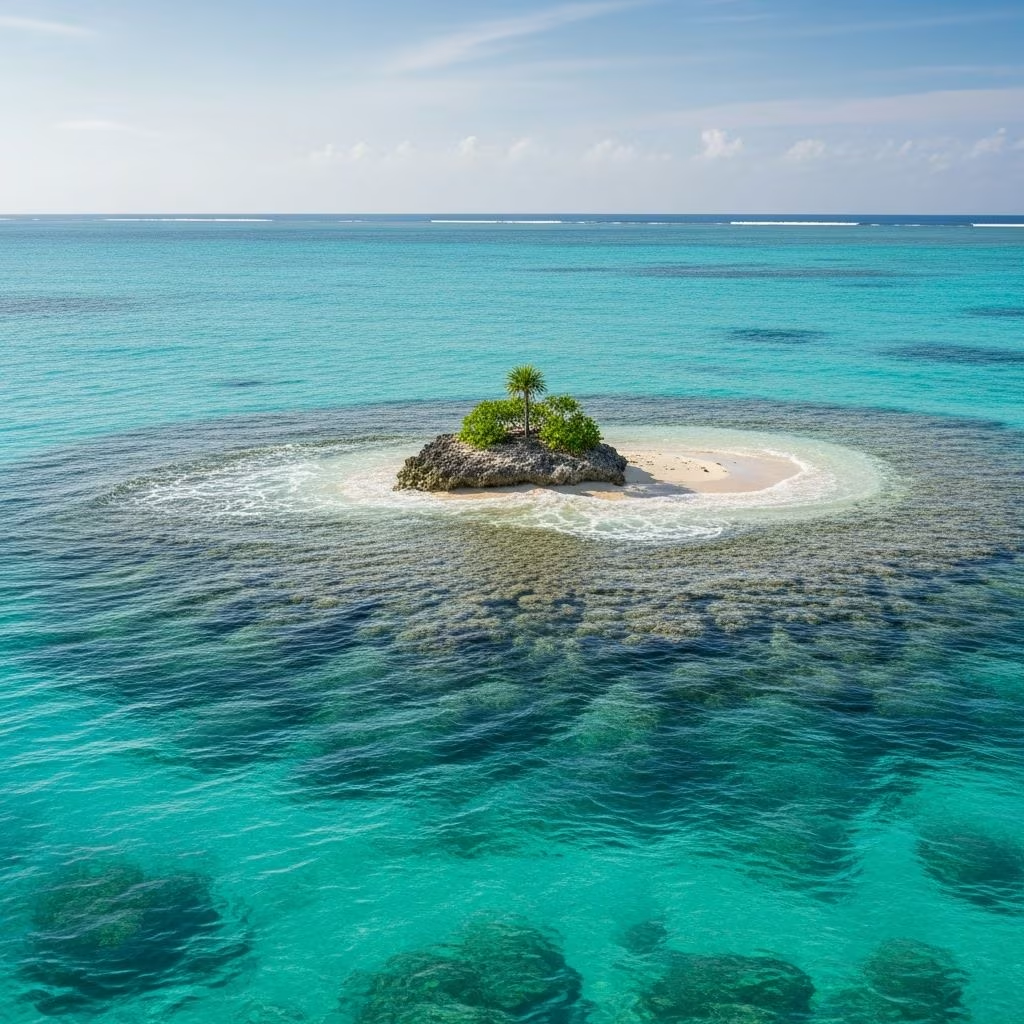
Indonesia’s staggering collection of 17,508 volcanic islands ranges from substantial landmasses to barely-visible specks. Simping Island, formerly called Pulau Kelapa Dua, located in West Kalimantan province, represents the absolute minimum—measuring merely 0.5 hectares. At first glance appearing as little more than a mound of sand, stone, and vegetation bobbing in calm waters, Simping Island nonetheless constitutes sovereign territory and represents the extreme lower boundary of recognizable island geography.
Dangar Island, situated north of Sydney in the Hawkesbury River, encompasses 29 hectares and supports approximately 250 residents in a deliberately car-free community. The island’s almost entirely forested landscape, waterfront houses, beaches featuring aboriginal rock carvings, and laid-back atmosphere attract residents seeking escape from metropolitan life while maintaining urban proximity. The absence of automobile traffic distinguishes Dangar Island from most developed areas, creating an environment where pedestrian movement and boat transport constitute primary mobility options.
| Island Name | Location | Size (sq km or hectares) | Population | Primary Characteristics |
|---|---|---|---|---|
| Bishop Rock | Isles of Scilly, Britain | 0.0011844 sq km | 0 (automated) | Historic lighthouse, smallest with building |
| Just Enough Room | St. Lawrence River | 0.001005 sq km | 1 family | Smallest inhabited island, private residence |
| Simping Island | West Kalimantan, Indonesia | 0.005 sq km | Minimal | Volcanic origin, minimal development |
| Sea Lion Island | Falkland Islands | 5.6 sq km | Handful | Nature reserve, five penguin species |
| Corvo Island | Azores, Portugal | 11.2 sq km | 400 | Volcanic landscape, adventure activities |
| Little St. Simons | Georgia, USA | 45 sq km | Staff only | Private barrier island, exclusive access |
Existing on islands measuring mere hectares or square kilometers presents peculiar challenges distinguishing small island life from mainland existence. Accessing supplies, healthcare, and emergency services requires reliable transportation across water barriers subject to weather disruptions. Fresh water acquisition, waste management, and energy generation pose heightened complexity compared to larger communities with established infrastructure. Climate change impacts, including rising sea levels and increased storm intensity, disproportionately threaten diminutive islands lacking elevation or land mass sufficient to absorb environmental stress.
Conversely, small islands present opportunities for sustainability experimentation, community cohesion, and environmental stewardship. Limited land area inherently constrains development, naturally preserving ecological character. Close-knit populations develop intricate interdependencies fostering social resilience. Islands designated as nature reserves or protected areas can serve as laboratories for conservation science, generating knowledge applicable to larger ecosystem management.
No universal agreement exists regarding smallest island designation. Bishop Rock holds the record for smallest island with a building, while Just Enough Room Island represents the smallest permanently inhabited island by area. Simping Island constitutes the smallest in Indonesia’s vast archipelago. Rankings depend on specific criteria including permanent habitation, building presence, and recognized sovereignty.
Yes, though with significant limitations. Just Enough Room Island has supported permanent residence despite covering barely one-thousandth of a square kilometer. Most such residents possess strong motivations including family heritage, privacy preference, or professional requirements like lighthouse keeping. Modern utilities and transportation mitigate challenges compared to historical island living.
Safety varies dramatically by location. Developed tourism islands like Isla Mujeres operate with standard safety infrastructure. Remote nature reserves and protected islands present natural hazards including wildlife encounters and isolated emergency response. Private islands may maintain strict safety protocols. Travelers should research specific island conditions and obtain appropriate travel insurance.
Diminutive islands can support remarkable biodiversity despite limited area. Sea Lion Island’s 5.6 square kilometers host five penguin species, sea lions, elephant seals, and large seabirds. Specialized ecosystems develop where predation pressure remains low and food sources abundant. Island biogeography demonstrates that size doesn’t determine ecological significance.
Resource management on small islands demands sophisticated approaches. Most rely on boat transportation for supplies, limiting waste generation incentives. Some islands implement strict recycling, composting, and conservation protocols. Renewable energy installations including solar and wind power suit isolated locations. Water collection through rain capture and desalination supplemented by limited groundwater resources.
The world’s smallest islands paradoxically possess disproportionate appeal despite limited physical space. They challenge contemporary assumptions about habitability, prove human adaptability to extreme constraints, and demonstrate that ecological significance transcends geographical size. Whether functioning as lighthouse sentinels, penguin sanctuaries, or private retreats, these diminutive landmasses capture human imagination and inspire reflection on our relationship with natural environments.
Visiting small islands offers travelers distinctive experiences unavailable on larger destinations. The combination of ecological authenticity, intimate human communities, and natural wonder creates memorable encounters that fundamentally alter perspective on travel, sustainability, and human possibility. As interest in experiential tourism continues expanding beyond conventional resort models, these tiny islands increasingly attract adventurers, conservationists, and seekers of genuine connection with both natural and human communities.
