

 Travel Essentials
 Travel Essentials

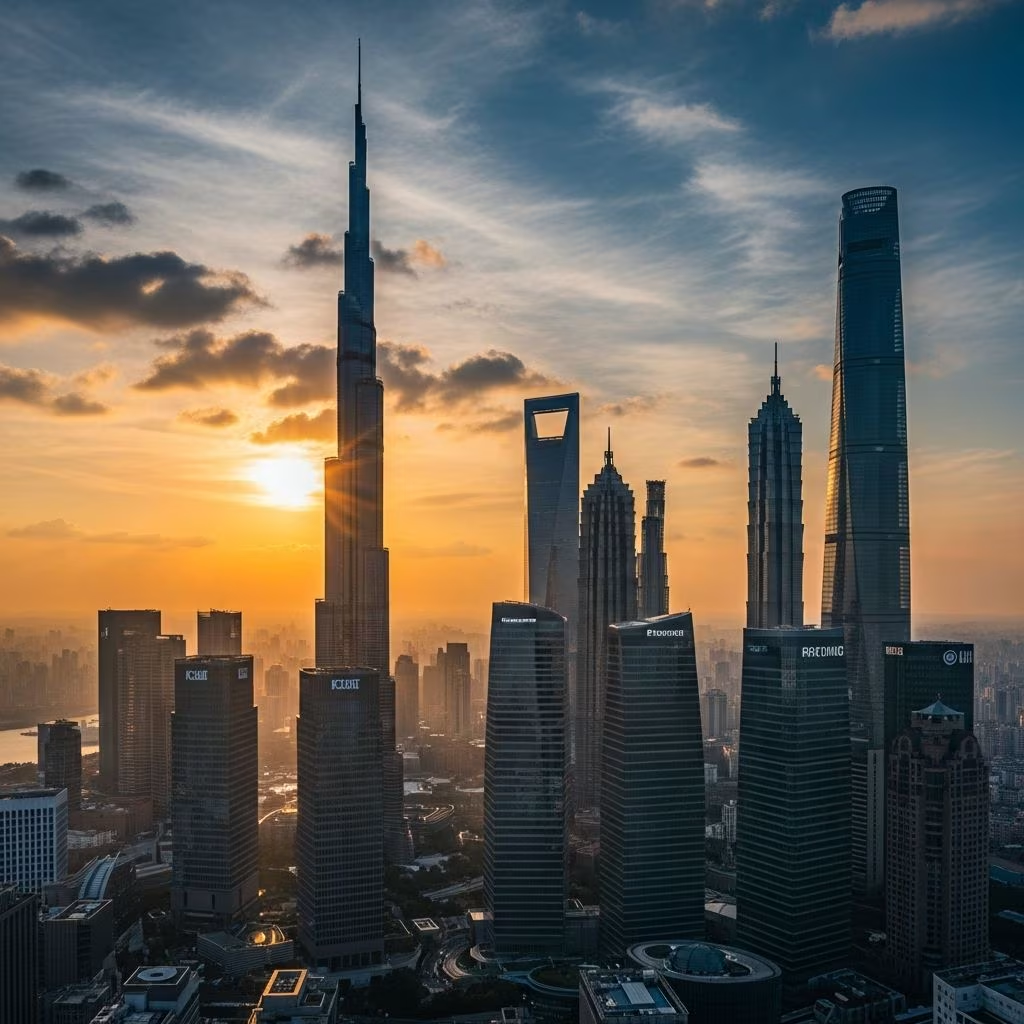
Discover the planet's tallest buildings, from Dubai's iconic Burj Khalifa to emerging Asian towers, showcasing modern engineering and design innovation.
 Travel Essentials
The race to construct the world’s tallest buildings represents humanity’s drive to push architectural boundaries and create iconic landmarks that define modern cities. These towering structures serve not only as symbols of progress and prosperity but also as functional spaces housing offices, residences, hotels, and retail establishments. Over the past few decades, the landscape of record-holding skyscrapers has shifted dramatically, with Asian and Middle Eastern cities increasingly dominating the rankings of the world’s highest buildings.
Vertical construction has undergone significant transformation since the early days of skyscraper development. Modern engineering techniques, advanced materials, and innovative architectural designs have enabled cities around the globe to construct buildings that reach unprecedented heights. These structures incorporate cutting-edge technology to manage wind resistance, seismic activity, and structural stress, allowing them to safely accommodate thousands of occupants while maintaining aesthetic appeal.
The transition from predominantly Western-dominated skylines to a more globally distributed collection of record-breakers reflects broader economic shifts. As emerging markets in Asia and the Middle East experience rapid urbanization and economic growth, these regions have invested heavily in ambitious architectural projects that showcase their development and attract international attention.
The current landscape of tallest buildings reveals fascinating patterns in global architecture and urban development. Here are the leading structures currently holding records:
| Rank | Building Name | Location | Height (Meters) | Height (Feet) | Year Completed | Primary Use |
|---|---|---|---|---|---|---|
| 1 | Burj Khalifa | Dubai, UAE | 828 | 2,717 | 2010 | Mixed-Use |
| 2 | Merdeka 118 | Kuala Lumpur, Malaysia | 679 | 2,227 | 2023 | Mixed-Use |
| 3 | Shanghai Tower | Shanghai, China | 632 | 2,073 | 2015 | Mixed-Use |
| 4 | Makkah Royal Clock Tower | Mecca, Saudi Arabia | 601 | 1,972 | 2012 | Hotel/Retail |
| 5 | Ping An Finance Center | Shenzhen, China | 599 | 1,965 | 2017 | Finance/Office |
The Burj Khalifa in Dubai has maintained its position as the world’s tallest building since its completion in 2010, standing at an impressive 828 meters (2,717 feet). This architectural marvel required approximately six years of construction and cost nearly one billion euros. The project demanded extraordinary quantities of materials, including 330,000 cubic meters of concrete, substantial steel reinforcement, and expansive glass surfaces that create its distinctive appearance.
The Burj Khalifa’s design incorporates advanced engineering solutions to manage the extreme heights and environmental challenges of Dubai’s desert climate. Its mixed-use designation includes office spaces, residences, and a luxury hotel, making it a multifunctional landmark that generates economic activity while serving as a tourist attraction. The building’s observation decks have become one of the world’s most visited paid attractions, contributing significantly to Dubai’s tourism revenue.
Asia has emerged as the epicenter of skyscraper construction, with multiple cities vying for prominence in the global architectural rankings. China alone hosts 48 of the world’s tallest buildings, distributed across numerous cities including Shanghai, Shenzhen, Beijing, and Guangzhou.
Shanghai Tower, completed in 2015, represents one of China’s most sophisticated architectural achievements. Standing at 632 meters (2,073 feet), it features 128 occupied floors and incorporates advanced sustainability features, making it one of the most environmentally conscious supertall structures in the world. The tower’s twisted design reduces wind load while providing unique architectural appeal.
Merdeka 118 in Kuala Lumpur, Malaysia, recently completed in 2023, now ranks as the second-tallest building globally at 679 meters (2,227 feet). This relatively recent addition to the rankings demonstrates that the competition for height records remains active, with new projects continuing to challenge existing standards.
Other notable Asian structures include:
The Middle East, particularly Saudi Arabia and the United Arab Emirates, has invested substantially in supertall structures that combine commercial and religious significance. The Makkah Royal Clock Tower in Mecca stands 601 meters (1,972 feet) and serves as a defining landmark for one of Islam’s holiest cities. This structure integrates traditional Islamic architectural elements with modern engineering, featuring a massive clock face visible from considerable distances and serving pilgrims visiting the region.
Dubai continues to expand its portfolio of record-holding structures, with the Burj Khalifa remaining its flagship achievement while numerous other buildings populate the global rankings. The city’s strategic positioning as a business hub and tourism destination has driven continuous investment in architectural excellence.
While Asia dominates current rankings, North America maintains significant representation through several prominent structures. One World Trade Center in New York, completed in 2014, stands at 541 meters (1,776 feet) and represents American resilience and architectural innovation following the September 11 attacks. The building serves as a symbol of renewal and economic vitality in Lower Manhattan.
Central Park Tower, also in New York City and completed in 2020, reaches 472 meters (1,550 feet) and has become the world’s tallest residential building, commanding premium prices for its exclusive apartments.
Chicago’s Willis Tower, completed in 1974, once held the world’s tallest building record at 442 meters (1,451 feet). Though now ranked 25th globally, it remains an architectural icon and demonstrates how the competitive landscape has evolved over the past five decades.
The distribution of the world’s tallest buildings reveals clear regional patterns in economic development and urban investment:
This concentration reflects both economic capacity and the appeal of supertall structures as symbols of national achievement and international competitiveness. Cities that successfully brand themselves through iconic architecture attract international investment, tourism revenue, and professional talent.
Modern supertall buildings employ diverse construction methodologies and material combinations tailored to specific environmental conditions and performance requirements:
These technical innovations enable architects and engineers to overcome physical challenges inherent to extreme heights, including wind pressure, temperature fluctuations, and structural stress distribution.
Contemporary supertall buildings increasingly incorporate mixed-use programming rather than serving single functions. Office spaces, residential units, hospitality facilities, and retail establishments coexist within single structures, creating dynamic environments that generate economic activity throughout the day and evening hours.
This approach maximizes land utilization in expensive urban cores while creating vibrant communities within buildings themselves. Residents can access employment, dining, shopping, and entertainment without leaving their structure, reducing commuting time and environmental impact.
The trajectory of global skyscraper development suggests continued growth in Asian cities, particularly as emerging markets expand their financial sectors and urban infrastructure. Several projects currently under development promise to challenge existing height records, with proposed structures in various stages of planning and construction across Asia, the Middle East, and potentially Africa.
Sustainability and environmental performance have become increasingly important considerations in contemporary supertall design. Future buildings will likely incorporate greater emphasis on renewable energy integration, water conservation systems, and materials sourcing that minimizes environmental impact while maintaining structural integrity and aesthetic appeal.
The Burj Khalifa in Dubai, United Arab Emirates, stands as the world’s tallest building at 828 meters (2,717 feet), a record it has maintained since 2010.
Numerous countries contribute to the global rankings of tallest buildings, with China, the United Arab Emirates, and the United States leading in terms of number of structures represented in the top rankings.
Most contemporary supertall buildings serve mixed-use purposes, incorporating office spaces, residential units, hotels, and retail establishments. This multifunctional approach maximizes economic returns and urban density.
Advanced damping systems, aerodynamic shapes, and sophisticated structural engineering techniques work together to manage wind-induced movement. Many buildings incorporate tuned mass dampers that counteract wind forces automatically.
Shenzhen, China, hosts numerous supertall structures reflecting its rapid economic development and role as a major financial center. Shanghai also commands significant representation among the world’s tallest buildings.
