

 Travel Essentials
 Travel Essentials

Explore the story of the Wright Brothers' groundbreaking 1903 flight at Kitty Hawk, North Carolina, their innovative experiments, and the lasting legacy at this historic site now preserved as a national park.
 Travel Essentials
The dawn of powered flight marked a pivotal moment in human history, forever altering how we traverse the skies. On December 17, 1903, brothers Wilbur and Orville Wright achieved the impossible on the remote dunes of Kitty Hawk, North Carolina, launching the world into the age of aviation. This feat, born from years of relentless experimentation, not only defied gravity but also sparked global innovation. Today, visitors flock to this site to witness where dreams took wing.
Wilbur (1867-1912) and Orville (1871-1948) Wright hailed from Dayton, Ohio, where they ran a successful printing business and later a bicycle shop. Lacking formal engineering education, their self-taught genius shone through mechanical tinkering. Inspired by Otto Lilienthal’s glider flights and the emerging bicycle craze—which taught balance and control—the brothers turned their gaze skyward in 1896.
Their bicycle expertise proved crucial. Bikes demanded rider control through subtle weight shifts, a principle they applied to aircraft stability. By 1899, Wilbur penned letters to the Smithsonian Institution, diving deep into aeronautical literature and corresponding with pioneers like Octave Chanute. This groundwork fueled their conviction that powered, controlled flight was within reach.
Why North Carolina’s Outer Banks? The Wrights sought steady winds, soft sands for safe landings, and isolation from prying eyes. Consulting U.S. Weather Bureau data, they pinpointed Kitty Hawk—12 miles south of the village, near Kill Devil Hills. Winds averaged 15-20 mph, ideal for lift, while dunes cushioned crashes.
In 1900, they arrived by train to Elizabeth City, then boat to Kitty Hawk. Local resident William Tate hosted them in a sparse camp atop Big Kill Devil Hill. Harsh conditions—sand, mosquitoes, no trees—tested their resolve, but the site’s attributes outweighed hardships.
The Wrights’ path to powered flight hinged on gliders. Their 1900 model, a 17-foot biplane with forward elevator, disappointed with insufficient lift. Flying it as a kite, they gathered data, challenging existing aerodynamic tables.
1901 brought a larger glider: 22-foot span, 290 sq ft wings. Tested at Kill Devil Hills, it too underperformed, prompting the brothers to build their own wind tunnel. This device revolutionized wing design, optimizing camber and aspect ratio.
| Glider Year | Wingspan | Wing Area | Key Innovations | Glides Recorded |
|---|---|---|---|---|
| 1900 | 17 ft | 165 sq ft | Forward elevator, wing warping | Dozens (kite mostly) |
| 1901 | 22 ft | 290 sq ft | Increased camber | Hundreds |
| 1902 | 32 ft | 305 sq ft | Movable rudder, hip cradle controls | Over 1,000 |
The 1902 glider was their masterpiece: 32-foot wings, dual rudders solving adverse yaw. Over 1,000 glides from Big Kill Devil Hill honed piloting skills. Wilbur logged flights up to 622 feet in 26 seconds, mastering pitch, roll, and yaw—the three axes of control.
These innovations made their machine steerable, unlike rivals’ unstable designs.
Back in Dayton, the brothers crafted a 12-hp aluminum engine—lightweight, no gearbox. Propellers, carved from tests showing 75% efficiency, were bicycle chains-driven. The 1903 Flyer: 40-foot wings, 21-foot forward elevator, total weight 605 lbs fueled.
They returned to Kitty Hawk in September 1903, erecting a shed for the Flyer. Ground tests revealed propeller issues, fixed by November. A 60-foot monorail track with dolly launched it into wind.
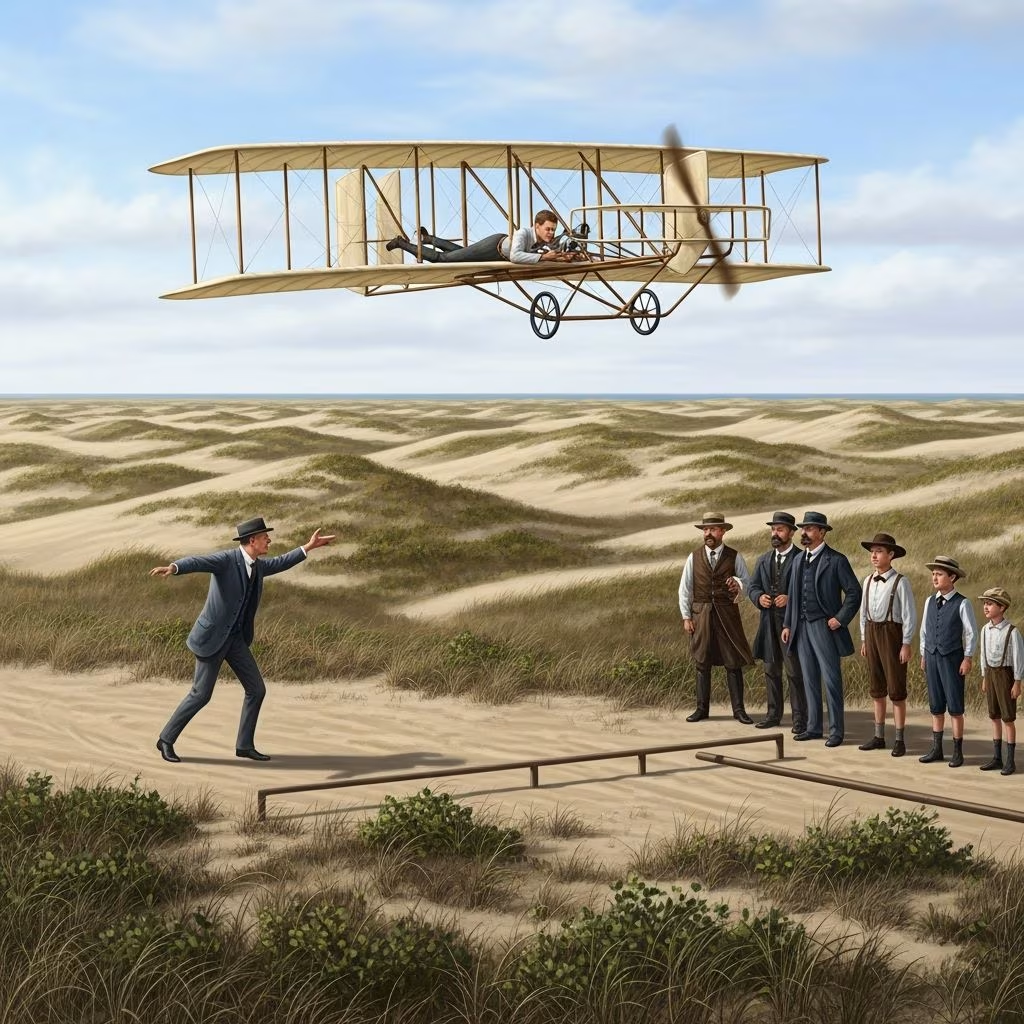
Failed attempts on December 14 saw Wilbur stall after 3.5 seconds. Repairs followed. On the 17th, gusty 27-mph winds challenged them. Orville, winner of a coin toss, lay prone; Wilbur steadied the wing.
At 10:35 a.m., the Flyer surged 120 feet in 12 seconds. Four flights followed: 175 ft (12s), 200 ft (15s), 852 ft (59s), 1,017 ft (1m 12s). A gust wrecked it post-landing.
John T. Daniels snapped the iconic photo. Locals and lifesaving station crew witnessed, affirming the event amid skepticism elsewhere.
Claims persist that Gustave Whitehead flew in 1901 Connecticut. A 2013 law there backed this, citing photos and articles. However, Smithsonian curator Tom Crouch and aviation experts dismiss it for lack of proof—no photos, unreliable reports. Jane’s Aircraft briefly agreed but retracted. Consensus: Wrights first with controlled, powered, heavier-than-air flight.
The Wrights iterated Flyers, selling to the U.S. Army in 1908. Orville’s 1908 Fort Myer demo crashed, killing Lt. Thomas Selfridge—the first aviation fatality. Patents led to lawsuits, protecting wing-warping.
Today, Wright Brothers National Memorial (est. 1927) spans 428 acres. Climb the 1932 monument (flight replicas atop), tour the camp replica, museum with Flyer I (Smithsonian-loaned 2003-2004). Annual December 17 reenactment draws crowds.
Visiting Tips:
This UNESCO-recognized site blends history, nature, adventure. Hike dunes, glide modern replicas, ponder innovation. North Carolina’s First Flight State motto reflects pride, despite Ohio/Connecticut tussles.
Orville Wright, after Wilbur’s failed attempt days earlier.
120 feet in 12 seconds; longest that day 1,017 feet.
Yes, at the National Air and Space Museum; replica flights at Memorial.
Consensus yes; Whitehead claims lack evidence.
Fly into Norfolk (1.5 hrs drive) or Raleigh (3.5 hrs); stay in Nags Head.
