

 Travel Essentials
 Travel Essentials

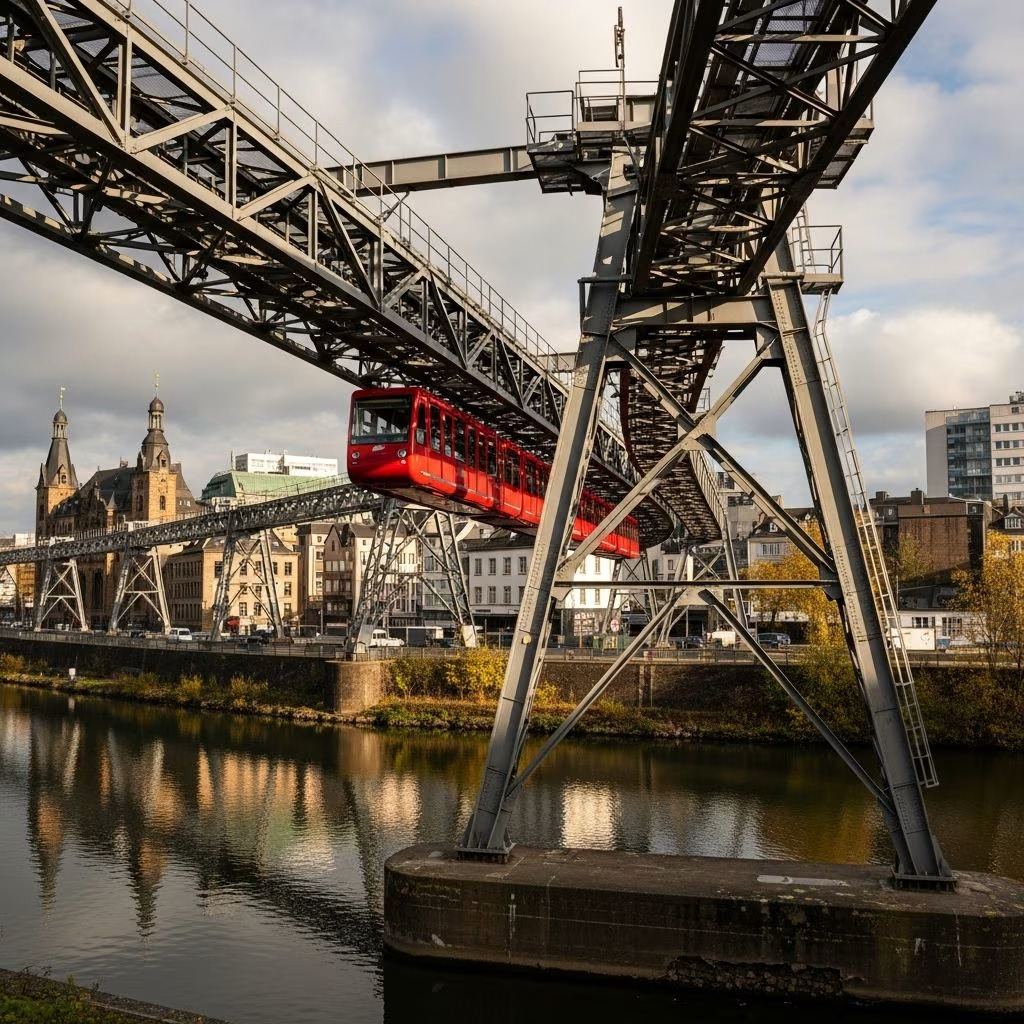
Explore Wuppertal's historic Schwebebahn, the world's oldest electric suspension railway that hangs above the city, transporting 85,000 daily passengers.
 Travel Essentials
Nestled in the industrial valleys of western Germany lies one of the world’s most distinctive public transportation systems. The Wuppertal Schwebebahn, which translates to “suspension railway,” represents a unique approach to urban mobility that defies conventional expectations about how trains should operate. Rather than traveling along traditional tracks at ground level or even hovering above the landscape with wheels on top, this revolutionary system suspends its carriages from overhead infrastructure, creating the distinctive appearance of trains that hang upside-down through the city.
The ingenuity of this design becomes immediately apparent when observing the system in action. Passengers board conventional-looking train cars at street level, yet instead of wheels rolling beneath them on traditional rails, the cars are supported from above by a single continuous rail structure. This technical distinction might seem merely aesthetic, but it fundamentally changes how the system interacts with the urban environment below. The carriages traverse their route approximately 39 feet above the Wupper River and 26 feet above the surrounding streets, creating an experience that combines the practicality of modern transportation with the wonder-inspiring qualities of steampunk engineering.
The story of Wuppertal’s suspension railway begins with innovation born from practical necessity. In the late 19th century, engineer Eugen Langen conceived of a rail system that could efficiently serve the growing communities along the Wupper River without consuming valuable ground space. Langen initially proposed his “Single-Rail Hanging Railway” system to several German cities, including Berlin, Munich, and Breslau, but these urban centers declined the unconventional technology.
The towns of Barmen, Elberfeld, and Vohwinkel, however, recognized the potential of Langen’s system. These municipalities faced a distinctive challenge: they needed to connect their communities effectively while preserving the river valley’s limited available land. After initial design work led by Anton Rieppel of MAN-Werk Gustavsburg, construction commenced on this unprecedented transportation network. The infrastructure supporting this system would eventually comprise 486 pillars and bridgework sections, representing an extraordinary feat of industrial-era construction.
Building and testing the system consumed six years of dedicated work. The elevated tracks and stations were constructed between 1897 and 1903, with the first operational segment opening to public traffic on March 1, 1901. This milestone transformed Wuppertal into a pioneer of electric suspended transit technology, and the system was formally recognized as the oldest electric elevated railway with hanging cars in existence.
The engineering behind the Schwebebahn represents a sophisticated solution to the constraints of urban geography. The system’s fundamental design parameter—suspending mass from above rather than supporting it from below—required innovative approaches to load distribution, structural integrity, and passenger safety. Rieppel’s patented structural design created a framework that could withstand continuous operation through varied weather conditions while maintaining passenger comfort.
The practical implementation of this technology involved creating a continuous rail structure supported by the aforementioned network of pillars. Each carriage connects to this overhead rail at multiple points, distributing weight and ensuring stability throughout the journey. At either end of the operational line, servicing depots include specialized track loops that allow trains to be rotated for maintenance and directional changes.
The suspension system’s engineering proves particularly advantageous for the Wuppertal context. By eliminating the need for ground-level infrastructure, the design preserves riverbank space and maintains unobstructed views of the landscape below. The 13-kilometer route runs predominantly above the River Wupper, allowing the waterway to flow unimpeded beneath the elevated structure. This consideration reflects thoughtful urban planning that balanced transportation needs with environmental and aesthetic concerns.
Today, the Schwebebahn operates as a fully functional rapid transit system serving the greater Wuppertal metropolitan area. The complete journey along the suspension railway’s 13-kilometer route encompasses approximately 35 minutes and includes 20 designated stops. This extended network efficiently connects diverse neighborhoods and commercial districts, demonstrating how the century-old technology continues to provide practical value in contemporary urban mobility.
The system’s capacity and efficiency are noteworthy. Currently, the Schwebebahn accommodates approximately 85,000 passengers daily, establishing it as a significant component of Wuppertal’s public transportation infrastructure. This substantial ridership volume validates the original designers’ confidence in the system’s ability to serve urban transportation needs effectively. For residents and visitors alike, the suspension railway provides not merely a functional means of traversing the city, but also an experience that combines practical mobility with engineering appreciation.
Riding the Schwebebahn offers passengers distinctive vistas unavailable from conventional transportation modes. The elevated perspective above the Wupper River and city streets provides panoramic views of Wuppertal’s industrial heritage, architectural landmarks, and natural landscape. This visual component of the journey transforms routine commuting into a memorable experience, contributing to the system’s enduring cultural significance within the city.
The Schwebebahn’s longevity reflects not merely good design but also remarkable institutional commitment to preservation and recovery. During World War II, the suspension railway suffered substantial damage from bombing campaigns that targeted Germany’s industrial infrastructure. This historical trauma might have spelled permanent closure for many transportation systems; instead, the Schwebebahn’s importance to Wuppertal’s identity and functionality spurred rapid reconstruction efforts.
Engineers and workers accomplished a remarkably swift restoration, restoring full operational capability within less than a year after the conclusion of European combat operations. This recovery demonstrated the system’s essential role in urban life and the technical expertise available to support its rehabilitation. The successful restoration also proved the soundness of the original engineering principles, as reconstructed sections continue operating effectively through the present day.
Beyond its practical transportation function, the Schwebebahn has evolved into an iconic symbol of Wuppertal’s identity and Germany’s industrial heritage. The city’s tourism department proudly positions the suspension railway alongside internationally recognized landmarks, stating that “Paris has the Eiffel Tower, New York has the Statue of Liberty — and Wuppertal is known worldwide for its suspension railway”. This cultural prominence reflects how distinctive engineering can transform a utilitarian infrastructure into a defining characteristic of urban identity.
The system achieved additional cultural prominence through royal endorsement in its earliest days. German Emperor Wilhelm II and his consort Auguste Viktoria took a test ride on the suspension railway months before public operations commenced, providing imperial validation of the technology’s significance. This early royal patronage elevated the Schwebebahn’s prestige and contributed to its recognition as a remarkable achievement.
Contemporary tourism initiatives have further cemented the Schwebebahn’s role as a cultural attraction. In October 2024, a dedicated museum opened to invite both residents and visitors into the system’s historical narrative. The museum features interactive exhibits including a Lego replica of the railway and a virtual reality experience wherein guests sit in an original carriage car while experiencing a digitally reconstructed journey through Wuppertal as it appeared in 1929. These innovative presentations bridge historical understanding with modern visitor engagement.
| Characteristic | Specification |
|---|---|
| Total Route Length | 13 kilometers |
| Number of Stops | 20 designated stations |
| Complete Journey Duration | Approximately 35 minutes |
| Height Above River | 39 feet |
| Height Above Street Level | 26 feet |
| Daily Passenger Volume | Approximately 85,000 |
| Opening Date | March 1, 1901 |
| Supporting Pillars | 486 pillars and bridgework sections |
The Wuppertal Schwebebahn occupies a unique position within the global landscape of public transportation infrastructure. While monorail systems exist in numerous cities worldwide, the suspension railway represents one of the few remaining examples of hanging-carriage technology. This rarity enhances the system’s technical and historical significance, as many competing designs proved less adaptable to urban environments or less durable through technological transitions.
The classification of the Schwebebahn as rapid transit reflects its structural design and operational efficiency. Despite appearing unconventional, the system provides grade-separated operation—meaning it does not intersect with ground-level traffic—delivering the reliability and speed associated with modern rapid transit networks. This technical achievement demonstrates how innovative engineering can achieve contemporary transportation standards through non-traditional methodologies.
The Schwebebahn employs an overhead rail structure from which carriages hang by multiple connection points. This design distributes passenger weight across the entire suspension system rather than concentrating it at wheel contact points, creating a stable and reliable transport mechanism.
Yes. The system has operated continuously for over 125 years with a proven safety record. Modern safety systems have been integrated into the original engineering, and the daily transport of 85,000 passengers demonstrates public confidence in the system’s reliability.
Absolutely. The suspension railway operates as a public transit system and welcomes tourists alongside resident commuters. The complete 35-minute journey provides an accessible introduction to this distinctive transportation experience.
The hanging design solved specific geographic constraints in Wuppertal. By suspending infrastructure above the landscape, engineers preserved valuable riverbank space and maintained clear views of the Wupper River while efficiently connecting hillside communities.
The Schwebebahn ranks among the world’s only remaining suspension railways, making it extraordinarily rare. Most competing designs from the early 20th century were eventually replaced by alternative technologies.
For travelers planning to experience the Schwebebahn firsthand, several practical considerations enhance the journey. The system operates throughout the day, providing transportation when most beneficial for visitors’ schedules. The 35-minute complete journey offers a comprehensive introduction to the system’s unique character and Wuppertal’s landscape. Visitors may also board at intermediate stations for shorter segments if time constraints limit availability.
Photography enthusiasts should anticipate remarkable opportunities throughout the journey. The elevated perspective provides distinctive urban and natural landscape compositions unavailable from conventional transportation viewpoints. The views of the Wupper River and surrounding industrial heritage create compelling visual documentation of this engineering achievement.
The recently opened museum dedicated to the Schwebebahn complements direct experience with historical context and technical information. The virtual reality exhibition particularly appeals to visitors interested in understanding how the system functioned during earlier operational periods, offering temporal perspective on technological consistency and community adaptation.
The Wuppertal Schwebebahn stands as a testament to 19th-century engineering vision adapted to 21st-century transportation needs. Over 125 years of continuous operation through technological advancement, historical trauma, and evolving urban requirements have established the suspension railway as both a functional transit system and a cultural monument. The system’s survival and prosperity contradict assumptions that innovative early designs inevitably become obsolete. Instead, the Schwebebahn demonstrates how thoughtful engineering, community commitment, and adaptive management can transform experimental technology into a cherished institution that serves practical needs while inspiring wonder in observers.
