

 Travel Essentials
 Travel Essentials

Discover the recent formation of a captivating blue water spring in Yellowstone National Park's Norris Geyser Basin, complete with details on its origins, safety tips, and what it means for visitors.
 Travel Essentials
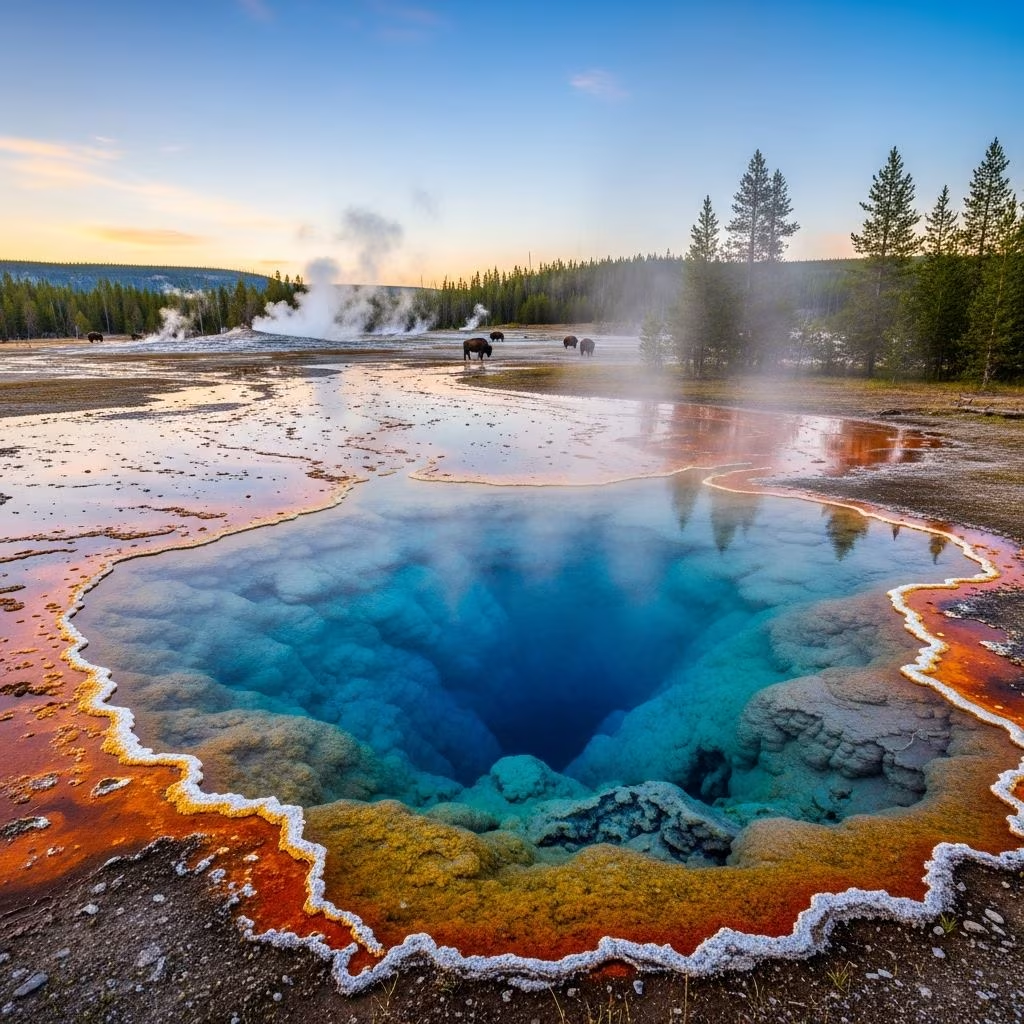
Yellowstone National Park, renowned for its dramatic geothermal wonders, has unveiled yet another captivating feature: a striking new hot spring filled with milky blue water. Discovered in the Norris Geyser Basin during routine maintenance in April 2025, this approximately 4-meter-wide pool appeared suddenly, transforming a previously unremarkable patch of ground into a serene yet powerful testament to the park’s restless subsurface energy.
The new spring materialized at the northwestern edge of an area known locally as ‘Tree Island’ within the Norris Geyser Basin, one of Yellowstone’s most thermally active zones. Park geologists, conducting their annual checks on temperature logging stations, stumbled upon the feature during their first visit of the year. What they found was a sizable depression brimming with light blue, silica-rich water, encircled by evidence of recent upheaval: scattered rocks roughly 30 centimeters in diameter and a light gray silt coating matching the spring’s exposed walls.
Satellite imagery provided crucial clues to the timeline. No sign of the hole existed in images from December 2024, but by January 6, 2025, a small depression had begun to form. By February 13, the water-filled pool was fully established. Intriguingly, the park’s monitoring equipment detected no signals of a single large explosive event, leading experts to conclude that the spring resulted from multiple smaller hydrothermal disturbances. These events first ejected rocks and later silica mud, gradually excavating the pit before it filled with heated, mineral-laden water.
This process underscores the nuanced dynamics of Yellowstone’s hydrothermal systems. Unlike cataclysmic eruptions, this formation involved incremental changes, flinging debris short distances and allowing the pool to stabilize without widespread disruption.
Yellowstone hosts over half of the world’s active geysers and thousands of hot springs, thanks to its position atop a volcanic hotspot. Magma lurks just 5 to 13 kilometers beneath the surface, heating rainwater and snowmelt that percolate deep underground through natural fracture networks. This superheated water rises, manifesting as hot springs, geysers, fumaroles, and mud pots.
Hot springs like the new blue pool represent the most prevalent type. Their open plumbing lacks the constrictions that build pressure for geyser eruptions. Instead, water circulates freely: superheated fluid cools upon surfacing, sinks, and gets replaced by hotter water from below, maintaining equilibrium without explosive releases. The Norris Geyser Basin exemplifies this volatility, with its acidic waters and frequent shifts in activity, making it a hotspot for such novelties.
Comparable features elsewhere in the park include Blue Star Spring near Old Faithful, a deep blue pool rimmed by star-shaped sinter deposits, averaging 88.2°C with high conductivity from dissolved minerals. Similarly, Sapphire Pool boasts a clear blue expanse with colorful thermophiles along its sinter shelves, its behavior altered by the 1959 Hebgen Lake earthquake. These enduring icons highlight how new formations like the Norris spring fit into Yellowstone’s ever-evolving geothermal tapestry.
USGS geophysicist Michael Poland and Yellowstone geologist Jeff Hungerford detailed the discovery in the USGS Caldera Chronicles, emphasizing the role of subtle, repeated events over a dramatic singular blast. Their analysis of satellite data and field observations ruled out a major explosion, attributing the spring’s creation to progressive small-scale activity.
This event aligns with Norris Geyser Basin’s reputation for unpredictability. The basin’s dual sections—Porcelain Basin and Back Basin—feature some of the hottest, most acidic waters in the park, with temperatures exceeding 90°C in places. Such conditions foster rapid changes, as seen in prior instances like the emergence of other thermal pools.
Monitoring remains vigilant. Yellowstone’s extensive seismic and GPS networks, coupled with gas sensors and temperature probes, track these shifts to discern normal variability from precursors of larger unrest. No elevated risks have been linked to this new spring, but it serves as a reminder of the park’s living geology.
The beauty of features like the new blue spring comes with inherent dangers. Hydrothermal waters can exceed 90°C, capable of causing severe burns on contact. The ground around them is often fragile, camouflaging scalding hazards beneath thin crusts.
Yellowstone reinforces: Think safety, act safely. The park is a dangerous place. Incidents, though rare, underscore these rules—over 20 scalding injuries have occurred since 1872.
Norris Geyser Basin offers prime viewing of the new spring via accessible boardwalks. The 2.2-km Porcelain Basin Loop showcases steaming vents, mud pots, and geysers like Whirligig, while Back Basin features Steamboat Geyser, the world’s tallest active geyser. Arrive early to beat crowds; summer sees over 4 million visitors annually.
| Feature | Location | Key Traits | Avg. Temp (°C) |
|---|---|---|---|
| New Blue Spring | Norris Geyser Basin (Tree Island) | Milky blue water, ~4m wide, post-2024 formation | ~90+ (estimated) |
| Blue Star Spring | Old Faithful area | Star-shaped sinter rim, minimal thermophiles | 88.2 |
| Sapphire Pool | Biscuit Basin | Clear blue with thermophile shelves, post-earthquake changes | 71 |
Combine with nearby attractions like Artists Paintpots or a drive to Mammoth Hot Springs. Lodging options include park cabins or nearby West Yellowstone hotels; book early for peak season.
No—view from boardwalks only. Waters are scalding hot, and the ground is unstable.
Changes began in early January 2025, fully forming by mid-February.
No, it’s typical hydrothermal activity. Yellowstone’s monitoring shows no elevated risks.
Similar to Blue Star or Sapphire in color and chemistry but newly formed via small explosions.
Yes, but check for winter closures. It’s open daily with free park entry via pass.
This new spring exemplifies why Yellowstone captivates scientists and travelers alike. Spanning 8,991 square kilometers across Wyoming, Montana, and Idaho, the park safeguards a supervolcano that last erupted 640,000 years ago. Daily earthquakes—up to 70—and shifting thermal features keep it alive.
Preservation efforts balance access with protection. The NPS manages over 10,000 hydrothermal sites, educating on their fragility. Climate change poses challenges, potentially altering water cycles and temperatures, but core geology endures.
For adventurers, this discovery invites reflection on nature’s power. Whether hiking trails or gazing into azure depths, Yellowstone reminds us of Earth’s dynamic pulse. Plan responsibly, tread lightly, and prepare to be awed.
